Seal and back-up rings
Outside and inside diameters, section thickness and any split detail define the ring. Include the mating groove drawing when it controls the fit.

Outside and inside diameters, section thickness and any split detail define the ring. Include the mating groove drawing when it controls the fit.
Mark the seat profile, contact band and edge detail. Include the mating component and the conditions used for functional testing.
Send the bore, wall and flange dimensions together. State whether the bore is checked loose or after the bushing is fitted into its housing.
Define the mounting geometry and the required electrical properties. Name the grade and any permitted filler, rather than identifying the material by color.
Mounting holes, stepped faces and clearances can be reviewed on one drawing. Identify any electrical contact, support or no-marking areas.
Specify thickness, flatness and the support used during measurement. Show how the finished part is fastened or supported in the assembly.
PTFE is often considered for sliding, chemical-contact and electrical-insulation applications. It combines low friction and broad chemical resistance with relatively low stiffness. Fillers change the material, so the grade matters as much as the polymer name.[1]
Send the manufacturer and grade already on your drawing. When the choice is still open, describe the mating part, working conditions and properties that need checking. Any proposed alternative should be agreed before stock is purchased.
Use the full material designation on the order, including any restriction on reprocessed content. For an insulating spacer or wetted part, record the required electrical or chemical data separately.
Glass, carbon, bronze and other fillers are available in PTFE compounds. Ask for the exact filler type, proportion and grade data before comparing candidates; one filled grade cannot stand in for every other.[1]
A trade name or internal material code needs a matching specification. Attach the approved datasheet or material requirement so the quote can identify the same stock, rather than silently substitute a similar name.
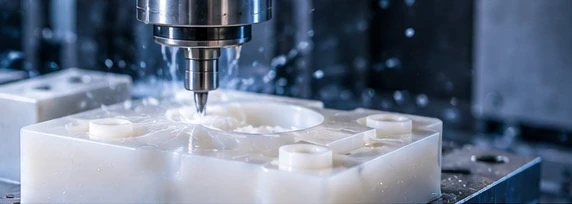
Rings, sleeves, seats and spacers start with the diameters, lengths and profiles on your drawing. Identify the sealing edge or fitting bore before choosing where the part can be held and where a second operation may be needed.
Explore CNC turningBlocks and plates bring together mounting holes, pockets, flat faces and locating features. Show the supported faces and access to the deeper details. A broad, thin plate needs a different holding review from a compact block.
Explore CNC millingA loose bushing and a bushing pressed into a housing are different checks. For the loose part, state the measurement temperature, support, any conditioning period and the required dimensions. Agree a measuring method that does not squeeze the feature into a different shape.
Provide the housing bore, shaft dimensions, mating materials and assembly method. Identify which clearance or contact surface must be checked after installation. Keep that assembly test separate from the loose-part size limits.
For a loaded seal or sliding part, include temperature, pressure or load, contact medium, motion and duration. PTFE can deform over time under sustained stress; this time-dependent behavior is called creep.[3] A dimensional report alone does not establish performance in that environment.
| Feature | Drawing information | Inspection agreement |
|---|---|---|
| Bores and outside diameters | Dimension limits, controlled length and the mating geometry. | Measurement temperature, support and whether the requirement applies before or after installation. |
| Thin rings and sleeves | Wall or section thickness, split details and any shape-control requirement. | How the part is supported without forcing it to match the inspection fixture. |
| Seat and sealing faces | Contact profile, edge detail, specified finish and surface defects to reject. | Which checks are dimensional and which need a separate leak, pressure or assembly test. |
| Holes and mounting faces | Hole sizes, pattern, datums and the surfaces that locate the component. | Fixture contact points and any permitted marking on nonfunctional faces. |
| Material identity | Grade, filler designation, stock condition and document requirements. | The material record and how it is associated with the delivered lot. |
Send the feature-specific limits and any general tolerances stated on the drawing. Where a requirement is unclear, resolve it during review rather than applying a new tolerance without agreement.
Identify lips, seat edges and contact bands that must retain their shape. Put any chamfer or edge-break requirement on the drawing so it is not treated as a general cleanup instruction.
Specify acceptable residues, handling restrictions and how contact faces should be protected. For easily marked components, agree separators, bagging or individual protection before the batch is packed.
PTFE is difficult to bond because of its low surface energy.[1] If bonding is part of the assembly, identify the exact treatment, treated area and acceptance test. Do not leave the bonding process to a generic “surface finish” note.
Provide the fluid or gas, concentration, temperature, pressure, motion and mating surface. The quote should separate machining to the drawing from any required functional testing.
Specify the property and test that matter in the assembled device. Confirm the chosen grade’s data, especially when fillers or other modifications are involved.
Include the shaft or guide material, load, motion, lubrication and service conditions. When another polymer is being considered, compare it against the same requirements.
Compare engineering plasticsInclude the revision, grade, quantity and the surfaces or fits that need particular attention.
Separate material records, dimensions and assembly tests. Confirm who performs each check.
Record the accepted revision, stock designation, inspection plan and delivery quantity.
Match lot identification and packaging to the order, keeping exposed contact surfaces protected.
Request prices for sample and repeat quantities separately. Keep the stock grade and size, material removal, delicate features, secondary setups, inspection and packaging scope consistent when comparing quotations.
Prepare a clear RFQDiscuss the specified PTFE grade and machining requirements with Kevin. Confirm the production source, inspection and communication responsibilities before ordering.
How VETCNC works with customersYes. PTFE stock can be turned or milled into custom mechanical parts.[2] Send the drawing and grade to review stock availability, workholding, dimensions and the inspection method for your geometry.
Virgin PTFE is unfilled. Filled compounds include added materials such as glass, carbon or bronze, which change the properties.[1] Use the full grade and filler designation. Choose against the actual mechanical, electrical and chemical requirements, not just the label “filled.”
A useful answer needs the drawing, grade, feature size and inspection state. Highlight the critical fits and any applicable general tolerances. We can then discuss which requirements need a sample check or a revised inspection agreement instead of quoting one tolerance for every PTFE component.
Both may be relevant. State the loose-part dimensions separately from the installed fit. Include the mating housing and shaft requirements when the acceptance check is performed after installation.
These are suitable part types to submit for a machining review. Include the exact contact geometry, material and edge requirements. Pressure, leak and service-life tests are separate items to agree; they are not established by the machined dimensions alone.
PTFE is the polymer name. Teflon™ is a Chemours brand used for a range of fluoropolymers, including PTFE.[4] If your specification names a branded resin, provide the product designation so that a substitution is not assumed.
State the required surface texture, contact area, edge condition and any prohibited marks. A note such as “smooth” is open to interpretation. Identify separately any cleaning, bonding treatment or functional test required after machining.
Yes—list the exact documents required with your inquiry. The quote needs to confirm what is available for the chosen grade and lot, how parts are identified, and which dimensional or other results will be recorded.
Include both sample and production quantities in the request, along with what the sample must demonstrate. Record approval against the specific drawing revision, grade and checks before releasing the batch.
Send a dimensioned drawing and a matching 3D model when available, the material specification, sample or batch quantities, inspection conditions and desired delivery date. Flag any unresolved grade or fit question. Price and timing can then be reviewed against the complete scope.
A ring might need a close diameter, a particular seat profile, or an installed clearance. Tell us which one controls the job and include the mating-part information when you have it.
Use this optional brief to collect those details, or open the quote form directly to attach your drawing.
Share your drawing, material and quantity. Tell us what you need and we will reply by email.
Manufacturer references for PTFE grades and properties. Application suitability and supply scope require confirmation for each project.
Prepare the material and processing requirements for your part.
Compare CNC metals, engineering plastics and surface finishes through worked selection cases, dimensional calculations and a reusable decision worksheet.