
Skip to content
vetcncCNC MANUFACTURING
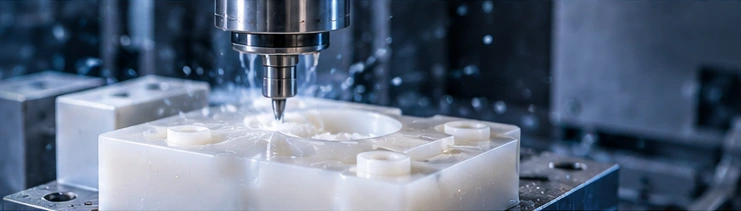
Illustrative CNC setup for a polymer part — AI illustration, not a vetcnc production photograph

PEEK CNC machining
for custom components

Compare PEEK Grades

PEEK grades for machined parts

Beige polymer stock shape — AI illustration, not a vetcnc production photograph

Unfilled PEEK

A starting point for parts that need PEEK’s heat resistance, chemical resistance and mechanical performance without added reinforcement. Specify the actual stock grade, rather than only “natural PEEK.” [1]

Specify in the drawing or inquiry
Electrical and fluid-contact requirements; stock supplier; temperature and load.
Glass-filled PEEK

Glass reinforcement can improve stiffness and resistance to creep. It can also wear a mating surface, so a structural support and a sliding bearing should not receive the same material decision. [2]

Specify in the drawing or inquiry
Filler percentage; sustained load; mating material; any fiber-exposure limits.

Carbon-filled PEEK

Carbon-fiber reinforcement changes stiffness, thermal behavior and electrical properties. Carry the exact formulation into the drawing review; it is not interchangeable with unfilled PEEK. [3]

Specify in the drawing or inquiry
Fiber content; electrical requirement; contact conditions; supplier designation.

Bearing-grade PEEK

Wear-modified formulations are developed for sliding applications. A blend containing PTFE, graphite and carbon fiber is different from a grade reinforced only for stiffness. [4]

Specify in the drawing or inquiry
Load, speed, lubricant, shaft finish and the exact wear-grade designation.

These are formulation families, not a stock list or a claim that different manufacturers’ grades are equivalent. Material source, availability and suitability are confirmed for each order.

PEEK bushings, insulators, manifolds and fixtures

6 part examples

PEEK bushings and sleeves

Define the bore, outside diameter and mating shaft together. For sliding duty, include the load, speed, lubrication and acceptable wear, not only the room-temperature fit.

PEEK guides and support blocks

Mark locating holes, supported faces and load direction. A guide that sees rubbing contact needs different review points from a block used only for positioning.

PEEK insulators and spacers

Identify the electrical requirement, contact points and mechanical loading. Do not substitute a reinforced or wear-modified grade without reviewing its electrical properties.

PEEK manifolds and valve components

Specify port locations, thread forms, sealing faces and the fluid involved. Define any leak test and its acceptance conditions before treating the component as ready for service.

PEEK locating fixtures

Show how the fixture is supported and which surfaces locate the mating part. Include thermal cycles and any limits on contact marks, burrs or cleaning residues.

PEEK housings and mounting blocks

Call out thin walls, pocket floors and fastener locations. Share the mating component or assembly drawing where stiffness and alignment are part of the requirement.

Match the grade to heat, load and electrical requirements

Working conditions to define for a PEEK machined part
Part requirementInformation to provideDecision before production
Heat and thermal cyclingWorking temperature range, duration at temperature, cycling and applied load.A temperature rating is not a finished-part fit or load rating. Review the supplier data for the exact grade and the assembled condition. [1]
Sliding and wearContact pressure, speed, lubricant, mating material and its surface finish.Compare a wear formulation with the actual contact conditions. Glass reinforcement is not automatically a better bearing choice. [2] [4]
Electrical insulationRequired resistance or dielectric performance, geometry, test method and environment.The filler package matters. Verify the chosen grade rather than extending unfilled PEEK data to carbon-filled material. [3]
Chemicals and cleaningFluid names, concentrations, exposure temperature and cleaning cycles.Check the full service environment against the specified formulation. “Chemical resistant” is not approval for every fluid or concentration.
Controlled applicationsApproved material designation, stock source, cleanliness and required records.Agree documentary evidence and acceptance requirements before purchasing stock; a polymer name alone is not a product approval.

CNC milling and turning for PEEK components

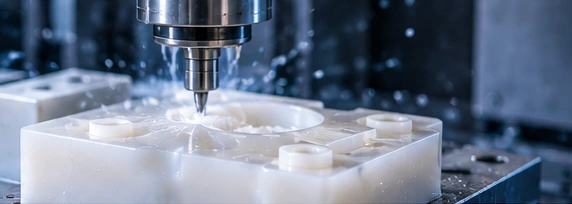
Illustrative plastic milling operation — AI illustration, not a vetcnc production photograph

PEEK CNC milling for pockets, faces and hole patterns

Send a 3D model with a dimensioned drawing for pocket depths, internal corners and positional requirements. The review should identify how the blank will be supported and which faces need to remain undisturbed through the setup.

PEEK CNC turning for bores, sleeves and mating diameters

For a turned part, identify the dimensions that function together: a bore and shaft, a shoulder and stop face, or a groove and mating seal. Include the assembly temperature and whether the fit is assessed before or after installation.

Tooling and workholding must suit the formulation

Filled and unfilled PEEK do not respond identically during cutting. Heat, tool condition and support of the workpiece affect edges and dimensional stability. These are process-planning questions, not reasons to reuse a metal-machining program unchanged. [5]

Plan stress relief before the final machining pass

Review the stock’s processing history

Residual stresses can redistribute when material is removed. Ask whether the supplied rod, plate or tube has been stress relieved, and whether the proposed geometry needs an intermediate stabilization step. [6]

Agree when final dimensions will be measured

Where stress relief is needed, its position in the process and the final inspection condition should be agreed before production. There is no single annealing schedule on this page: the actual formulation, section thickness and supplier guidance govern that decision. [6]

  1. 01Confirm stock and grade
  2. 02Rough-machine supported features
  3. 03Stabilize where required
  4. 04Finish and inspect as agreed

PEEK tolerances, fits and surface requirements

Drawing requirements and inspection planning for precision PEEK components
FeaturePut on the drawingAgree for inspection
Bores and outside diametersSize limits, mating part, clearance or interference, and acceptance temperature.Agree the measuring method and whether the fit is verified free-state or assembled.
Flatness and parallel facesDatum surfaces, wall section, support condition and any permitted clamping.Inspect without forcing a flexible part into shape; record the agreed support arrangement.
Threads and fastener holesThread designation, engagement, insert requirement and assembly loading.Define the thread check and any assembly trial separately from the hole’s position.
Sealing and sliding surfacesFinish requirement, measurement locations, edge condition and mating surface.Identify which faces require recorded checks and whether a sample trial is needed.
Positions and multi-face geometryDatum system, feature relationships and released drawing revision.Choose an inspection plan that checks the functional relationships, not just individual sizes.

Tight tolerances are confirmed feature by feature

No blanket tolerance is promised for every PEEK part. Share the actual dimensions, geometry, formulation and service conditions so the process and inspection scope can be reviewed together.

Design details that affect a PEEK part’s fit

Leave support around thin walls and deep pockets

Identify the surfaces that can be held during machining. On slender or uneven sections, discuss the order of material removal and whether a prototype is needed before the design is released for a batch.

Define the mating component, not just the PEEK part

For press fits, threaded connections and seals, share the mating material and assembly method. The drawing should show where the part is allowed to move and where alignment or contact must be maintained.

Add the features you need us to review

No review topics selected.

Finishing PEEK without changing the working surfaces

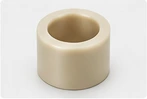
Illustrative sleeve with a through bore — AI illustration, not a vetcnc production photograph

As-machined PEEK

Use the drawing to identify acceptable tool marks and surfaces that need a specific finish. Appearance should be reviewed separately from functional roughness.

Deburred edges and intersections

Name the edges that need a break and the passages that must be clear of burrs. Do not round a sealing edge or locating feature without agreement.

Specified sealing or sliding faces

Identify the face, target finish and measurement direction. Agree any additional finishing operation on the exact formulation and geometry.

Cleaning and identification

Specify permitted cleaning agents, cleanliness expectations and marking locations. Any additional coating or treatment needs its own compatibility and acceptance review.

Material records and inspection for your PEEK order

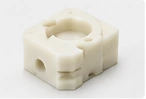
Illustrative locating fixture geometry — AI illustration, not a vetcnc production photograph

Identify the stock before it is machined

Request the supplier designation, filler content, stock form and lot identification needed for your order. Any proposed substitution should be raised for approval before material is purchased or cut.

Link measured features to the drawing revision

List the dimensions that need recorded results, the datum arrangement and the inspection condition. Where a report is required, agree its format and sampling scope rather than assuming every order uses the same document.

Approve the sample and the evidence together

For a first order, discuss a sample review that includes the part, the requested records and any agreed assembly checks. Special tests or declarations should be quoted explicitly, not implied by a material description.

What changes the cost of PEEK machining?

The grade and starting stock

Quote the specified formulation and the blank size required by the geometry. A change to the supplier, filler package or stock form needs review; it should not be made just to reach a lower price.

Material removal and setup time

Deep pockets, multiple orientations, thin sections and stock left for finishing all affect the machining route. Share both sample and repeat quantities so setup work can be considered in the right context.

Acceptance and documentation

Include the surfaces needing extra finishing, recorded dimensions, cleanliness expectations and any sample approval. A comparable quotation needs the same grade, scope and evidence on each supplier’s offer.

From a PEEK prototype to repeat production

Share the current design

Send matching CAD and drawing files, the PEEK specification and quantities. Identify requirements that are still open for engineering discussion.

Review the sample scope

Agree the production source, machining route, inspection plan and any stabilization or finishing work before the sample is made.

Approve the part and revision

Check the sample against the agreed criteria. Record approved changes in the controlled drawing instead of relying only on email comments.

Repeat against the same specification

For a reorder, confirm the revision, material source, quantity and records. Bring any proposed process or supply change back for approval.

Your PEEK parts and service conditions brief

Records and approvals to discuss

Selections are included with your inquiry. Nothing is sent until a live submission endpoint is connected and you submit the inquiry.

Discuss your PEEK project with Kevin

I have spent ten years in the CNC industry, following my father’s generation into manufacturing. Our family business grew through exhibitions and long-standing customer relationships. I want online conversations to make it easier for you to understand who is making your parts and how the work will be checked.

Meet Kevin and vetcnc

The production source should be clear

We have multiple factories in China. Where a requirement does not fit our own production, I can discuss coordinating with a partner or introducing you directly. For your PEEK inquiry, we will first review the material, process and inspection needs, then agree who is responsible for the work.

Questions about ordering PEEK machined parts

Can you machine PEEK parts from my CAD model?

Share the model together with a dimensioned drawing, exact PEEK specification and quantities. The model describes the shape; the drawing needs to identify the dimensions, surfaces and records used to accept the part.

Which PEEK grade should I specify?

Begin with the application requirements and any approved material list. Unfilled, glass-filled, carbon-filled and wear-modified PEEK are different formulation families. We can discuss the machining implications, but the final material selection needs approval for your design and service conditions.

Is glass-filled PEEK better for a bushing?

Not automatically. Glass reinforcement can help stiffness, while exposed fibers can increase wear of the mating surface. Provide the shaft material, contact load, speed and lubrication before selecting a bearing formulation. [2]

Can carbon-filled PEEK be used as an electrical insulator?

Do not assume that it has the same electrical behavior as unfilled PEEK. State the insulation or resistance requirement and check the exact grade’s data and test conditions. No material is automatically substituted when you select a grade in the brief. [3]

What tolerances can you hold on PEEK?

Send the actual feature sizes, wall sections, datum system and formulation. A tolerance needs to be reviewed together with the process, inspection temperature and support condition. The quotation should confirm which dimensions and reports are included.

Does every PEEK part need annealing?

No. Stock history, the amount of material removed, geometry and dimensional stability requirements guide that decision. Where annealing or another stabilization step is needed, agree its position in the process and how final dimensions are accepted. [6]

Can a PEEK part be used at the temperature in a supplier datasheet?

A supplier’s test result or service-temperature guide does not by itself establish the allowable load, life or fit of your component. Provide the continuous and intermittent temperatures, duration, cycling and mechanical load for application review. [1]

Can you supply a PEEK prototype before a production order?

Include the sample quantity and expected batch quantity in the inquiry. Agree the sample’s material, inspection scope and approval criteria so any design or process changes can be recorded before the production revision is released.

Are material certificates and inspection reports included?

Specify which records you need with the RFQ. Material identification, lot traceability, dimensions and special tests are separate requirements; their availability, scope and format should be confirmed in the quotation.

Is ordinary PEEK automatically suitable for a controlled application?

Use the approved material and evidence requirements for your project. Name the exact grade, stock source, end use and required declarations. This page does not claim medical, food-contact or other application approval for unspecified stock.

Can I reorder the same PEEK part later?

Keep the approved drawing revision, material specification, finish and acceptance records together. On a repeat order, confirm the current quantities and whether any material-source or process changes need your approval.

Can you introduce a partner if the project does not fit your factories?

Yes. Kevin can discuss direct production, coordination with a suitable partner or a direct introduction. The production source, responsibility for inspection, commercial arrangement and permitted sharing of your files should be clear before the project proceeds.

Send your PEEK drawing for a quote

  • Matching CAD model and dimensioned drawing
  • Exact PEEK grade, stock source, filler content and color
  • Temperature, load, mating component and chemical exposure
  • Critical fits, working surfaces and inspection conditions
  • Sample and batch quantities, records and requested delivery

Agree confidentiality and the transfer method before sharing sensitive or restricted files.

Your drawing and contact details

Design preview. No files or details will be sent until submission is connected.

Attach CAD Files or Drawings

*Required fields

Agree confidentiality and the transfer method before sharing sensitive or restricted files.

Material references and scope of this page

Technical background comes from the material manufacturers below. Their product data is not a certification of vetcnc parts, a statement of stock availability or an endorsement of vetcnc. Use the current documentation for the exact stock grade and application.

  1. Ensinger — TECAPEEK natural

    Unfilled PEEK: grade-specific properties and thermal data.

  2. Ensinger — TECAPEEK GF30 natural

    Glass reinforcement, stiffness and mating-surface considerations.

  3. Ensinger — TECAPEEK CF30 black

    Carbon reinforcement and grade-specific mechanical, thermal and electrical data.

  4. Ensinger — TECAPEEK PVX black

    An example of a wear-modified formulation; not a universal definition of every bearing-grade PEEK.

  5. Ensinger — Why machining PEEK is challenging

    Tooling, thermal control, support and material-specific machining considerations.

  6. Ensinger — Annealing and dimensional stability

    Stress redistribution and case-specific stabilization planning.

  7. Drake Plastics — PEEK polymer guide

    Additional manufacturer background on unfilled, reinforced and bearing formulations.

vetcncCNC MANUFACTURING

Get a Quote

Design preview. This form is not connected; no files or details will be sent.

Upload Drawing

*Required fields

PEEK part geometry illustration

Enlarged part geometry illustration
Email us