
Skip to content
vetcncCNC MANUFACTURING
Illustrative metal component with machined faces and contours, not a vetcnc customer part

Metal CNC
machining services

Compare Metals

Compare metals for your CNC machined parts

7 metal families

Aluminum

A starting point for lightweight housings, brackets and plates. Compare the required strength and surface finish before choosing between grades.[1]

Grade discussion
6061-T6, 7075-T6
Before quoting
Confirm temper and any anodizing requirements.
Stainless steel

Consider stainless steel where corrosion resistance matters. The environment and final material condition matter as much as the grade name.[2]

Grade discussion
304, 316L, 17-4 PH
Before quoting
Specify exposure conditions and any heat treatment.

Carbon & alloy steel

Often considered for shafts, tooling and loaded mechanical parts. Hardness and heat treatment change both the service properties and the machining plan.[3]

Grade discussion
1045, 4140; other grades by review
Before quoting
State delivery condition and final hardness.

Titanium

Consider titanium when weight, strength and corrosion requirements justify it. Allow for grade-specific machining and inspection planning.[2]

Grade discussion
Grade 2, Grade 5 (Ti-6Al-4V)
Before quoting
Provide the exact grade and material specification.

Brass

Used for fittings, inserts and turned components. Brass grades differ in machinability and composition; the intended application should guide the choice.[3]

Grade discussion
Specify the required copper-zinc alloy
Before quoting
Declare any composition or lead-content limits.

Copper

Consider copper for electrical or thermal functions. Include the required conductivity and contact-surface requirements rather than specifying color alone.[1]

Grade discussion
Specify conductivity, purity and temper
Before quoting
Identify contact faces and any plating requirements.

Inconel alloys

Nickel-based alloys need a grade-specific review for demanding service conditions. Their machining behavior can make tooling and process planning particularly important.[3]

Grade discussion
Specify the nickel-alloy grade and condition
Before quoting
State service conditions and the required specification.

Grade examples are for discussion, not a live stock list. Availability, material records and machining feasibility are confirmed for each order.

What does your metal part need to withstand?

Application requirements to review before selecting a machining metal
Your priorityTell us aboutWhat to check
Low part weightPart envelope, weight limit and load case.Compare actual grade properties, not the metal family alone.
Corrosion or chemical exposureFluid, cleaning agents, temperature and contact with other metals.Confirm the environment before accepting a corrosion-resistance claim.
Mechanical load and wearLoads, sliding contacts, mating parts and the required hardness.Separate strength, stiffness and wear requirements; they are not interchangeable.
Heat or electrical transferWorking temperature, conductivity target and contact faces.Review surface treatment as well as the base material.
Appearance and assemblyVisible faces, color sample, fits and acceptable tool marks.Identify cosmetic faces separately from dimensionally critical features.

Use this as a discussion checklist, not an automatic material recommendation. The selected grade must meet the actual design and service conditions.[1]

Specify the alloy, condition and drawing revision

Alloy and temper

Write the complete grade and condition, not just “aluminum” or “steel.” Keep the drawing, CAD file and purchase order consistent.

Required material standard

Include the applicable specification and revision when your project calls for one. Discuss a proposed substitute before changing the material.

Finished-part dimensions

Identify fits, datums, threads and any dimensions that apply after heat treatment or coating.

Traceability and records

Tell us whether you need material certificates, batch identification or specific test results so they can be addressed in the quotation.

Your metal parts brief

Items to discuss

This brief stays in your browser. It is not a quotation or an engineering approval.

CNC milling, turning and multi-axis machining for metal parts

CNC milling

Flat faces, pockets, slots and hole patterns in blocks, plates and housings.

Discuss tool access, corner radii and any thin sections.

View cnc milling

CNC turning

Diameters, bores, grooves and threads in shafts, bushings and rotational parts.

Identify fits, thread details and any off-axis features.

View cnc turning

5-axis machining

Multi-face or contoured geometry that needs additional tool orientations.

Review the model before deciding on indexed or simultaneous machining.

View 5-axis machining

Examples of machined metal parts

Housings and enclosures

Pockets, mating faces and internal clearances.

Bushings and sleeves

Bore size, outside diameter and mating fits.

Fixture plates and blocks

Hole patterns, datums and mounting surfaces.

Flanges and hubs

Bolt circles, sealing faces and concentric features.

The part images show geometry only. They do not identify a material grade or represent completed customer work.

Choose the finish before finalizing the dimensions

Part materialOptions to discussConfirm on the drawing
Aluminum partsAnodizing, conversion coating or an agreed painted finish.State color, cosmetic faces, masking and finished dimensions.
Stainless partsPassivation, polishing or another specified treatment.State the purpose, surface requirements and applicable specification.
Carbon and alloy steelHeat treatment or a specified protective finish.Confirm final hardness, treatment order and coating allowance.
Copper and brassAs-machined, polished or plated surfaces as specified.Identify electrical contact areas and any composition restrictions.
Titanium and nickel alloysA grade- and application-specific finishing plan.Discuss the governing specification and any post-treatment inspection.

Do not leave a critical fit to a generic finish note. Identify the surfaces that must be measured in the final supplied condition.

Material records and inspection for your order

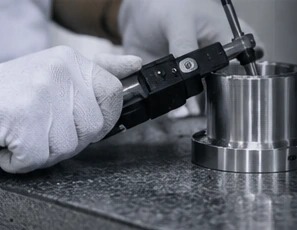
Illustrative dimensional inspection of a metal component, not a vetcnc inspection record

Match the material record to the order

Agree which records are required and how the material designation and batch will be identified. A generic certificate should not be treated as evidence for a specific delivery.

Define the dimensions to check

Identify critical characteristics and agree the inspection method, sample size and report format before production.

Separate raw material from finished-part acceptance

A material certificate and a dimensional report answer different questions. Include any needed hardness, finish or other checks in the order requirements.

Confirm responsibilities before work starts

Know which factory will produce the part, who coordinates outside processes and who handles acceptance questions.

What changes the cost of a machined metal part?

Stock and material condition

Grade, size, stock form and any specified condition affect the starting material and purchasing route. A low raw-material price does not by itself establish the lowest finished-part price.

Machining and finishing

Tool access, stock removal, setup changes, tight features and additional treatments all belong in the same review. Alloy and heat treatment affect how the material cuts.

Order quantity and acceptance

Compare the same grade, drawing revision, quantity, finish and inspection scope across quotations. State sample quantities separately from a forecast or a later repeat order.

Ask for an alternative only where the design permits it. Any change of grade, condition or acceptance requirements needs agreement before manufacture.[3]

From your drawing to a repeat order

  1. Share the drawing

    Send the model, matching drawing, grade, quantity and intended use.

  2. Review the specification

    Clarify material condition, critical dimensions, finishing and the records needed.

  3. Approve the quotation

    Agree manufacturing responsibility, scope, price, timing and any sample approval.

  4. Confirm the next order

    Reference the approved revision and report any changes before repeating production.

Work with vetcnc and our manufacturing partners

“I want you to understand who is making your parts and what has been agreed—not have to guess from a website.”

Kevin · vetcnc

Read our company story

Our family has worked in machining since my father’s generation. My ten years in the CNC industry and our factories in China are the starting point for a direct conversation about your project.

When a requirement is outside the right fit for our factories, we can discuss a manufacturing partner, coordination through vetcnc or a direct introduction. The arrangement and responsibilities should be clear before you place an order.

Questions about metal CNC machining

Which metals can I discuss with vetcnc?

This page covers aluminum, stainless steel, carbon and alloy steel, titanium, brass, copper and Inconel alloys. Send the exact grade, material condition and drawing requirements. The review confirms suitability, availability and the manufacturing arrangement for your order.

Can you quote a metal that is not listed here?

Yes, you can send the material designation and applicable specification for review. Listing a metal family does not mean every grade, stock form or condition is available. We will need to confirm the actual requirement before quoting.

Do I need to choose a grade before asking for a quote?

An exact grade supports a more definite quotation. When the choice is still open, describe the part’s function, loads, environment and required properties. Potential alternatives can be discussed, but the final choice needs engineering approval for your application.

Can you substitute an equivalent Chinese grade?

Do not assume that two differently named grades are interchangeable. Supply the required standard, composition and properties. Any proposed substitution should be reviewed and explicitly approved before purchasing or machining the material.

What drawings and files should I send?

A 3D model and its matching 2D drawing are a useful starting point. Include the part number, revision, units, grade, condition, tolerances, threads, surface finish, order quantity and any required records. Agree confidentiality before sharing restricted files.

Do all metals use the same machining tolerances?

No universal tolerance is promised on this page. Feature size, geometry, material condition, workholding, finishing and the inspection approach all need review. Mark the critical characteristics on the drawing rather than applying a tight tolerance to every surface.

Can I ask for a material certificate or inspection report?

Include the required document type, specification and traceability expectations in the inquiry. Availability and scope must be confirmed for the particular order. A material certificate does not replace dimensional inspection of the finished part.

Can you machine a prototype before a repeat order?

Share both the initial quantity and your later plans. Agree the purpose of the sample, its material and finish, and the approval requirements. Keep later production quantities distinct from a non-binding forecast.

Is the cheapest metal always the lowest-cost option?

Not necessarily. Compare the full manufacturing scope, including stock, setups, machining, treatment, inspection and quantity. A material change is only useful when the alternative still meets the part’s requirements.

Will all of the work be done by vetcnc factories?

The appropriate manufacturing arrangement is confirmed during project review. Where a partner is needed, discuss whether vetcnc coordinates the work or introduces you directly, and agree who is responsible for production, records and communication.

Request a quote for your metal parts

  • CAD model and matching 2D drawing
  • Alloy, condition and required material standard
  • Quantity, units and drawing revision
  • Critical dimensions and finished-surface requirements
  • Material records, inspection and requested delivery

Agree confidentiality and the transfer method before sharing sensitive or restricted files.

Your metal part and drawing

Design preview. No files or details will be sent until submission is connected.

Attach CAD Files or Drawings

*Required fields

Agree confidentiality and the transfer method before sharing sensitive or restricted files.

Material selection references
  1. Protolabs — CNC machining materials selection
  2. Protolabs — Material choices for CNC machining
  3. Sandvik Coromant — Workpiece materials

These references support general material guidance. They do not establish vetcnc stock availability, certification or process capability. Confirm the actual grade and requirements for each order.

vetcncCNC MANUFACTURING

Get a Quote

Design preview. This form is not connected; no files or details will be sent.

Upload Drawing

*Required fields

Part illustration

Email us