On this page
A CNC machining lead time is the elapsed time to a specified milestone, not the number of hours a spindle cuts metal. A usable ship-date estimate starts with an approved part definition and follows the longest dependent path through material readiness, a machine slot, machining, any outside finishing, inspection and packing. Programming and material procurement may happen in parallel. A short cutting cycle cannot cancel a five-day queue, and a quoted “one week” is impossible to compare until the start event, end event and working-day basis are clear.
If you need parts for an assembly trial, ask for the dispatch date of accepted parts in the required condition and a separate expected arrival date. If the drawing, material or finish is still open, request a conditional schedule and identify exactly which approval starts the clock. The steps below make a lead-time promise testable without assuming that every machine shop, alloy or batch runs on the same timetable.
The ship date is a chain, not spindle time
Machine cycle time describes a defined, repeatable operation on one part. Setup prepares a machine and fixture for that operation. Production lead time includes the elapsed passage through a process, including waits between stages. The Lean Enterprise Institute distinguishes machine cycle, processing, production lead and order lead time; its definitions do not treat any one of them as a substitute for a customer delivery promise. [1]
For a custom order, a useful schedule has a start and finish marker. The start may be the supplier’s acceptance of a purchase order with a released drawing and material specification. The finish may be completion of machining, release from final inspection, dispatch from the supplier, or delivery at your dock. Those are different dates. State the one that matters in the purchase order and ask for the others only where they affect your decision.
Between those markers, some work overlaps and some cannot. A programmer can plan toolpaths while specified stock is on order, but the finished part cannot be machined before suitable stock and a production slot are available. Coating that must follow the final cut cannot be completed during that cut. A final inspection required in the coated condition cannot be signed off on an uncoated sample. The elapsed schedule follows the longest required chain, not a sum of every line item and not the machine cycle multiplied by quantity. NIST’s value-stream approach includes both material and information flows for precisely this kind of process view. [2]

Freeze the part definition before starting the clock
A machining schedule cannot be firm while the supplier is guessing which part to make. A released 3D model and drawing should identify the same revision and resolve the features that change the route: material and condition, quantity, critical fits, threads, surface treatment, required inspection and acceptance state. The existing CNC machining RFQ guide explains the full file package. For lead-time planning, its most important result is a date on which the supplier can stop estimating alternatives and release one version to production.
That does not mean every minor note stops programming. The distinction is whether an open question could change stock, tools, setup, finish, inspection or the number of parts. A tolerance change on a bearing seat can add a finishing and measurement step; a correction to an unrelated title-block typo may not. Ask the supplier to name the unresolved items that hold the schedule, rather than accepting a vague “lead time starts after confirmation.”
When a prototype must be approved before a production batch, put that approval on the timeline as a separate gate. The production clock may start after sample acceptance, not after the first quote. A revised model issued during production may require new programming or even replacement stock. The schedule effect depends on what has already been done and whether the previous material can still be used; it is not a fixed penalty per revision. VETCNC’s prototype and production service overview separates prototype, pilot and production releases, while this article shows how to date the handoffs between them.

Material and capacity create waits before the first cut
Ask whether the required stock is physically available, merely quoted by a distributor, or still to be ordered. “Aluminum” alone does not identify the alloy, temper, plate thickness or bar size. The starting form can affect both procurement and the cutting plan. A substitute may shorten procurement but is only a valid shortcut if the design authority approves its grade, condition and downstream performance. Even when stock is available today, it does not mean an appropriate machine, fixture and operator are free today.
A supplier can spend little time cutting a part and still hold it in a queue before the next operation. The University of Wisconsin’s quick-response manufacturing account uses manufacturing critical-path time to include both work and waiting. It specifically distinguishes the periods in which a job is processed from time spent waiting for a machine or person. [3] For a buyer, the useful question is not “How fast is your machine?” but “What date is the job planned to enter each constrained operation, and which resource is the current bottleneck?”
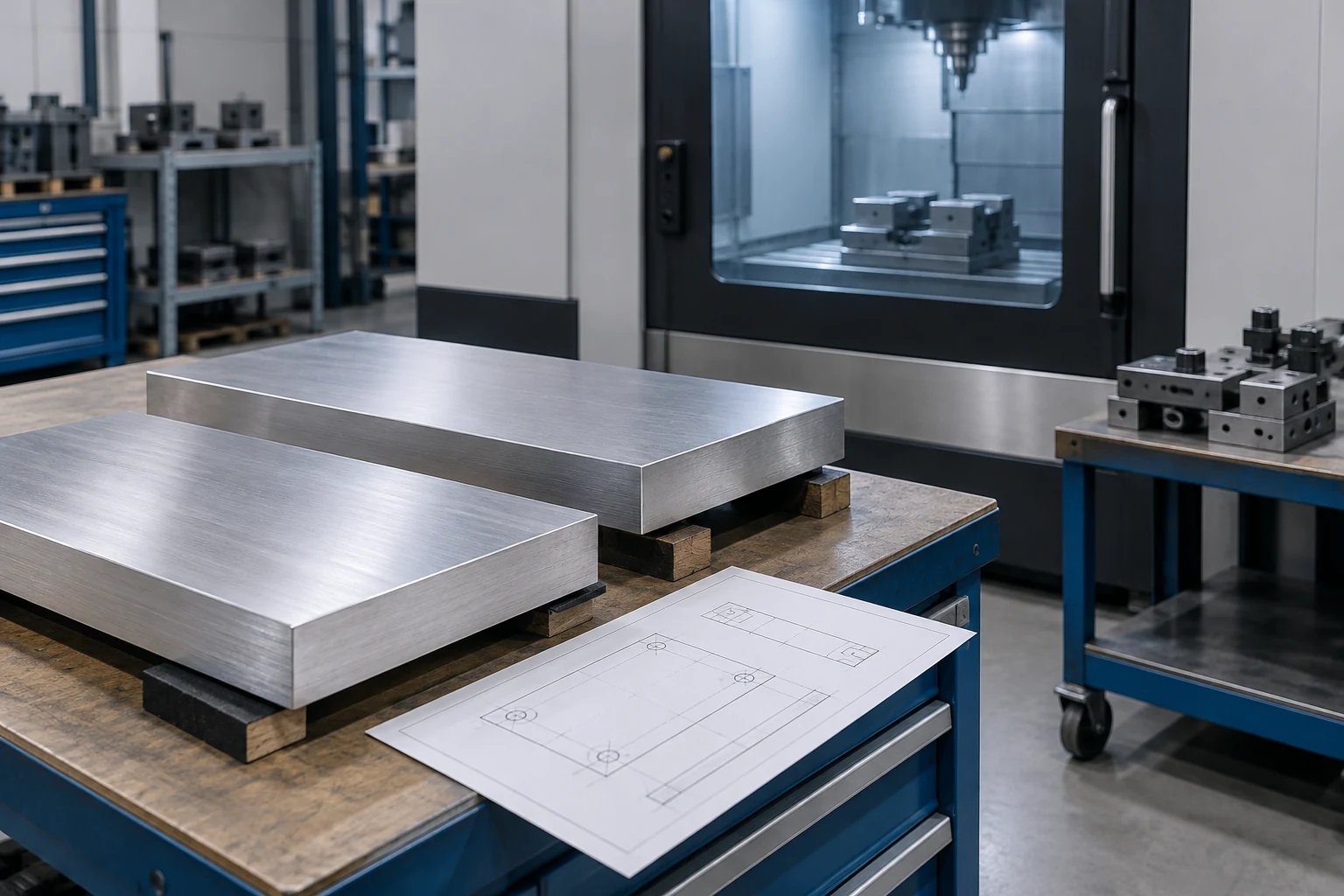
Queue time is a live capacity condition, so yesterday’s generic web estimate is not a reservation. If a quotation says “five working days after material receipt,” material receipt is an event outside those five days. If another says “ten calendar days after accepted order” and includes stock procurement, the second may be earlier even though its number is larger. Get both suppliers to state the same start, end, material assumption and day convention before comparing.
Part geometry determines the operations in the queue
Two parts cut from the same alloy do not have the same route just because they share an envelope size. A shallow, open pocket may allow short, stable tools and one accessible setup. A deep pocket with narrow access can require longer tool reach and a different strategy; milling-tool guidance from Sandvik Coromant explicitly treats deep-cavity access and long overhang as stability and productivity considerations. [4] The point is not that every deep pocket takes a fixed number of extra hours. It is that its actual tool access and acceptable finish have to be planned before a machine-time estimate is credible.
Features on several faces can require another orientation, a different fixture or a separate machine. A part may also need turning before milling, a threaded feature after roughing, or deburring before treatment. Some operations can be grouped in one setup if the part and equipment permit it; others have a real handoff. An estimate should name the planned route and the acceptance-critical operations, rather than hide all work under “CNC machining.” That route explains where new queues can appear.
Quantity changes two things at once. A larger release can spread one setup across more pieces, yet it also needs more total cutting, handling and possibly inspection time. Two 50-piece releases might require a second setup if they are separated by weeks; one 100-piece release might not meet a buyer’s need for the first 50. Ask whether staged accepted shipments are feasible under the same drawing and inspection plan. The answer depends on whether the supplier can release a conforming subset before the full batch finishes, not on an assumed universal batch size.

Finishing and inspection can set the last possible ship date
List the condition in which the buyer must receive the part. A machined part awaiting anodizing, passivation, heat treatment or another specified operation is not the same deliverable as the finished part. If treatment is performed outside the machine shop, its transfer, processing slot, return and acceptance are part of the dependency chain. Do not assume that a machinist’s completion date is the dispatch date of the ordered condition.
Inspection belongs to the requirements, not to an arbitrary schedule allowance. If a drawing calls for a bore fit, datum-related position, coating thickness or documented material identity, the check must match the relevant finished state. An in-process measurement may prevent errors, but it does not automatically replace a final check after a process that can affect the feature. The CNC machining tolerances guide explains why size and geometric relationships are separate acceptance questions.
Tell the supplier which records are required with the order. A dimensional report, material certificate or treatment record may need to be prepared and matched to the batch. If an approval sample is required, state who reviews it and by when; an unbounded buyer approval period is not a supplier machining delay. None of this justifies skipping a required check to make a rush date. It identifies the work that must be scheduled and the point at which the parts become releasable.

A 20-plate order: eleven working days to dispatch
Consider a planned order for 20 milled aluminum plates. The released drawing requires an anodized finish and a final dimensional report. For this scheduling exercise, the supplier accepts the complete order at the start of working day 0; the parts can be dispatched only after the coated condition is inspected and protected for shipment. The day counts below are assumed inputs to show the logic, not observed shop performance or a VETCNC quotation.
| Required activity | Assumed working-day interval | Dependency and scheduling result |
|---|---|---|
| Obtain specified plate stock | Day 0–3 (3 days) | Starts on release; cutting cannot start before suitable stock arrives |
| Program and prepare the route | Day 0–2 (2 days) | Runs in parallel with stock procurement; it does not add two days after Day 3 |
| Wait for the reserved machining slot | Day 3–5 (2 days) | Starts when stock and plan are ready; actual cutting waits for capacity |
| Set up and machine 20 plates | Day 5–7 (2 days) | Finishing cannot start until the machined batch is ready for transfer |
| Transfer and anodize the batch | Day 7–10 (3 days) | Includes the assumed outside-processing handoff and return |
| Final inspection and protective packing | Day 10–11 (1 day) | Dispatch can occur at the end of Day 11 |
The elapsed result is 11 working days from release to dispatch, not 3 + 2 + 2 + 2 + 3 + 1 = 13 days: programming overlaps stock procurement. Only two of the 11 assumed days are the setup-and-machining interval. The example is deliberately explicit about what the three outside-processing days include. If freight to the buyer takes additional time, an arrival promise needs a separate transit and customs estimate where applicable.
Now change one assumption: the specified stock does not arrive until Day 6. The Day 5 machining start is impossible. The new ship date is not necessarily Day 14, because the missed machine reservation might not be recoverable immediately. The supplier must recheck machine capacity and all downstream bookings. Conversely, if a suitable in-stock grade and condition are approved before release, the material branch may shorten; whether dispatch actually moves forward depends on whether the machining slot and anodizer can also move. This is why a dependency table gives a more useful answer than a standalone “typical lead time” range.
Compare two lead-time quotes on the same basis
Ask each prospective supplier to write one line that reads: “X working or calendar days from [specific release event] to [specific shipment or delivery event], for [part revision, quantity, material and final condition].” Then resolve the items that would change that line. This is a compact schedule request, not a demand that every supplier expose its entire shop plan.
- Start and stop: Does time begin at RFQ, purchase order, deposit, material receipt or approved drawing? Does it stop at machining completion, final acceptance, dispatch or arrival?
- Day convention: Are weekends, holidays and a daily order cutoff included? Which time zone applies to a cross-border order?
- Material and route: Is the specified grade and condition already reserved, and are all required setups and outside finishing inside the quoted interval?
- Release evidence: Are the agreed inspection, treatment records and protective packing complete before dispatch?
- Schedule exceptions: Which buyer approval or substitute decision would pause or reset the commitment, and how will a changed date be communicated?
A quote that promises seven days after stock arrives cannot be called faster than a ten-day release-to-dispatch quote without the stock arrival date. Likewise, “shipped in seven days” and “delivered in seven days” are different commitments. The machining cost and supplier selection guide covers price and scope comparison; here the comparison unit is an accepted part at a named schedule milestone.

Shorten elapsed time at the controlling stage
Rush requests help only when they act on the stage that controls the ship date. Use the supplier’s dependency chain to select a change, then have the supplier recompute the date. Removing a cosmetic step will not recover time if the specified material remains unavailable; finding stock will not help if a required approval sits unanswered.
- Release one buildable revision. Resolve material, functional dimensions, finish, quantity and required records before accepting a firm date. Keep subsequent design changes identified by revision and ask for their actual schedule effect.
- Check the first constrained resource. Confirm stock availability and the earliest real machining slot. Consider an approved stock form or alternate grade only after verifying the fit, strength, corrosion and finishing requirements that motivated the original choice.
- Review the route without weakening the part. An accessible feature or a permitted surface requirement may allow simpler machining; an actual design authority must accept that change. Keep required fits, datums and inspection intact.
- Coordinate downstream work early. Reserve the required outside treatment and identify final inspection/records before cutting finishes. If a partial shipment would solve the buyer’s immediate need, define the accepted subset and its packaging rather than promising a full batch early.
Ask for a revised milestone date after any intervention. An expediter can change priorities, but cannot make an unavailable alloy appear or turn an unapproved prototype into accepted production parts. The practical target is the earliest reliable dispatch of conforming parts, followed by a separately planned arrival—not the smallest number on a quote.
Technical sources
- Lean Enterprise Institute. Cycle Time, including the distinctions among machine cycle, processing, production lead and order lead times.
- National Institute of Standards and Technology, Manufacturing Extension Partnership. Value Stream Mapping, updated May 22, 2024. Mapping of material and information flow to identify lead-time opportunities.
- Charlene Yauch, University of Wisconsin–Madison Interdisciplinary Professional Programs. Ten Things You Should Know About Quick Response Manufacturing, November 3, 2023. Manufacturing critical-path time and waiting versus work.
- Sandvik Coromant. Silent Tools for milling. Deep-cavity reach, overhang and vibration in specific milling applications.