On this page
A CNC spindle’s maximum rpm, torque and power describe different limits. The useful question is how much torque and mechanical power are available at the speed required by the cut, for the required duration. The largest horsepower number on a specification sheet cannot answer that on its own.
On a mill, the spindle rotates the cutter through its toolholder. On a conventional lathe, the main spindle rotates the workpiece. The calculations below use a milling cutter; the milling-machine component guide explains the spindle’s place in the machine.
Spindle speed is not cutting speed
Spindle speed, n, counts revolutions per minute. Cutting speed, vc, describes the surface speed at the cutting diameter. For a cylindrical cutter:
vc = π × D × n / 1,000, with D in mm, n in rpm and vc in m/min.
At a hypothetical 6,000 rpm, a 6 mm cutting diameter gives approximately 113 m/min; a 20 mm diameter gives approximately 377 m/min. The spindle speed is unchanged, but the outer edge of the larger cutter travels farther in each revolution. These are arithmetic examples, not recommended settings for a material.
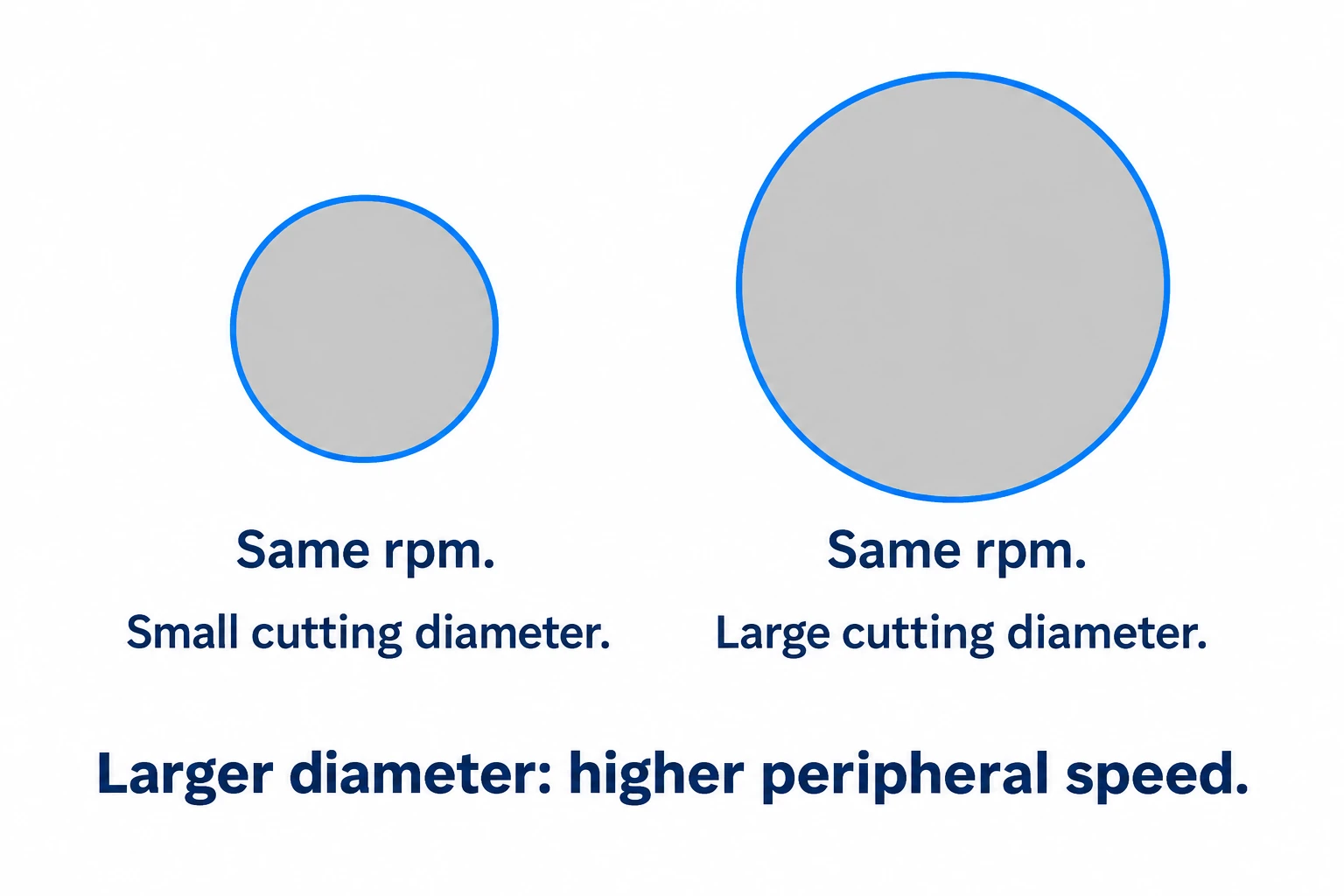
Use the diameter where cutting actually occurs. On a ball-nose tool or another shaped cutter, that may differ from the nominal outside diameter. Material, tool geometry and engagement determine the appropriate cutting-speed range.
Power depends on torque and rotational speed
Torque is the turning moment transmitted by the spindle, expressed here in N·m. Mechanical power is the rate of energy transfer, expressed in kW. At steady rotation:
P ≈ T × n / 9,550, or T ≈ 9,550 × P / n.
The constant converts rpm and N·m to kW. Sandvik Coromant’s metric milling formula sheet gives the equivalent relationship for cutting torque and net cutting power. Keep the power and torque at the same location in the drive path: electrical input power is not the mechanical power delivered at the spindle. [1]
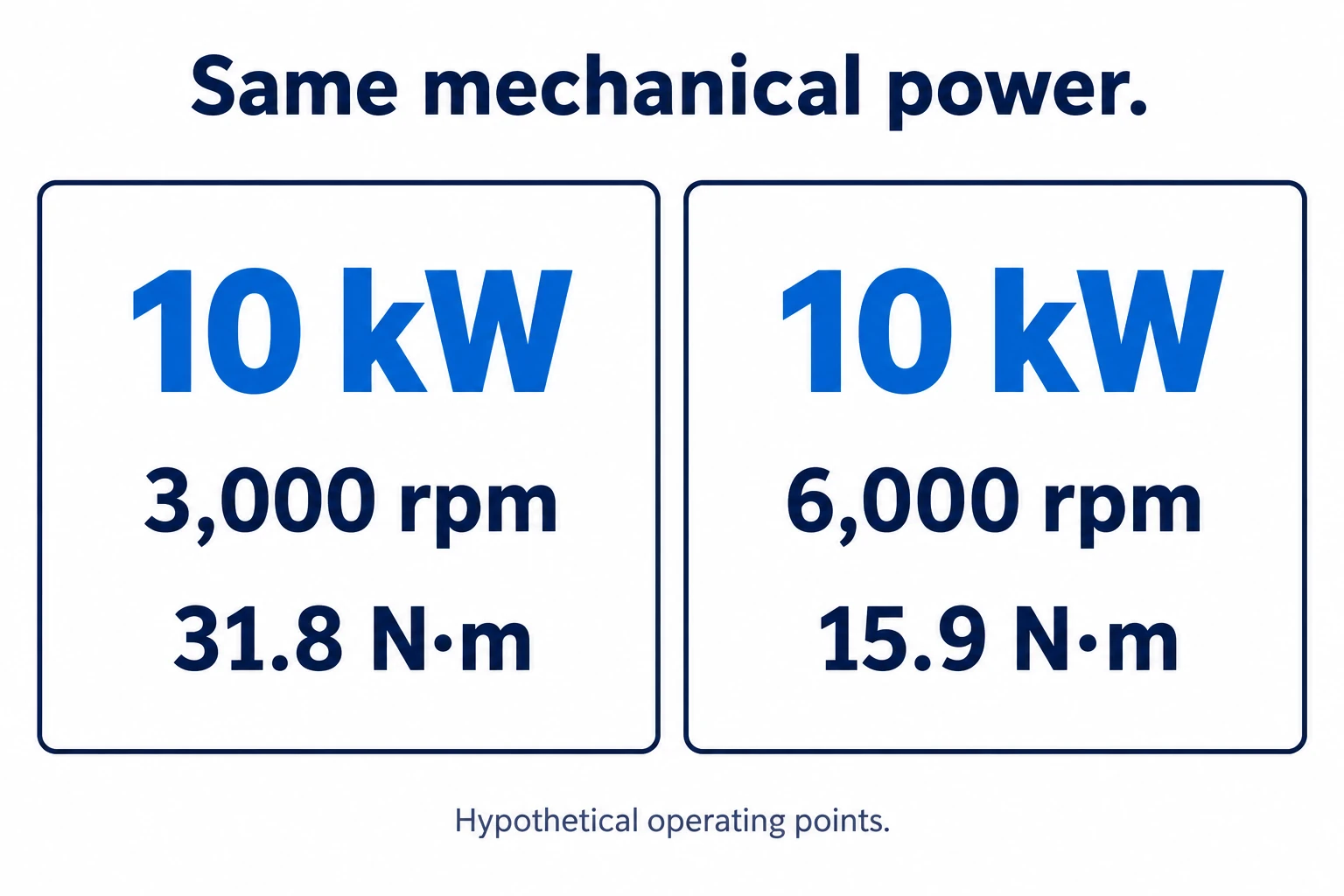
| Hypothetical mechanical power | Speed | Corresponding torque |
|---|---|---|
| 10 kW | 3,000 rpm | 31.8 N·m |
| 10 kW | 6,000 rpm | 15.9 N·m |
This comparison assumes 10 kW is available at both speeds. It shows that doubling speed at the same power halves torque. It does not establish that a spindle rated “10 kW” can provide 10 kW throughout its speed range. At low speed, a torque limit may restrict the available power.
Read the curve and its duty rating together
Read the installed spindle’s plot at the speed of the planned cut. Haas’s Mini Mill 8k/10k Torque Charts shows a 10,000-rpm belt-drive option: at about 5,000 rpm, the plotted power is approximately 9.5 kW. The chart labels those curves 200% spindle load. That point is the chart’s 200% load envelope, not a stated continuous limit. A planned steady 6 kW cut still needs the 100% continuous limit at that same speed. [2]
For a different 10,000-rpm spindle (10K-40T-IN-15), Haas states that its 200% peak is available for three minutes, 150% for ten minutes, and 100% (half of the stated peak number) continuously, subject to the specified electrical supply and operating conditions. These durations do not describe the Mini Mill chart above. Use the duty statement for the actual installed model; do not transfer one model’s curve or another maker’s load-display percentage. [3]
At another rpm, return to the curve rather than carrying the 5,000-rpm value across the speed range. Gear ranges, windings and drive limits can change both torque and power. For intermittent work, retain the maker’s cycle and recovery conditions. The VMC specification guide places that spindle result alongside setup and tool limits; Mazak likewise explains why headline peak ratings alone do not settle a cut. [4]
Match the spindle to the operation
A large cutter running at a modest rpm can need substantial torque. A small cutter may need higher rpm to reach the selected cutting speed. Neither observation makes one spindle universally better: cutting engagement, material and the required removal rate affect demand.
Available power also does not settle tool reach, vibration, chip evacuation or fixture stability. For repeated short operations, acceleration and deceleration can contribute meaningful noncutting time; maximum rpm alone does not predict the total cycle.
In a CNC milling review, connect the spindle discussion to the actual feature, tool access, material and surface requirement. The relevant evidence is a suitable operating range for the proposed cut and duty, followed by a process that can meet the part requirements.
Frequently asked questions
Does reducing rpm always increase available torque?
No. The equal-power formula only predicts that relationship where the same power is available. Real spindles have torque, speed and duty limits; use the applicable curve at the intended rpm.
Does a higher maximum rpm automatically shorten machining time?
No. The tool and material must support the cutting speed, while feed, engagement and stability constrain the cut. Positioning, tool changes and spindle acceleration also contribute to cycle time.
Is spindle power the machine’s electricity consumption?
No. Mechanical spindle output differs from electrical input and whole-machine demand. Drive losses and loads such as axis drives, pumps and cooling contribute to electrical consumption.
Technical sources
- Sandvik Coromant. Formulas and Definitions for Milling—Metric, H79. Cutting speed, torque and net cutting power formulas.
- Haas Automation. Mini Mill 8k/10k Torque Charts (2024), optional 10,000-rpm belt-drive chart. Power by rpm, with curves labeled 200% spindle load.
- Haas Automation. 10,000-rpm Spindle (10K-40T-IN-15). Three-minute peak, ten-minute 150% and continuous 100% duty conditions for that model.
- Mazak. Get to Know Your Spindle’s True Capabilities (November 7, 2025). Reading rpm, torque, power and duty together.
- NIST. A Virtual Machining Model for Sustainability Analysis (2010). Machine-energy boundary.