On this page
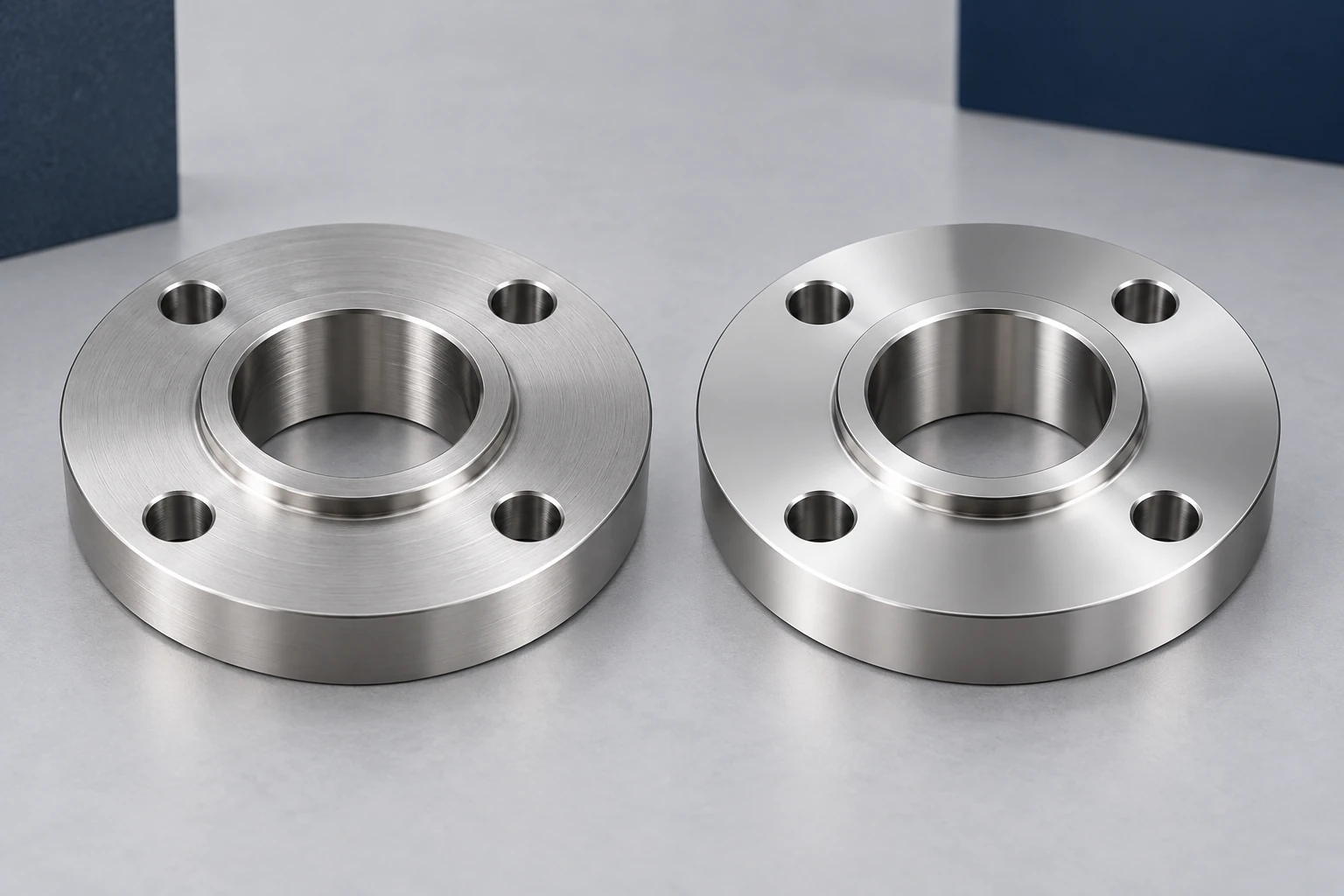
Choose chemical passivation when the main task is to remove contaminant iron and establish the required passive surface on an already suitable stainless steel finish. Consider electropolishing when controlled metal removal and surface smoothing are also needed. Electropolishing can provide passivation under suitable conditions, so a separate acid-passivation step is not automatically required. The specified process, alloy, final dimensions and acceptance tests decide the route.
Here, “chemical passivation” means the conventional acid-treatment route commonly compared with electropolishing. The broader term passivation describes the surface condition and can also result from an electrochemical process.
Compare the purpose before comparing the price
| Comparison | Chemical passivation | Electropolishing |
|---|---|---|
| Main treatment objective | Remove contaminant iron; support a passive surface | Remove surface metal; smooth and passivate |
| Machining texture | Not a polishing or scratch-removal operation | Can reduce micro-roughness; does not reliably erase deep defects |
| Dimensional planning | No intentional bulk stock removal | Removal allowance and final fits need review |
| Useful starting situation | Existing geometry and texture already meet requirements | Surface smoothing or selected fine-burr removal has a functional purpose |
| Evidence required | Specified treatment and applicable acceptance tests | Specified treatment, surface result and affected dimensional checks |
ASTM A967/A967M addresses passivation treatments and alternative tests for their effectiveness; it does not select a universally suitable grade or acceptance criterion for every application. [1] Keep the process requirement connected to the material and function. The materials and design guide provides that broader selection context.
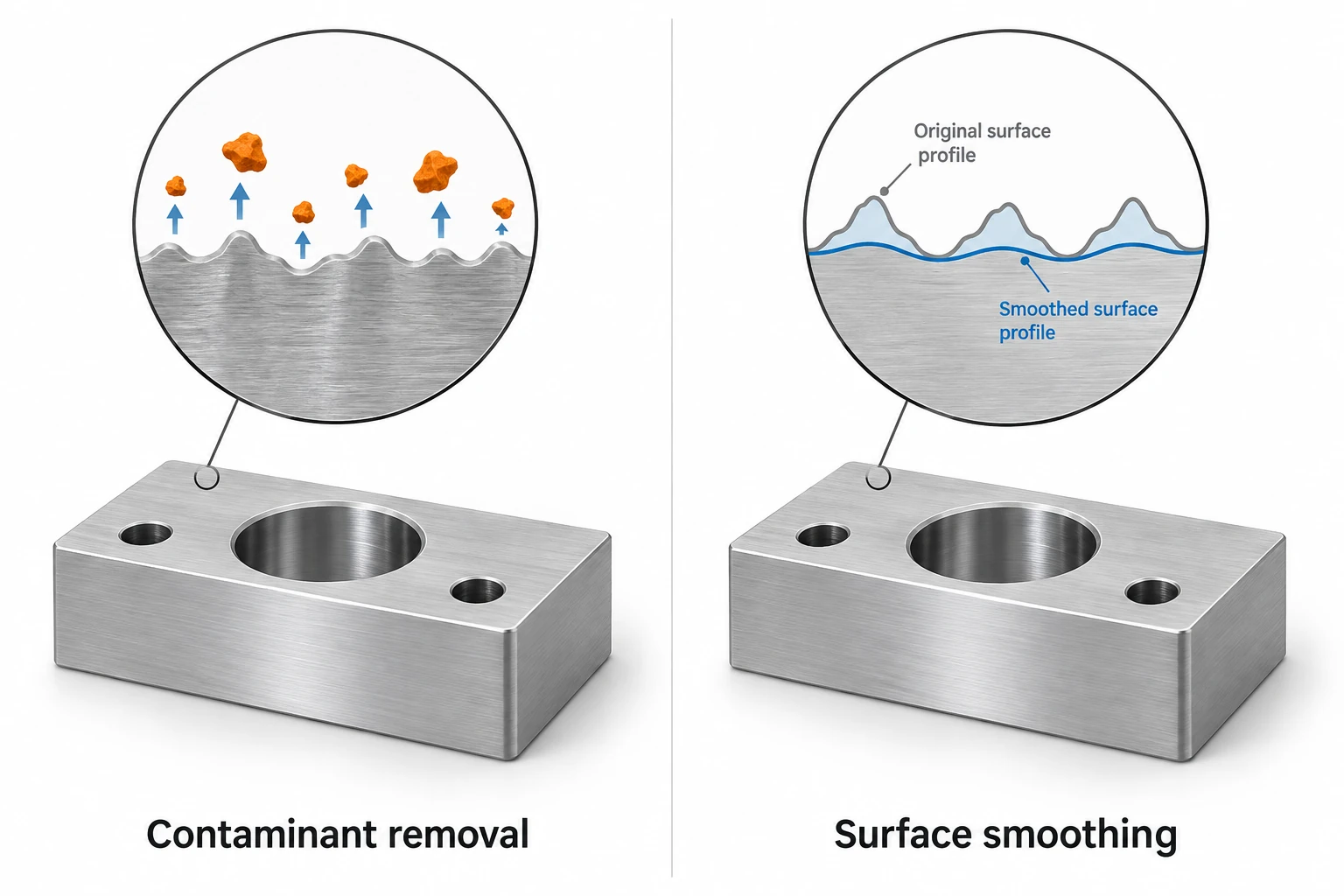
Cleaning, scale removal and polishing are different jobs
Oil, machining debris, oxide scale and surface texture are different starting conditions. A passivation callout should not be expected to solve all of them. ASTM A380/A380M treats cleaning, descaling, pickling and passivation as related operations with distinct purposes, and emphasizes geometry that permits cleaning solutions to circulate and drain. [2]
For a welded or heat-tinted part, define the required oxide removal and subsequent surface condition. For a scratched sealing land, assess the defect and available material allowance before choosing a finishing route. Simply extending the treatment time is not an engineering disposition for an unacceptable machined surface.
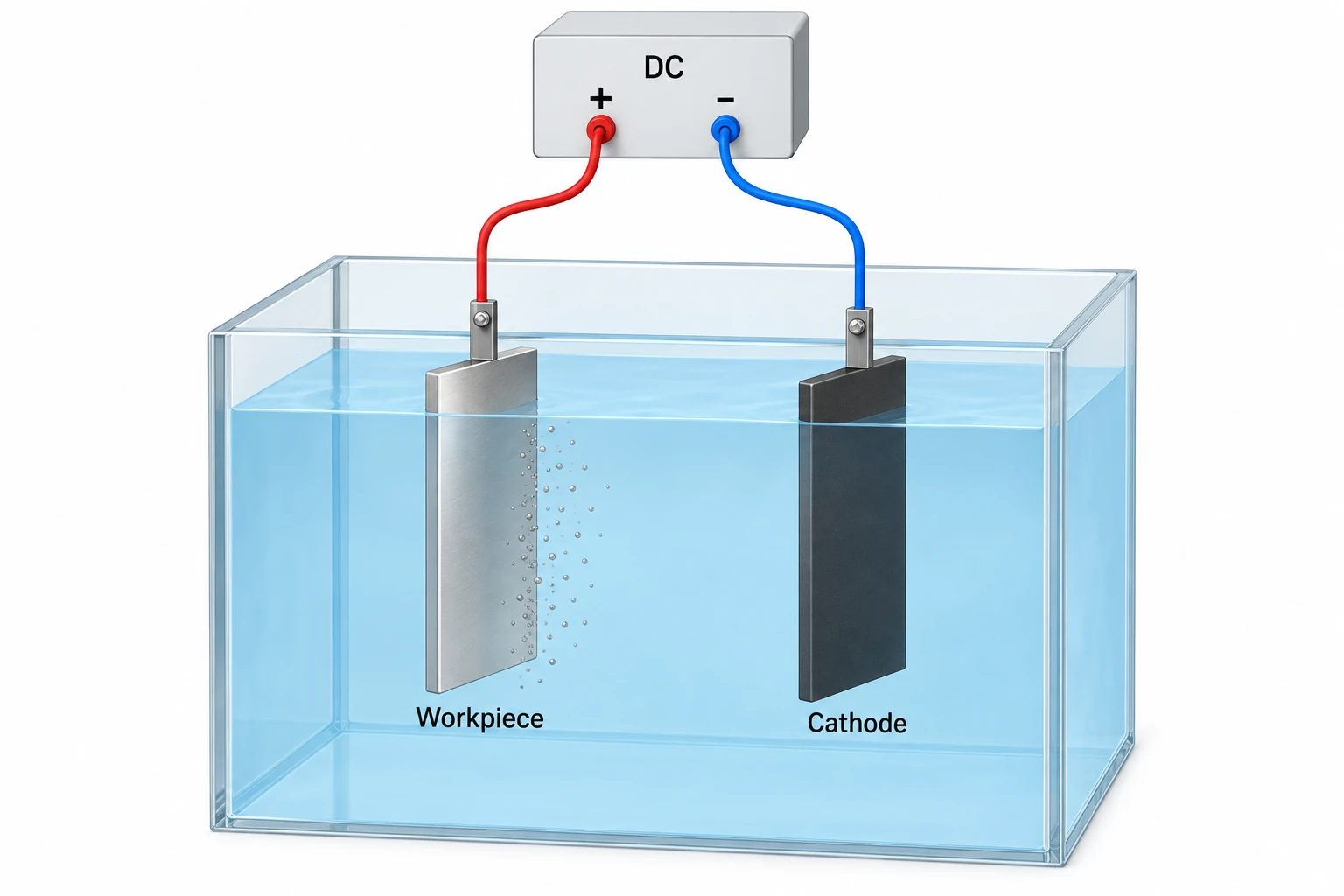
Electropolishing makes the workpiece the anode in an electrolyte and removes metal from it. It is therefore different from electroplating, which deposits a layer. Process conditions and geometry affect the removal. Euro Inox’s Electropolishing Stainless Steels explains the mechanism and the preparation and post-treatment sequence. [3]
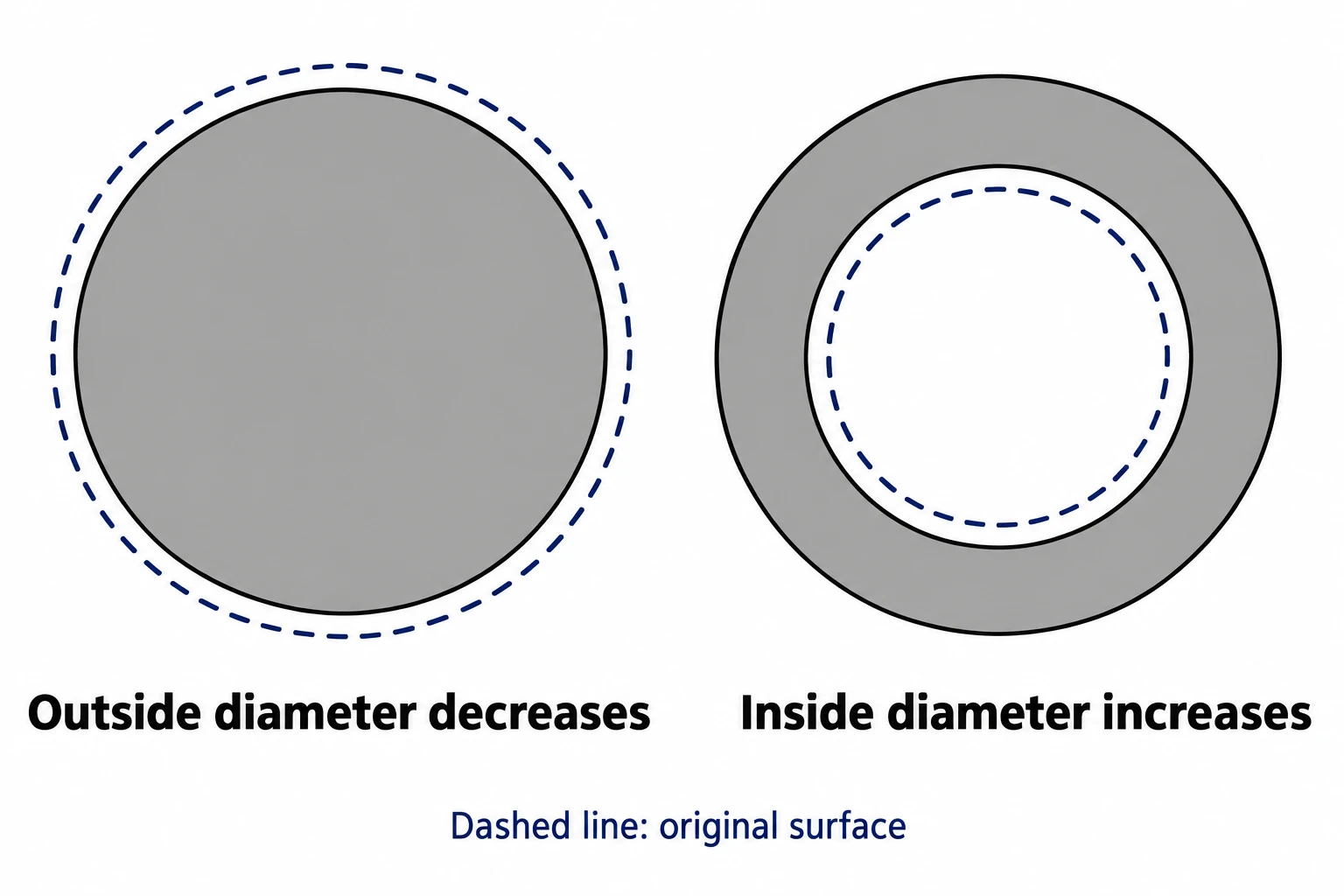
Allow for removal at both sides of a diameter
Electropolishing can change bores, shafts, threads, thin edges and contact surfaces. The effect on a fit is not described by a surface-removal value alone: a diameter includes two opposing surfaces.
Hypothetical geometry example: assume uniform removal of 5 µm, or 0.005 mm, normal to each cylindrical surface, with no other change. This is an arithmetic illustration, not a recommended removal amount.
| Feature | Before treatment | Calculation | After treatment |
|---|---|---|---|
| Shaft outside diameter | 10.000 mm | 10.000 − 2 × 0.005 | 9.990 mm |
| Bore inside diameter | 10.000 mm | 10.000 + 2 × 0.005 | 10.010 mm |
Actual removal need not be uniform around complex geometry or equal on exposed faces and deep internal surfaces. Agree the allowance, permitted variation, treatment zones and feasible protection with the processor. Evaluate final dimensions after the required treatment; do not accept a critical fit solely from a pre-treatment measurement.
For machined stainless steel components, identify the grade and supplied condition as well as the surfaces needing treatment. Free-machining sulfur-bearing grades can respond differently from other stainless grades; BSSA specifically cautions that their electropolished finish may be less satisfactory. [4]
Does an electropolished part also need passivation?
Not automatically. ASTM B912 specifically addresses passivation using electropolishing. Its public scope explains that passivation occurs simultaneously under proper operating conditions, with the result depending on the stainless grade, solution and process conditions. [5]
That does not mean all cleaning and post-treatment can be omitted. The processing route still needs suitable preparation, removal of residues, rinsing and drying. An acid post-treatment used to remove process by-products is not the same purchasing question as requiring a separate, independently specified passivation operation. Follow the agreed route and any explicit drawing or customer requirements.
If an existing order calls for both processes, resolve the requirement with the responsible engineer and processor before removing either step. The useful question is what each specified operation and test is intended to accomplish.
Accept the surface by its function
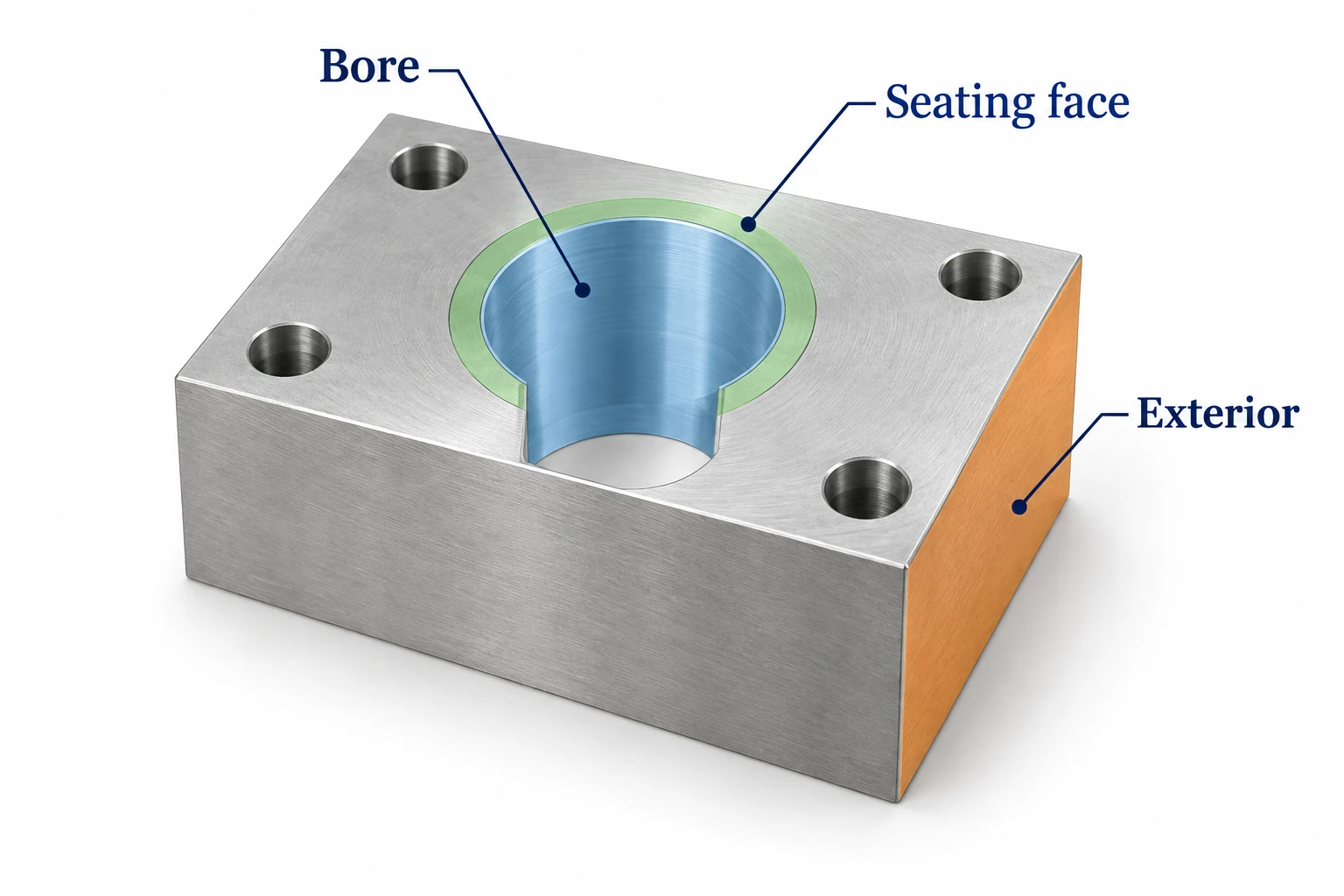
A reflective part is not proof of a specified roughness, cleanliness level or corrosion result. BSSA notes that electropolishing may leave scratches and make surface inclusions more visible. [4] Define the outcome that matters to the component:
- Sliding or sealing interface: final size, geometry, texture parameter and measurement locations.
- Cleanability requirement: specified surface condition and cleaning or residue criteria for the application.
- Corrosion-related treatment: required process and appropriate effectiveness test, with acceptance criteria.
- Visible exterior: agreed appearance and viewing conditions, separate from technical checks.
Compare quotations against the same starting condition and final requirements. Preparation, racking, access to internal surfaces, dimensional control, testing and batch handling can change the work involved. The machining cost and supplier-selection guide helps separate that scope from the unit price.
Send the drawing revision, alloy and condition, required standard and edition, treatment areas, final dimensional limits, surface criteria and test/report requirements with the CNC machining RFQ. A process name is a starting instruction; the finished-part requirements establish whether the result is acceptable.
Passivation and electropolishing questions
Will chemical passivation make a machined part mirror bright?
It is not a polishing operation. If brightness or texture is a requirement, specify it separately and choose a suitable preparation and finishing route. A surface can be passive without having a mirror appearance.
Does electropolishing remove every burr?
No. It can remove suitable small projections, but burr size, access, geometry and allowed material loss limit the result. Heavy or inaccessible burrs need an appropriate removal strategy and a defined edge inspection; do not treat the process name as a burr-free guarantee.
Does either treatment make a part automatically suitable for food or medical use?
No. Suitability depends on the complete material, design, manufacturing, cleaning and application requirements. A treatment certificate or bright surface does not establish product compliance, sterility or performance in service.
Can a passivation test replace a surface-roughness measurement?
No. Passivation effectiveness and surface texture are different characteristics. If both are required, define and evaluate both. The applicable test method must also suit the grade and the acceptance purpose.
Technical sources
- ASTM International. A967/A967M-25, public scope of passivation treatments and effectiveness tests.
- ASTM International. A380/A380M-25, public scope of cleaning, descaling, pickling and passivation.
- Euro Inox. Electropolishing Stainless Steels, 2010, Materials and Applications Series 11, sections 2–3.
- British Stainless Steel Association. Electropolishing of stainless steels. Grade response and surface limitations.
- ASTM International. B912-26, public scope, including simultaneous passivation. Use the edition required by the order.