Fluid-routing blocks
Cross-drilled passages and connected ports route the specified fluid through a solid block. We machine the port seats and closure details around the actual passage layout.

Cross-drilled passages and connected ports route the specified fluid through a solid block. We machine the port seats and closure details around the actual passage layout.
Threaded adapters combine a defined bore with an external connection and wrench flats. Thread form and sealing face have separate jobs; each remains identifiable on the drawing.
A milled cover combines a seating face, fixing pattern and any observation opening. Support around fasteners helps the cover close without bending its edge into the mating joint.
Stepped standoffs separate conductive assemblies from a support. We machine the mounting shoulders and holes without assuming that a material data sheet establishes the finished assembly’s insulation rating.
A milled saddle cradles a defined pipe outside diameter. The contact arc and fixing arrangement share the load; a thin contact edge is not a substitute for a supporting seat.
Turned sleeves combine an axial shoulder with a through bore. The flange establishes seating while the bore retains its specified clearance around the installed member.
We quote milled and turned rigid PVC components made to your drawing, including pockets, port connections and mounting faces. The offer covers solid PVC stock; expanded sign board and flexible vinyl have different structures and uses.
Rigid PVC, often called PVC-U, suits milled blocks and turned parts where stiffness and chemical exposure matter. The exact stock formulation remains part of the material definition.[1]
Normal-impact Type I suits rigid supports and machined blocks where stiffness takes priority over impact toughness. A panel exposed to knocks or cold handling may instead justify a high-impact formulation. The property table remains tied to the selected product.[2] [1]
An impact-modified rigid PVC grade can help a cover withstand handling knocks. Compare the specified grades’ notched impact data and tensile moduli before changing stock for a loaded locating block.[2]
Rod suits rotational parts; plate suits blocks and covers. A part machined from an existing pipe retains that pipe’s wall and geometry limits, unlike a fitting turned from solid bar.
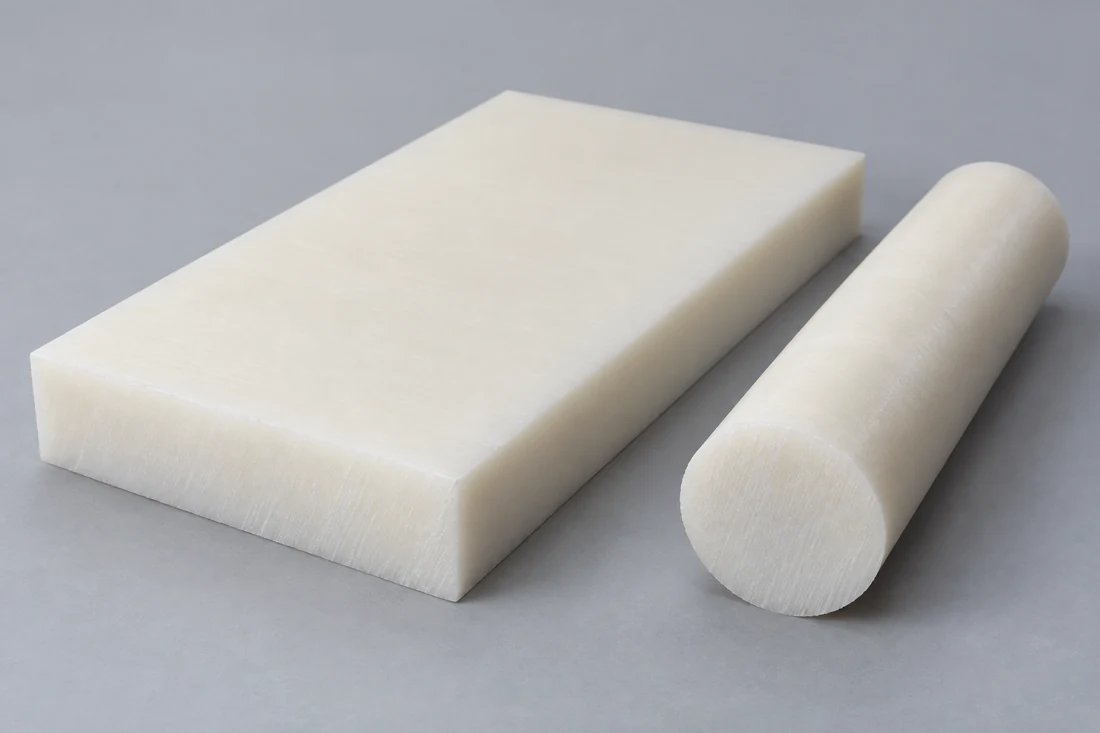

Expanded PVC contains a cellular structure and is often used for signs or light panels. A port thread, loaded fastener or sealing land needs a material and section selected for that task; a light foam board cannot inherit solid-stock properties.[3]
The reference below is Curbell’s published typical rigid-PVC data, kept with its ASTM basis; it does not describe every PVC formulation.
| Property | Reference value | Test basis | Condition or meaning |
|---|---|---|---|
| Specific gravity | 1.42 | ASTM D792 | Rigid PVC stock |
| Tensile strength | 7,500 psi | ASTM D638 | Typical stock value |
| Tensile modulus | 411,000 psi | ASTM D638 | Elastic stiffness |
| Flexural modulus | 481,000 psi | ASTM D790 | Bending stiffness |
| Notched Izod impact | 1.0 ft·lbf/in | ASTM D256 | Notched specimen |
| Heat deflection temperature | 158°F | ASTM D648 | 264 psi test stress |
| Water absorption | 0.06% | ASTM D570 | 24-hour immersion |
Curbell Plastics, PVC (Rigid) typical-property table. Values characterize the listed rigid material; HDT is a loaded short-term test, not a continuous-service limit. Exact formulation and exposure govern selection.

We mill pockets and drill intersecting passages from accessible directions. A port ending inside another bore needs a deburring route, so the internal crossing belongs in the machining plan.
Turning or milling creates the specified thread and its adjacent seat. A tapered thread can load a plastic wall radially; engagement, section and assembly torque need to suit that connection design.
PVC can soften locally when a tool rubs or chips collect in a pocket. Sharp tooling, effective chip removal and support of the remaining wall help preserve the finished edge and bore.[4]
The accepted geometry follows the drawing’s datums, final finish and defined free or assembled state.
| Feature | Requirement or reference | Accepted condition | Verification |
|---|---|---|---|
| Port thread | Drawing thread standard and size | Finished port | Specified thread gauge |
| Sealing land | Drawing flatness, texture and supported width | After machining and edge work | Face and surface check |
| Cover or mounting face | Drawing geometry and support condition | Free part or defined clamped state | Datum-based check |
| Electrical or pressure function | Application-specific test and limits | Defined assembly and exposure | Separately agreed test |
Drawing limits apply to the component’s actual geometry and condition. Material-property values do not set a machining tolerance or a pressure rating.
We quote the required port positions, seats and mounting relationships. Measurement access, wall flexibility and the assembled condition determine which checks answer the actual fit question.
An external profile or cross-hole can leave little material beside the thread. Retain the section needed by the specified connection rather than judging wall thickness from the main bore alone.
A milled inside corner retains the cutter radius. Local relief can clear a mating square corner without removing the whole sealing land or thinning the bottom of a fluid pocket.
Chemical compatibility depends on concentration, temperature, time and applied stress. A broadly resistant material can still be unsuitable for a particular cleaning agent or loaded threaded connection.[4]
A clearance hole should let the screw clamp the intended face rather than act as an expanding wedge. Washers, inserts or a compression stop may be design options where repeated tightening would otherwise distort the PVC.
A removable cover or adapter can make an internal passage accessible for cleaning. Parting the block at a serviceable face may be more useful than creating an inaccessible cavity in one piece.
Standoffs and barriers separate selected conductive parts. The assembly’s creepage path, contamination and test requirements determine its electrical acceptance; the polymer name is only one input.
Supports and installation adapters connect to the retained tank or pipe dimensions. A machined mounting part does not automatically inherit the pressure rating of a certified pipe-and-fitting system.
An opening may provide access to a fastener or connector while leaving the protected area covered. Its location and retained edge stiffness matter more than simply minimizing the cover thickness.

A sealing face follows its specified texture and flatness. Cosmetic smoothing of a different outer surface need not remove additional stock from that functional land.
Burr removal at intersecting holes needs access from the actual openings. Loose fragments inside a finished block can remain after the visible outside edges look clean.
A machined joint intended for solvent bonding or thermoplastic welding retains the geometry required by that joining process. Those operations are separate scope items, not an automatic finish on every CNC part.
The agreed cleaning method needs to be compatible with the PVC formulation. Packing protects the sealing seat from hard hardware and keeps loose chips out of the open passages.

The order record identifies rigid PVC grade and starting form. Foam sheet, flexible PVC or CPVC is a material change, even when a supplier describes each as a vinyl product.
We check the specified port position and seat from their drawing references. A thread check does not measure the remaining sealing land or establish alignment with a mating assembly.
A dimensional result covers the measured component. Pressure, leakage and electrical tests need their own specified method and acceptance scope; they are not implied by machining a PVC part.
A thin cover cut from plate uses stock differently from a deeply pocketed block. The stock form and retained section determine the material removed and the necessary support.
Intersecting passages, blind corners and threads on several faces add setups and deburring work. An open service face may reduce access difficulty while changing the joint design.
Recorded port locations, sealing textures or a separate leak test add defined work. Applying the same finish or tight limit to every outer face adds cost without necessarily improving the connection.
Programming, fixtures and first-part checks are shared across identical components. Separate port patterns remain separate variants, even when they start from the same block envelope.
An initial component checks port engagement, cover access and support in the intended assembly. The trial identifies any geometry change before the connection becomes a repeat part.
The trial uses the intended rigid stock and joining condition. Behaviour of the finished solid component is read from a trial in that same rigid stock.
The approved port layout and component revision define the batch. A drawing change is incorporated before another pattern is machined under the same part number.
Repeat supply retains the accepted seat and connection geometry. A changed fluid, joint or stock formulation is identified so its effect on the retained assembly can be assessed.
Not automatically. CPVC is commonly selected for hotter service, but its joint materials and allowable conditions differ. A PVC-only solvent cement can be unsuitable for a CPVC connection. The approved material, joining system and finished interface must match the intended exposure.
No. Type I identifies a material classification, not a finished-part food-contact approval. The exact stock formulation, applicable declaration and processing/cleaning requirements determine whether that use is supported.
A clear formulation gives you visibility; optical flatness, transmission and imaging quality are separate requirements with their own acceptance criteria. A viewing cover and an optical element need different acceptance criteria.
No. Thread standards differ in form, pitch and sealing arrangement. A similar nominal size does not make them interchangeable; the actual standard and gauge basis remain part of the port definition.
It still has measurable water absorption. The reference table reports a typical 24-hour immersion result for rigid stock; it is not a prediction of indefinite wet exposure or a guarantee that a fitted part never changes size.
No. UL 94 V-0 describes how a material specimen burns at the tested thickness. Use the applicable end-use evidence for any enclosure certification or fire-resistance requirement.
Send the drawing and model, rigid PVC stock designation, quantity and mating connection details. Include the fluid or cleaning exposure and any defined pressure, electrical or assembled-fit acceptance.
Rigid-stock data and the material, joint and inspection distinctions used on this page.
We use Google Analytics to see how this site is used. Analytics cookies are set only if you accept. Privacy Policy
