Guide rollers
We turn PET-P rollers with a defined running diameter, bore and end faces. Steps, flanges or grooves can locate the moving item, while the center opening follows the specified axle or bearing arrangement.

We turn PET-P rollers with a defined running diameter, bore and end faces. Steps, flanges or grooves can locate the moving item, while the center opening follows the specified axle or bearing arrangement.
Plain bearing bushings present a sliding bore around a shaft. We machine the bore, outside locating diameter and any flange or shoulder, keeping the running interface distinct from the surfaces that seat the bushing in its support.
We turn PET-P guide rings with the specified radial section, axial width and contact diameters. A step, relief or defined cut can be included when the ring drawing requires it for the groove and assembly arrangement.
A slide block combines a contact channel or rail profile with mounting faces and fixing holes. We mill the specified section and local clearance features into the PET-P blank, using the mounting references to locate the working path.
We mill pockets, stops and supporting lands that locate the workpiece in a PET-P nest. Reliefs clear the surfaces that should not establish position, while fastening features connect the nest to its fixture base.
Turned PET-P washers provide an axial contact face around a shaft. Bore size, outside profile and working thickness follow the drawing, with local steps or reliefs where the washer meets the mating shoulder.
VETCNC quotes custom milled and turned components from specified engineering PET-P stock. This page covers semi-crystalline mechanical stock; we confirm the exact product, sourcing, geometry and included acceptance for the order.
Engineering PET-P is a stock material for rigid locating and running components. The named unfilled Ertalyte product supplies the reference values below. Its semi-crystalline stock condition differs from the bottle and packaging products that also carry the PET name. [1]
An internally lubricated product such as Ertalyte TX is a separate selection for a sliding contact. We retain the specified stock product rather than treat its formulation as a surface finish on unfilled PET-P. The working counterface and contact duty guide that choice. [2] [1]
Round stock suits rollers, bushings, rings and washers. A tubular blank can reduce center removal where its product and wall suit the part. Material for the bore, outside running profile and end faces remains in the blank until those features are finished. [3]
A plate blank supports a profiled block or locating nest with a broad mounting face. The pocket depth and remaining base determine the required starting section; the finished contact path is machined in relation to that base rather than accepted from stock thickness alone.


Modulus describes elastic stiffness under load, while expansion describes temperature-related size change. Both affect a close mechanical interface, but one cannot stand in for the other. Stock stress and the amount removed also influence the geometry left after machining. [1] [4]
The table describes one named unfilled stock product and keeps each value with its stated test condition.
| Property | Reference value | Test basis | Stated condition |
|---|---|---|---|
| Tensile strength | 90 MPa | ISO 527-1/-2 | Type 1B specimen |
| Tensile modulus | 3,500 MPa | ISO 527-1/-2 | Type 1B; 1 mm/min |
| Compressive stress | 33 / 64 / 107 MPa | ISO 604 | 1 / 2 / 5% nominal strain |
| Heat deflection temperature | 80°C | ISO 75-1/-2 | 1.8 MPa test load |
| Linear expansion | 60 µm/(m·K) | Producer reference | 23–60°C mean |
| Water absorption, 24 h | 0.07% by mass | ISO 62 | Water at 23°C |
| Sliding wear rate | 3 µm/km | Pin-on-disk-like procedure¹ | 3 MPa; 0.33 m/s |
MCAM Ertalyte PET-P Product Datasheet, dated 20/10/2026, ISO columns. Most mechanical figures average dry specimens machined from 40–60 mm rod, otherwise 10–20 mm plate, at 23°C; direction is unstated. Tensile strength may be at yield or break per the stated procedure. Compression uses Ø8 × 16 mm cylinders at 1 mm/min; water uptake uses Ø50 × 3 mm discs. ¹Procedure similar to ISO 7148-2 Method A, against steel Ra 0.7–0.9 µm at 23°C and 50% RH. Values describe the stock comparison basis, not guaranteed purchase minima or finished-part ratings.

We turn the bore, running diameter and end faces to the drawing’s datum arrangement. A stepped roller or thin guide ring needs support around the retained section so that the last cut does not load an unsupported edge.
PET-P is notch-sensitive. For a larger bore, drilling followed by boring can reduce the heat and cracking risk associated with opening the full feature in one operation. The sequence is selected for the actual stock and bore, with chips cleared from the cutting zone.
We mill the working profile and its mounting features with support beneath the remaining floor or wall. Pocket corners, side openings and deep reaches determine cutter access; a clean path for chips helps keep the contact surface from being rubbed or recut. [4]
Feature acceptance uses the drawing’s actual datums, support and measurement condition.
| Feature | Requirement or reference | Accepted condition | Verification |
|---|---|---|---|
| Roller bore and seat | Drawing shaft/bearing fit and axial location | Specified free or assembled condition | Bore and shoulder relationship |
| Guide profile or nest contacts | Drawing working path and locating datums | Specified mounting support | Profile and contact-location check |
| Unfilled reference diameter | 50 mm, 23→53°C: ΔD ≈ +0.09 mm | Published interval mean held constant | Free material-growth calculation |
| Roller running band | Drawing profile and relation to bore axis | Defined datum setup after finishing | Profile/runout check as specified |
Thermal estimate: ΔD = αDΔT = 60×10⁻⁶/K × 50 mm × 30 K = 0.09 mm. It uses the unfilled stock’s 23–60°C mean within that interval. Installed clearance also depends on the mating material, support and restraint; the estimate does not set a machining tolerance.
We quote the selected sizes, profiles and datum relationships on the component drawing. A roller bearing seat, a long guide channel and a locating nest require different support and access for inspection; each accepted limit follows the feature that performs the task.
A groove or deep end recess reduces the material supporting the running band. Retaining a continuous path from that band to the hub helps carry the contact load. The outer profile and the supporting body need to be considered together.
A continuous ring needs a route onto its seat without forcing it over an oversized shoulder. If the design requires a split or a particular joint, its position and geometry belong on the drawing. A one-piece ring is not assumed to spring open for installation.
A rotating cutter leaves an inside radius, and a sharp notch is undesirable in PET-P. The moving part needs clearance at that corner. A local relief or a compatible mating radius can preserve the useful guide section without widening the whole channel. [4]
A nest should locate on the intended contacts and clear the rest of the workpiece. Relief around ribs, corner fillets or surface variation prevents an unintended high point from lifting the part away from its actual locating lands.
The roller presents its running band at the required height and position along the route. A flange or groove can constrain sideways movement, while the axle and surrounding frame determine how the roller is retained and allowed to turn.
A profiled block maintains the path of a moving slide through its working contact section. Mounting position and alignment along that path determine whether several guides share the intended contact rather than loading one edge or one end.
A nest supports the workpiece on selected faces and stops it against defined references. The fixture still needs access for loading, clamping and removal; a pocket that matches the entire outside shape can make release harder without improving location.
A thrust washer separates axial mating faces while retaining the required shaft clearance. Its contact annulus, locating step and neighboring shoulder establish where the axial load enters the washer, rather than the outside diameter alone.

The band retains its specified profile, texture and permitted tool marks. An appearance-only polish can change a crown, groove or local diameter. Any additional finishing follows the actual contact requirement rather than a general demand for gloss.
Burrs and loose fragments are removed at the sides and entrances without carrying the edge break into the working band or a fitted seat. A chipped entrance is evaluated against the specified edge and remaining contact, rather than hidden by extra rounding.
A lead-in may help the workpiece enter a guide or fixture, while a locating stop needs its defined face. Finishing distinguishes those boundaries so that easing a handling edge does not shorten the stop or remove a locating corner used by the drawing.
Finished openings are cleared of loose machining debris and cleaned to the agreed requirement. Identification stays on a permitted noncontact face, and packing keeps hardware or chips away from the roller band and locating lands.
The part record retains the PET-P product, stock form and any approved-source restriction. A proposed change to a bearing-modified product is identified before it becomes repeat stock; the accepted mechanical part is tied to that material definition.
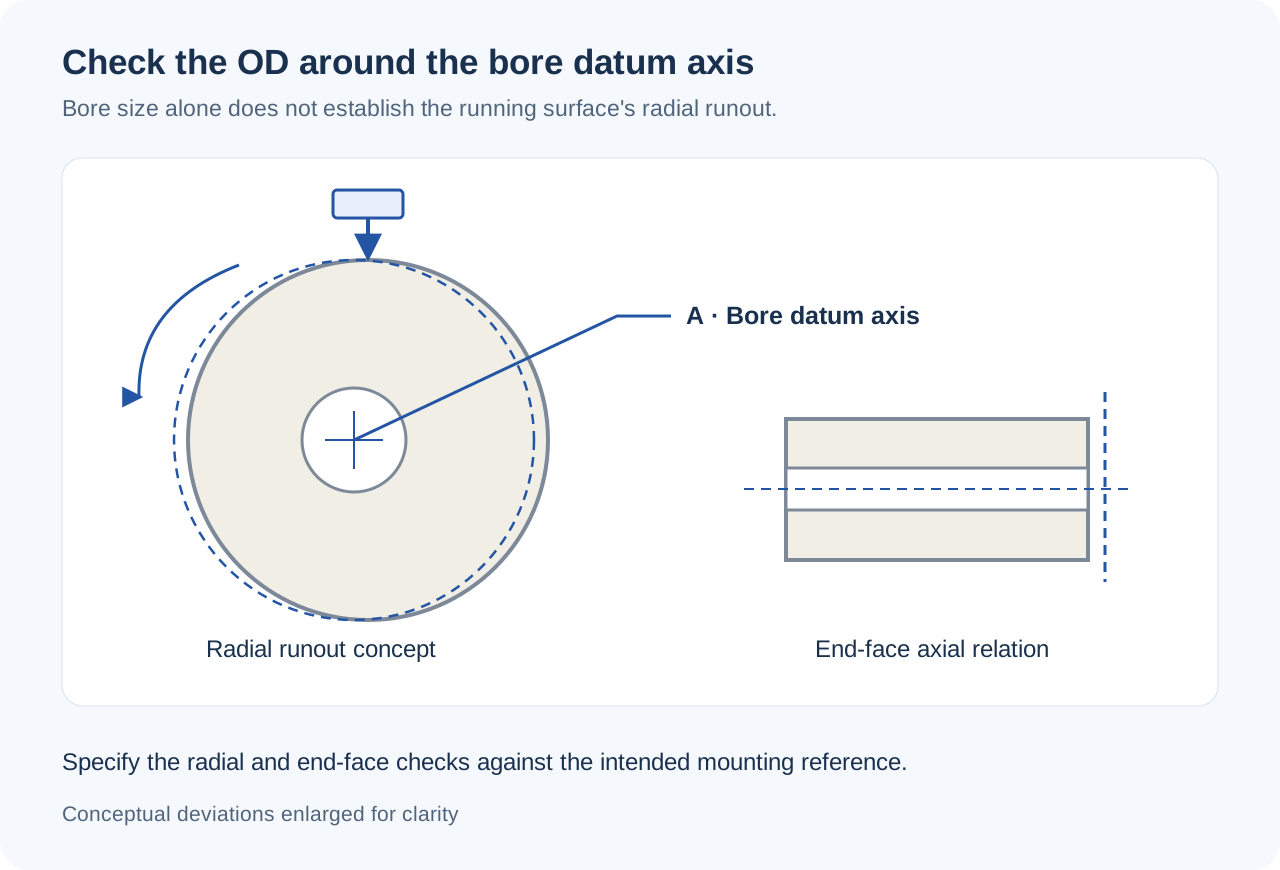
A roller can meet separate diameter limits and still have an off-center running surface. Inspection relates the outside profile and end face to the bore datum axis, with the runout or other relationship specified on the drawing checked in the defined setup.
A guide or nest is checked from the mounting references that position its working contacts. Where acceptance includes an actual movement or loading trial, that check has its own agreed setup and result. A dimensional report does not by itself establish service life.
A named bearing grade or source restriction affects sourcing. Round stock for a roller and a plate layout for several nests use material differently; the opening, retained section and available blank determine how much is removed.
A notch-sensitive larger bore can require separate opening and finishing steps. Deep guide sections, side holes or pockets on several faces also add tool reach and setups beyond a simple open profile machined from one direction.
Controlled roller texture, a defined groove profile or a recorded runout check adds specific finishing and inspection work. An assembled movement trial is a separate scope item, planned for the actual part and mating arrangement.
Programming, workholding and first-part preparation are shared across identical components produced together. Different nest profiles or roller revisions retain their own setup work. Repeats can reuse the accepted basis when the stock, geometry and acceptance remain unchanged.
An initial component checks how the item runs, seats and releases in the actual mechanism or fixture. Changes to a groove, stop or guide path are resolved before that geometry becomes the accepted production definition.
The representative part uses the intended engineering stock and included finishing steps. This establishes the manufactured result on that product, rather than treating a similar-looking polymer or a different bearing formulation as an equivalent trial.
The accepted material, drawing revision, working surfaces and required checks define the batch. A trial adjustment is recorded in that definition before the remaining components are made to it.
Repeat orders reference the accepted part and material definition. A changed source, bearing product or working profile is identified before replacement parts enter the same mechanism, so the affected fit and contact relationships can be assessed.
It is not an optical-window specification. The named semi-crystalline engineering stock is supplied in opaque colors, including natural white and black. Clarity associated with bottles or another polyester product does not transfer to it. A transparent window needs its own material and optical requirements, with the viewed faces and finish defined separately.
No. Low uptake describes absorption, while hydrolysis is chemical degradation. MCAM cautions against hot water and steam for Ertalyte PET-P and does not recommend high-pH alkaline exposure. A cleaning regime therefore needs compatibility assessment for the actual stock and cycle; the water-absorption row cannot qualify it.
The current Ertalyte TX datasheet identifies an internally lubricated bearing product but does not disclose the lubricant chemistry. Do not infer either PTFE content or its absence from that description. If the order restricts a particular additive, obtain the applicable product-specific composition or absence declaration before accepting the stock.
Not directly. The listed dynamic-friction data come from a sliding test against steel at a specified pressure, speed and surface condition. Roller traction depends on the actual product surface, normal force and slip condition. Roller grip is assessed from the actual product surface, normal force and slip condition in that contact.
Do not use unintended bottoming as the fastening stop. MCAM specifically advises leaving clearance at the bottom of drilled or tapped PET-P holes. Full thread engagement, the screw's tip projection and the available bottom clearance are three separate dimensions, each worth stating on the drawing. The intended clamped contact sets the assembly position.
A guide ring is selected to support and guide the moving interface; it is not automatically the primary fluid seal. Guidance controls lateral contact, while sealing needs its own geometry, material and leakage acceptance. Replacing the seal with a guide ring would change that function. A component that combines functions must be explicitly designed and validated for both.
Send the matching drawing and model, required engineering PET-P stock, quantity and working-surface finish. Include the mating geometry and any defined operating, mounting or inspection condition so we can quote the intended component.
Named engineering-stock data and the specific contact, process and application distinctions used on this page.
We use Google Analytics to see how this site is used. Analytics cookies are set only if you accept. Privacy Policy
