Skip to content
VETCNCCNC MANUFACTURING
Off-white insulating support strip, pocketed mounting block and flanged sleeve on a dark surface

PPSU CNC
Machining

Review PPSU Stock References

PPSU Supports, Sleeves and Reusable Equipment Components

6 component types

Instrument support strips

We machine repeated openings and attachment features that position items within a support. The pitch, retained sections and contact edges establish where the equipment is held without obstructing the access needed around it.

Flanged guide sleeves

A sleeve guides a shaft or inserted component through its working bore while a flange provides an axial stop. The bore, outside fit and seating face each retain their own drawing requirement.

Guide and mounting blocks

An open channel or local pocket can guide a moving item while the block attaches to the surrounding equipment. The locating surfaces are kept distinct from clearance faces and fixing regions.

Locating rings and collars

A ring centers a mating item or establishes an axial boundary around it. The working diameter and permitted contact band define that role rather than the appearance of a smooth outside surface.

Fixture contact nests

A nest supports a component at selected contact regions while leaving other surfaces accessible. Its contour and attachment position determine how the item is presented to the next operation.

Guide rollers and cylindrical supports

A roller or cylindrical support provides an outside contact band and a separate mounting bore. The design defines the intended movement, load and support rather than treating a material strength value as a bearing rating.

We machine specified PPSU stock into drawing-defined equipment components. The material is a candidate for repeated-use and steam-exposed applications; the finished geometry, cleaning environment and required acceptance determine the complete part specification.

PPSU Grade, Color and Stock Selection

Identify polyphenylsulfone explicitly

PPSU is polyphenylsulfone. The ordered polymer and supplier product are retained through machining so a similarly named high-temperature plastic is not substituted on appearance or a general sulfone-family description.[1]

Selection focus
The actual polymer and approved stock product.

Named color and formulation

The table uses Ensinger TECASON P MT grey as one named stock reference. Other colors and supplier formulations need their own product basis where composition, material evidence or application requirements are controlled.[1]

Selection focus
The approved product designation and color.

Rod or plate around the working shape

Rod suits a predominantly cylindrical sleeve or ring; plate suits a support pattern or fixture block. The starting envelope leaves material for the controlled contact surfaces and the holding needed to reach them.[1]

Selection focus
Stock utilization and access to final references.

Steam-exposed equipment duty

The named stock reference describes autoclave resistance. A required cleaning process still has its own temperature, chemistry, time and repetition; those conditions define the finished component's evaluation rather than an unspecified reusable label.

Selection focus
The complete intended cleaning and use sequence.
Unmarked white polymer rod and rectangular plate cut blanks
Plate blank envelope around a four-opening support pattern, highlighting retained webs

Keep the stock product separate from the part's validation

A material datasheet supplies the reference formulation and test basis. A support or sleeve adds geometry, residual machining state and contact surfaces that must remain compatible with its intended use and cleaning process.[1]

The following comparative values retain the named stock, test method and stated condition.

TECASON P MT grey PPSU — named stock reference
PropertyReference valueMethod / conditionDecision input
Density1.29 g/cm³Named stock productMass estimate
Tensile modulus2410 MPaASTM D638; 23°CElastic stiffness
Yield strength75.8 MPaASTM D638; 23°CTensile reference
Flexural strength107 MPaASTM D790; 23°CBending comparison
Compression at 1% strain10.3 MPaASTM D695Defined strain basis
24-hour water absorption0.37%ASTM D570; 23°C; estimatedMoisture conditioning
Saturated water absorption1.1%ASTM D570; 23°CLonger exposure input

Ensinger TECASON P MT grey stock-shape datasheet, dated 2018/04/09. Comparative supplier values retain the stated methods and conditions, and a finished-part operating or validation limit is agreed separately.

CNC Milling and Turning PPSU Components

Polymer plate supported beneath its retained section with two local clamps

Cutting heat and swarf removal

We plan the cut and chip path so heat is not concentrated in a small feature. Sharp cutting edges and cleared swarf help preserve a machined surface without rubbing or leaving softened material behind.

Clamping without forcing the shape

A thin sleeve or opened fixture can move under concentrated holding force. Support is placed around the retained section, with the final measurement state identified independently of how the blank was gripped.

Compatible process fluids

The MCAM machining guide identifies mineral-oil cutting fluids as a possible stress-cracking contributor for PPSU. A fluid suitable for metal machining is therefore not assumed compatible with the polymer and the part's later cleaning requirements.[2]

PPSU Working Bores, Seating Faces and Contact Geometry

Polymer sleeve with radial and axial interfacesConceptual separation of the guiding bore from the flange seating face.Working borePPSU componentMating featureContact interfaces
Specify where the component locates and where it merely clears.
PPSU component interfaces and acceptance
FeatureDrawing controlMeasurement stateVerification
Guiding boreSize and geometric relationshipSpecified environmentBore/axis check
Flange seatFace and axial locationRequired support stateFace/length check
Fixture contactContour and attachment relationReleased/mounted as definedProfile and datum check
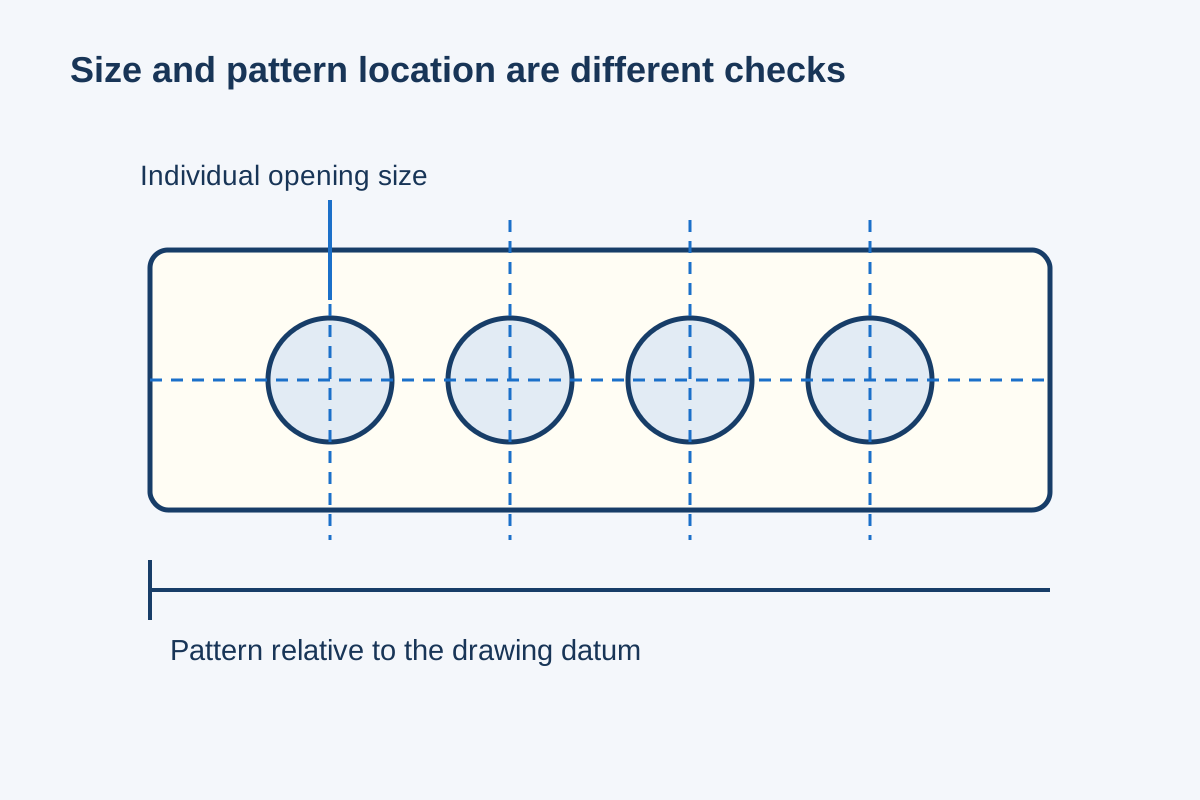
Support patternOpening size and pitchDelivered processed stateIndividual and pattern check

The component drawing supplies local limits and the relevant conditioning/support state; stock mechanical values do not set a universal machining tolerance.

Identify the PPSU Features That Contact the Equipment

We define the working bore, seating face, support contour and attachment pattern before establishing their machining and inspection sequence. Clearance surfaces can remain outside the tightly controlled contact region.

PPSU Component Details That Affect Manufacture

Material beside adjacent openings

Opening size and pitch act together to define the remaining web. A local increase in access can consume the section that connects the support to its mounting region.

Transitions behind loaded features

A narrow projection needs support into the main body. A permitted transition radius can retain that connection without moving the functional contact face.

Tool access within a fixture pocket

An internal contour must allow both cutting access and removal of chips. A local noncontact relief can improve access while the principal locating surfaces retain their intended shape.

Fastener seats on a thin section

A recessed head consumes local material. Its seat needs a supported land so the fastener does not simply draw a flexible cover or flange into an unintended shape.

Discuss Part Requirements

PPSU Parts in Repeated-Use Equipment

Positioning instruments or components

A support strip establishes where individual items sit while leaving the intended handling and cleaning access. The surrounding equipment defines the complete use and validation requirement.

Guiding a removable mechanism

A sleeve separates the guiding contact from its installation fit. The designed clearance allows the mechanism to be removed or moved without using the flange as an unintended bearing surface.

Presenting a component in a fixture

A machined nest supports named contact regions and leaves working surfaces accessible. Its contour and base reference establish how the component is oriented for the operation.

Separating or centering equipment elements

A ring or block maintains the specified relationship between adjacent components. The load and exposure act through the actual contact section rather than the full stock envelope.

PPSU Edge Finish, Cleaning and Surface Condition

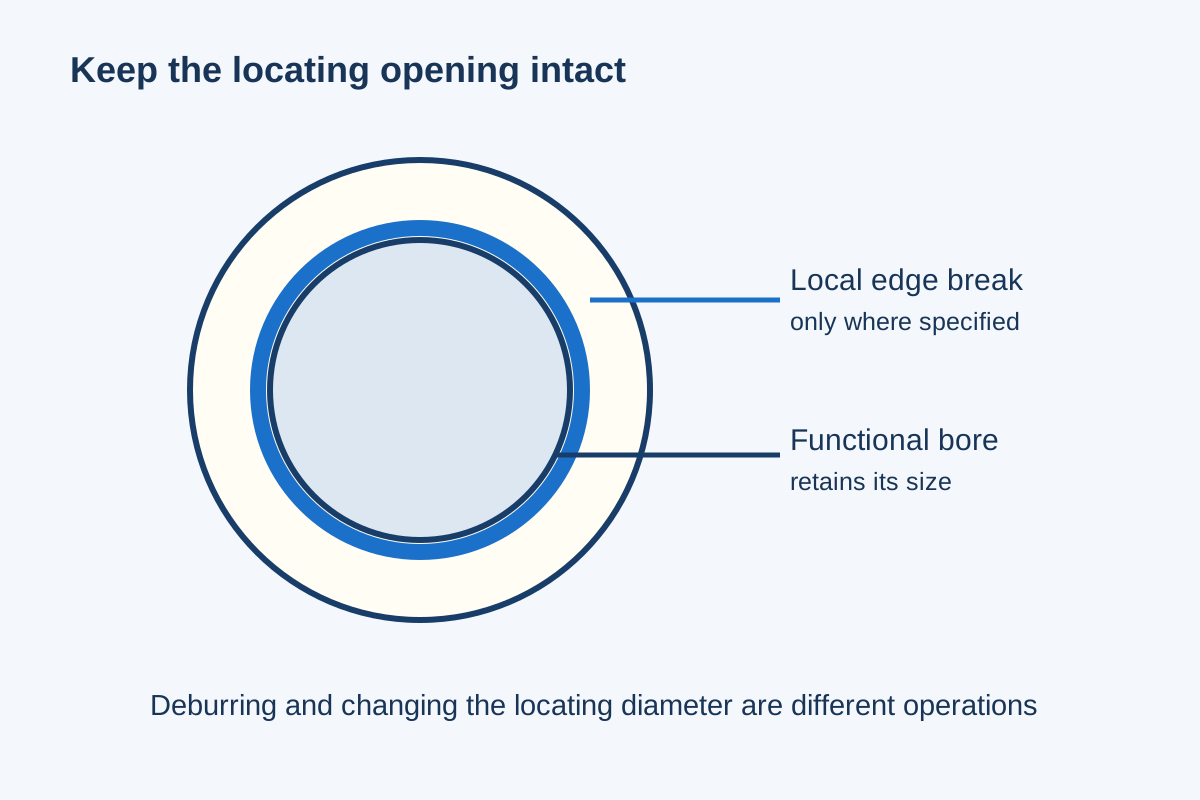
Conceptual circular opening separating a local edge break from the functional bore

Defined machined contact surfaces

The working contour or bore retains its required surface definition. Cosmetic polishing is not allowed to widen a guide or remove a small locating land.

Local edge control

Burr removal is limited to the permitted edge. A deliberate radius or chamfer is treated as geometry where it affects a supported item or its installation.

Specified cleaning compatibility

The included cleaning route is selected for the named stock and required delivered state. Solvent compatibility and residue requirements are resolved for that route rather than inferred from a general chemical-resistance claim.

Protection during identification and packing

The controlled contact surfaces are protected from loose hardware and neighboring parts. Identification remains clear of functional openings and any surface reserved by the equipment drawing.

PPSU Material and Finished-Part Acceptance

Four-hole support pattern with individual size and datum-related position indicated separately

Named stock and material evidence

The record identifies the supplier product and approved color or formulation. A family name or visually similar stock does not replace that identity when application evidence is product-specific.

Released or installed geometry

We inspect the selected working contacts in the support and environmental state required by the drawing. The free-state result is inspected in the support and environmental condition the drawing requires.

Additional exposure or functional acceptance

A dimensional result does not demonstrate a specified cleaning life, steam-cycle count or finished-device approval. Any required exposure or functional acceptance is identified separately in the supply scope.

What Affects the Cost of PPSU CNC Machining?

Named stock and usable envelope

The required stock product, blank form and material removed affect the starting cost. A wide fixture cut from solid plate can consume more material than a small sleeve turned from rod.

Deep features and supported setups

Restricted pockets, thin walls and several reference directions add access and holding work. Stable support matters even where the final part has a simple outside outline.

Surface and acceptance scope

Controlled contact surfaces, specified cleaning and recorded feature checks add identifiable operations. A separately required exposure test has its own preparation and result.

Quantity and unchanged geometry

Programming and workholding can be shared across identical parts. A new support pattern or contact contour changes that preparation rather than being absorbed by the same material name.

From a PPSU Geometry Trial to Repeat Components

Resolve the equipment contact

A trial checks the actual guiding, support and installation relationships. Changes are assigned to the relevant contact rather than applied as a general enlargement.

Evaluate the representative material state

A component used for an exposure or reuse decision retains the intended stock product and processing state. A geometry-only trial answers a narrower question.

Release the accepted component

The drawing, material identity, cleaning scope and final feature acceptance define the quantity order. Trial adjustments are incorporated into that released definition.

Preserve the repeated supply basis

Repeat parts follow the accepted contact geometry and named stock requirement. A different formulation or cleaning process is treated as a change to that basis.

PPSU CNC Machining FAQs

Does the 24-hour water-absorption value describe fully saturated PPSU stock?

No. The Ensinger reference separates its estimated 24-hour value of 0.37% from a saturation value of 1.1%, both at 23°C. These describe different exposure states. A long wet-service fit should use its intended conditioning and measurement basis rather than assume a short soak has reached the saturated condition.

Does an ISO 10993-5 statement cover every biological effect of a PPSU component?

No. Part 5 addresses in vitro cytotoxicity: the response of cultured cells exposed to the test item or its extracts. It does not itself establish every other biological endpoint. A material statement citing that part should be read for this specific test coverage rather than treated as evidence for all biological effects.

Does an ASTM resin designation also specify the supplied PPSU shape?

Not automatically. The Ensinger reference lists ASTM D6394-10 SP0311 for its resin while the separate shape-specification field reads none. A resin identifier therefore cannot silently replace the ordered stock-shape and component requirements.

Can the Vicat softening temperature be used as the working temperature of a loaded PPSU part?

No. Vicat describes a particular softening test. It does not rate a loaded sleeve, fixture or complete assembly over its service duration. The relevant load, time, environment and required dimensional behavior need an application-specific basis.

Should a repeatedly removed PPSU cover use a threaded insert?

It can be appropriate. MCAM recommends considering inserts where engineering-plastic threads face strong vibration or repeated clamping and unclamping. The insert, surrounding section and installation method still need to suit the actual fastening load and cleaning environment.

Is compression strength reported at 10% strain an allowable working stress?

No. It describes stress at a stated specimen deformation, not the permitted deformation of the assembled component. A working spacer or guide may require much less movement, and sustained loading introduces a separate time-dependent requirement.

PROJECT SUPPORT

Discuss Your PPSU Machined Component

Send the drawing or model, named stock requirement, quantity and intended cleaning exposure. Identify the working contacts, final conditioning state and any separately required functional or reuse acceptance.

PPSU Stock and Machining References

Named product values and machining principles support separate material and component decisions.

  1. Ensinger — TECASON P MT grey2018 stock-shape reference for comparative mechanical and moisture values.
  2. MCAM — Guide to Machining Plastic PartsHeat, swarf, supported holding and fluid-compatibility considerations.
  3. Ensinger — Resin and Shape Specification FieldsResin identification remains separate from stock-shape and component acceptance.
  4. ISO — ISO 10993-5:2009The scope of in vitro cytotoxicity testing and the meaning of that specific test reference.
VETCNCCNC MANUFACTURING

Get a Quote

Upload Drawing

*Required fields

Acetal part geometry illustration

Enlarged part geometry illustration

AI-generated part illustration.

English
WhatsApp Email us

Tell us about your project

Share your requirements and we will get back to you by email.

PDF, CAD or ZIP · up to 20 MB