On this page
Grinding and hard turning can both finish hardened steel journals, bores and faces. The choice depends on which process can reach the working surface and deliver its required geometry, texture and material condition. Hard turning is a candidate for accessible rotational features in a stable setup. Grinding remains relevant where its particular access or qualified surface condition suits the part. Neither process wins every comparison.
Compare the same hardened surface
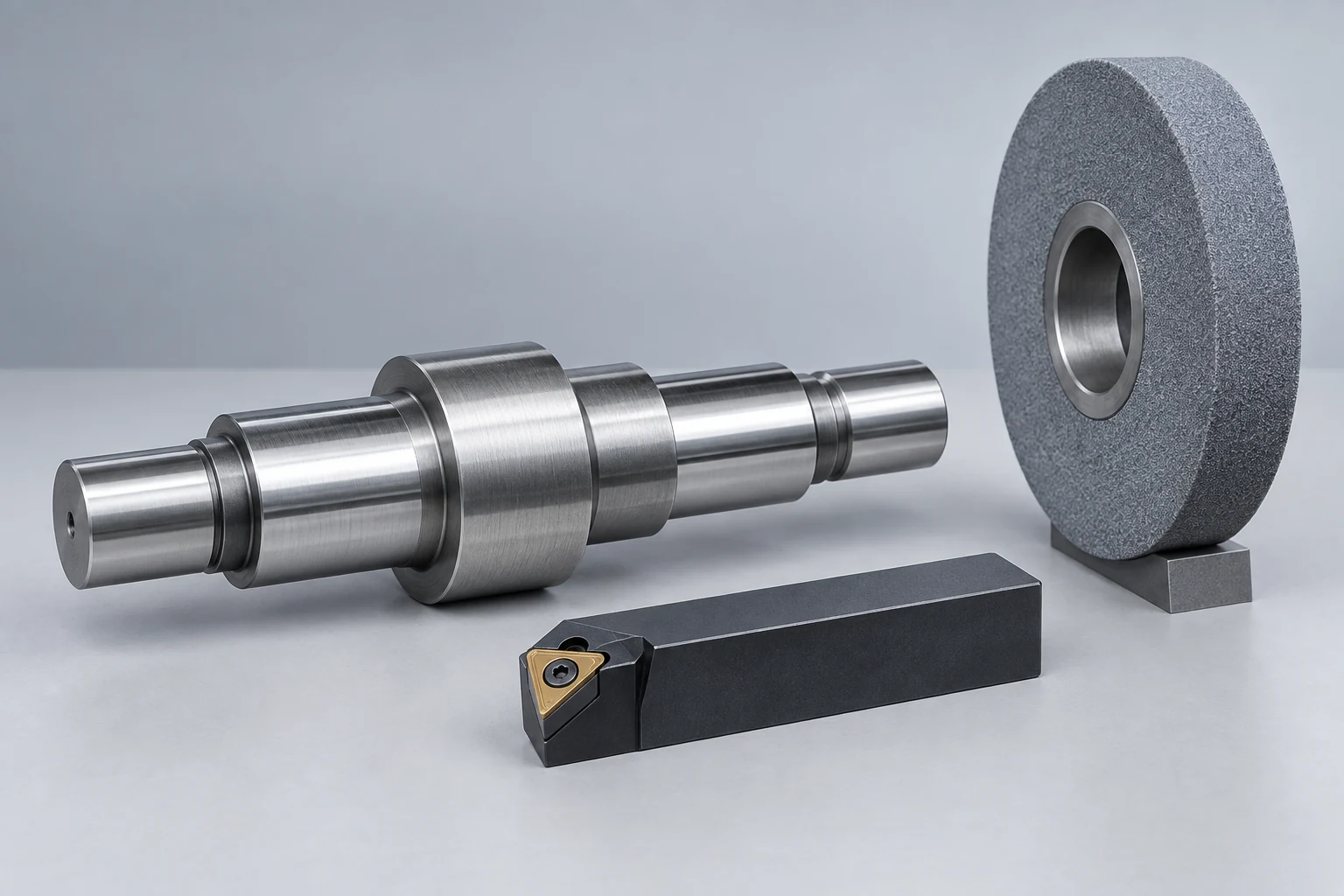
Hard turning uses a defined cutting edge to remove material from a rotating, hardened workpiece. Grinding removes material with abrasive grains in a wheel. “CNC” describes machine control; it does not make the two cutting mechanisms equivalent. The diameter, bore and face operations discussed in our CNC turning service are familiar feature families, but the hardened condition changes tooling and process demands. [1] [2]
Start with the same steel grade, actual heat-treatment condition, incoming shape and finished requirements. Comparing a through-hardened journal with a case-hardened one—or a short open diameter with a deep bore—does not isolate the process choice. Hardness alone cannot describe tool access, support or the working surface’s function.
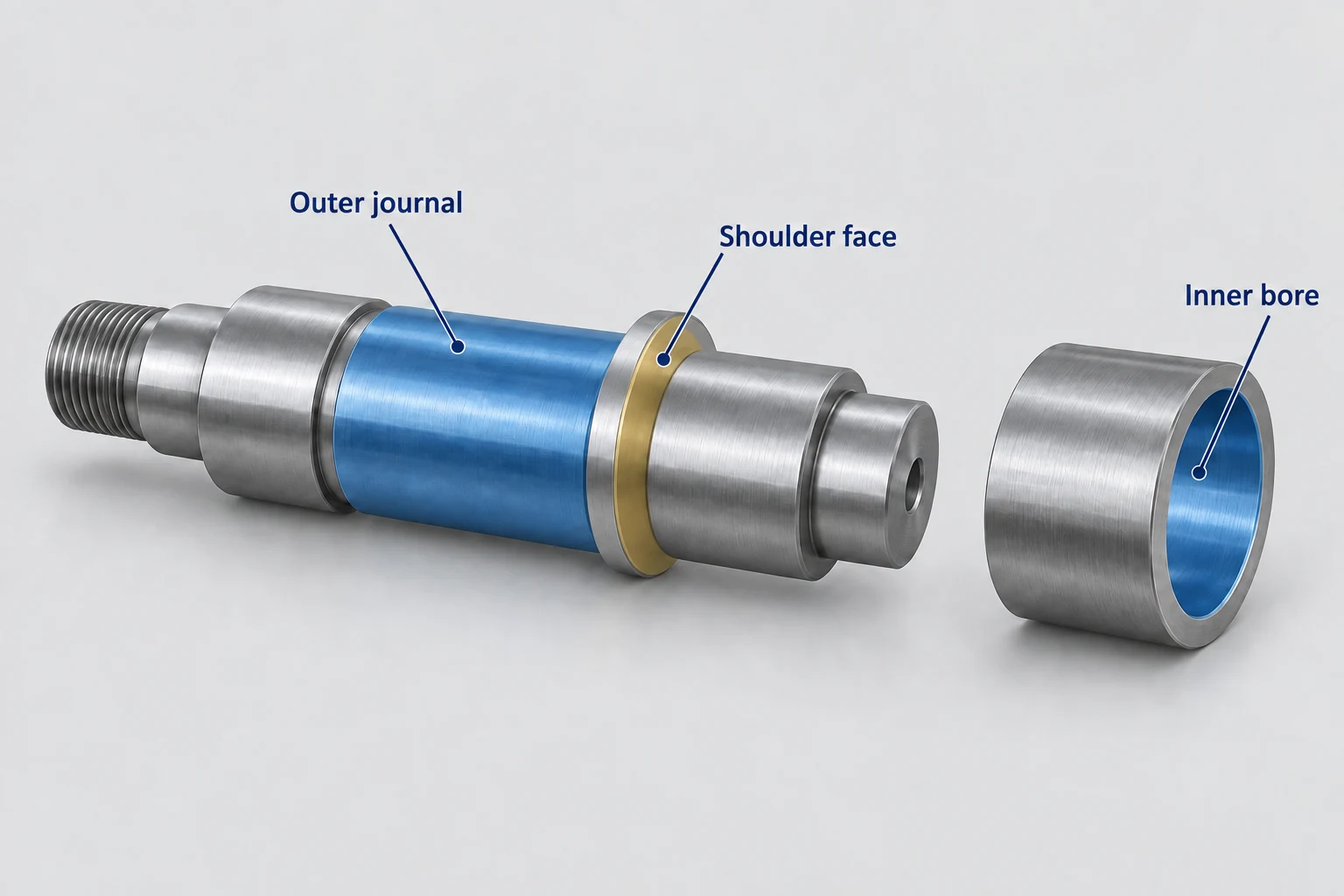
On a stepped shaft, the bearing seat, shoulder face and seal track may have different requirements. A route that finishes the seat successfully does not automatically qualify the seal track. Likewise, achieving the diameter does not establish roundness or runout relative to the required datum.
Check access and interrupted cuts
A turning insert can follow several accessible diameters and faces, but its holder needs clearance and its cutting edge needs support. Inside a bore, increasing bar overhang can make vibration harder to control. A grinding proposal has a different access problem: the wheel, spindle and approach must fit the bore or clear the adjacent shoulder. Compare the complete tool assemblies, not only the cutting tip or wheel diameter. [2] [8]
A small turning edge does not mean unrestricted access. A shoulder can obstruct the holder before the insert reaches the required surface. Conversely, a wheel suited to grinding the journal can still need end clearance near a shoulder. The neighboring geometry can therefore change which route is practical, even when the finished diameter stays the same.
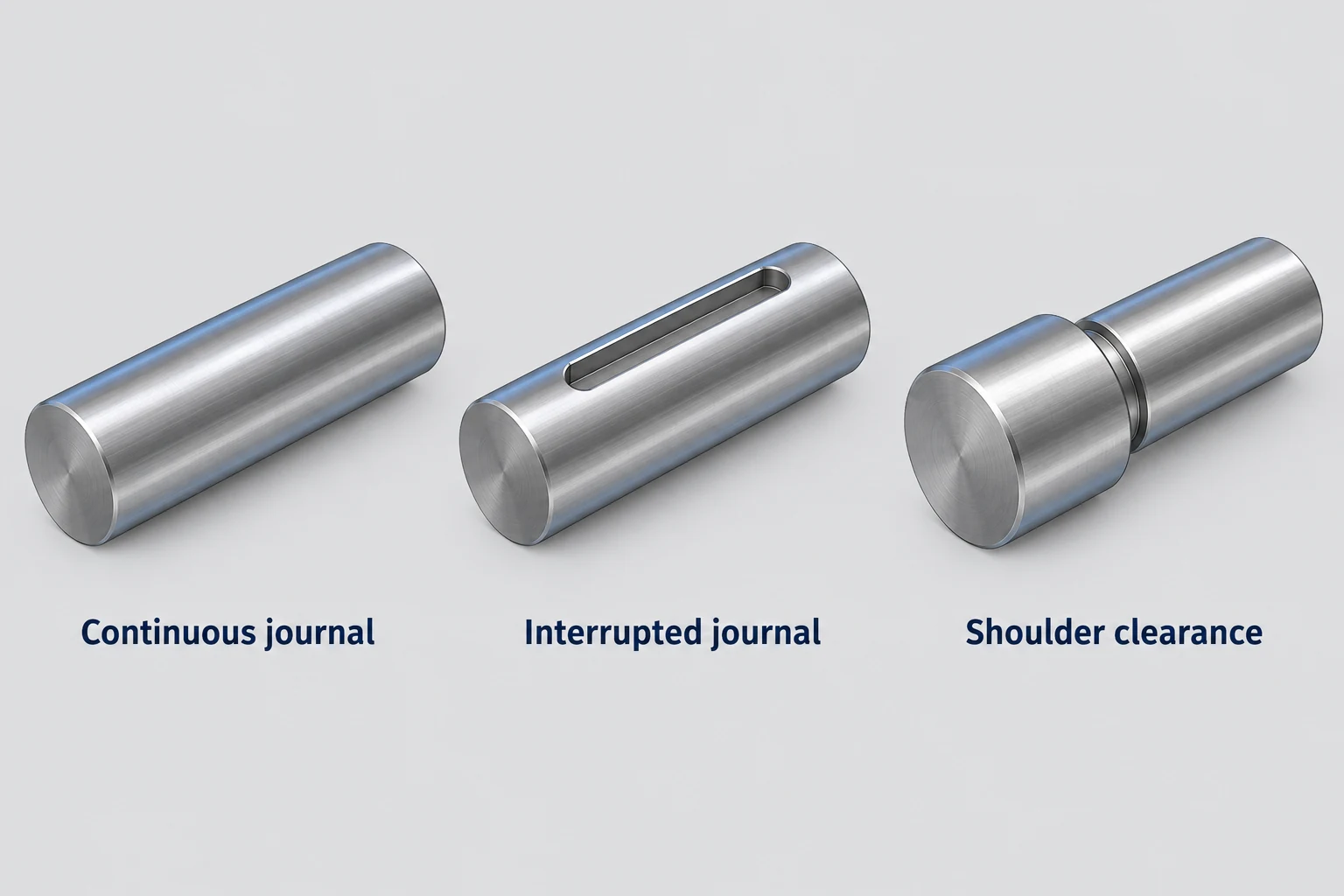
A keyway crossing a journal interrupts the turning cut. The edge repeatedly leaves and re-enters the material, so a tool intended for continuous finishing is not automatically suitable. Sandvik’s hard-turning guide distinguishes continuous, lightly interrupted and heavily interrupted applications through different grades and edge conditions. An interruption therefore calls for tool and process selection; it does not categorically rule out hard turning. [1]
| Surface or condition | Hard-turning consideration | Grinding consideration |
|---|---|---|
| Open journal and adjacent shoulder | Insert path and holder clearance may permit connected finishing. | Wheel profile and approach must reach each specified surface. |
| Deep or restricted bore | Boring-bar reach and stiffness can limit a stable cut. | Wheel and spindle access can limit the available arrangement. |
| Journal crossed by a keyway | Repeated entry requires an appropriate grade and cutting edge. | A grinding proposal still needs to address the interrupted geometry. |
| Radial shaft-seal track | Feed-related directionality needs evaluation beyond roughness. | Plunge grinding is recommended in SKF’s cited seal guidance; suitability remains application-specific. |
| Surface with integrity requirements | Cutting conditions and tool wear can change the near-surface material. | Wheel condition and grinding heat can change the near-surface material. |
The table compares candidates, rather than assigning a process from the feature name. Our precision grinding service separates external, internal and surface grinding because those operations have different access and holding requirements. A broad flat plate is outside this article’s comparison of rotational working surfaces.
Compare texture and surface integrity
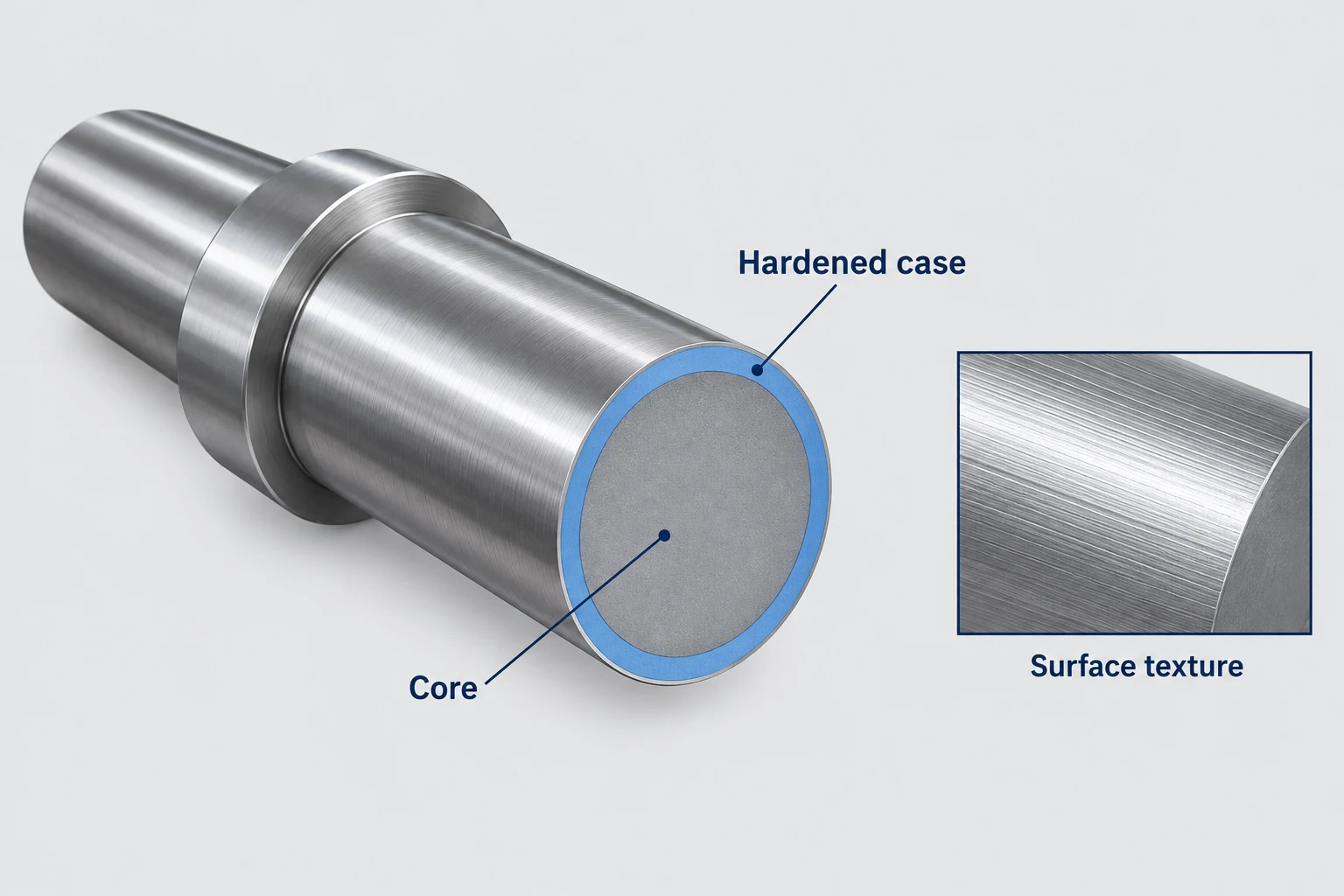
Two surfaces can meet the same Ra limit without having equivalent texture. Ra summarizes profile-height deviations under defined measurement and evaluation conditions. It does not fully describe texture direction, isolated defects or the material beneath the surface. [4]
A radial shaft-seal track illustrates why this matters. SKF’s industrial shaft-seal guidance warns that directional surface features can cause leakage, depending on shaft rotation, and recommends plunge grinding for the shaft counterface. That recommendation concerns the seal interface described in the guide, not every hardened journal. A hard-turning alternative has to address the interface’s lead and texture requirements; matching Ra alone does not settle it. Nor should “ground” be assumed to prove that lead is absent. [6]
Both processes can also change near-surface material. Norton explains how dull abrasive grains, friction, dressing and coolant delivery affect grinding heat and thermal damage. Research on hard-turned AISI 52100 steel shows that tool wear and cutting conditions influence residual stress and altered surface layers. Those results are condition-dependent and do not establish one acceptance rule for all steels. [3] [5]
For a surface with specified integrity requirements, dimensional and roughness results need the relevant material evaluation alongside them. A bright finish cannot resolve that question.
Compare the complete accepted route
Both routes remove stock. On a case-hardened component, that removal must leave the specified case and hardness at the final working surface. Bodycote’s case-hardening guidance connects grinding allowance with the case-depth specification. The same material-removal constraint matters when hard turning is proposed: an earlier heat-treatment record does not, by itself, establish the remaining case after finishing. [7]
Sometimes the useful proposal combines the processes. Hard turning can establish accessible rotational features while leaving stock for grinding a designated working land. This is a route to evaluate, not an automatic saving: the additional setup, datum transfer and final removal still have to make sense. If a drawing or qualified process specifically requires grinding, a substitute needs the responsible approval.
Compare proposals through the finished result. Include setup, inserts or wheel preparation, machining, any additional finishing and the required inspection. A shorter cutting cycle means little if another operation is still needed to achieve the accepted surface. The CNC machining RFQ guide explains how to keep that final condition and reporting scope consistent between quotations.
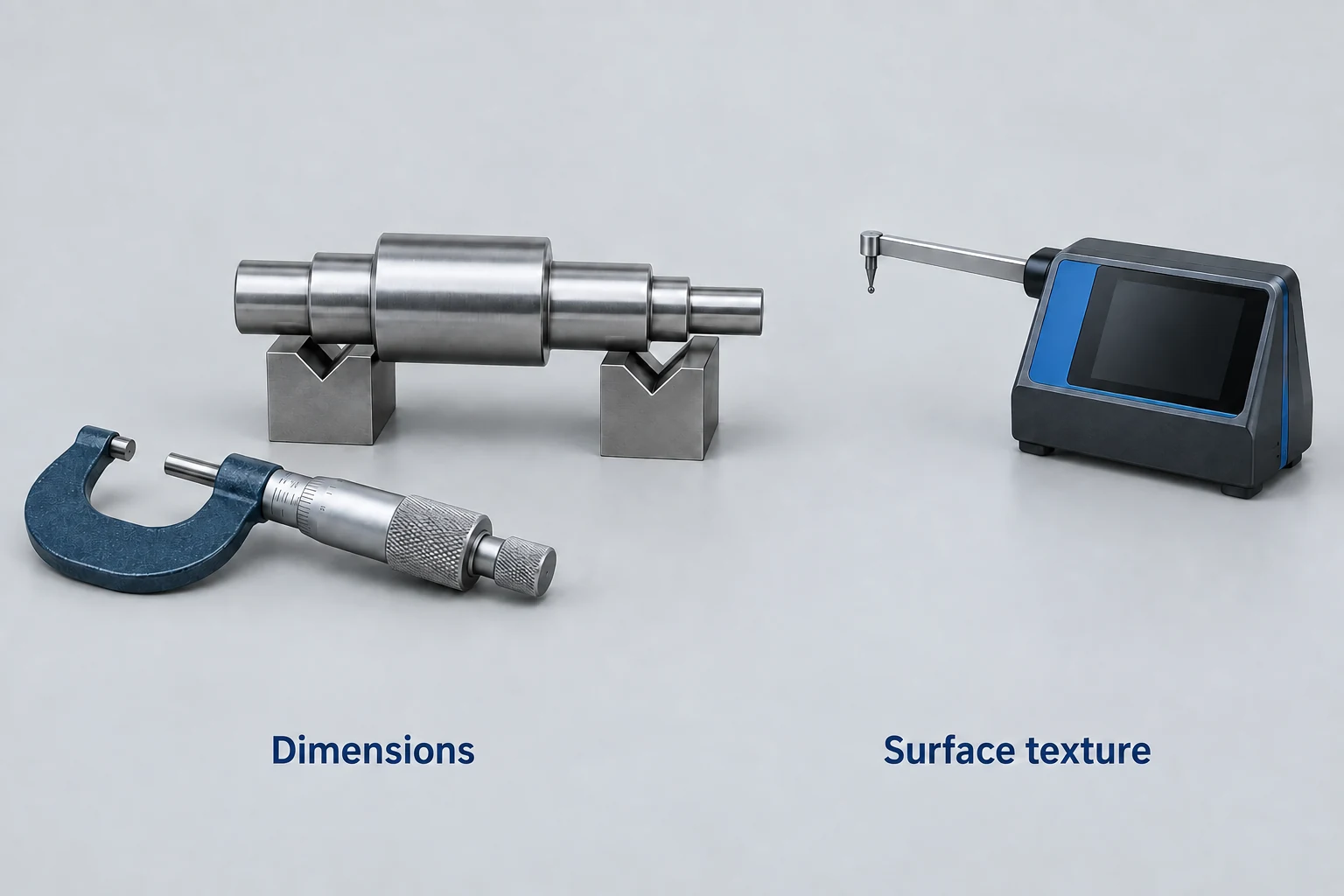
For the candidate route, verify the specified size, geometry and texture separately, with material-integrity or case checks where required. This connects the process comparison to the surface that will actually work in the assembly.
Grinding and hard turning FAQ
Can hard turning replace every grinding operation?
No. Hard turning is a candidate for suitable rotational surfaces with adequate tool access and support. The required texture, geometry, material condition or mandated process can retain a need for grinding. Flat surface-grinding tasks also cannot be treated as the same comparison.
Does a keyway rule out hard turning?
No. A keyway creates an interrupted cut, which changes the demands on the cutting edge. Appropriate grades and edge conditions exist for different interruption levels, but a continuous-cut tool is not automatically suitable. [1]
Can hard turning and grinding be used on the same surface?
They can form a sequence when hard turning leaves suitable stock for final grinding. The final operation must still meet the surface requirements, and the total removal must preserve any required case. Compare the complete route, including its additional setup.
Does a good Ra result prove that the hardened surface is sound?
No. Ra describes a measured texture characteristic. It does not establish form, absence of thermal damage, residual-stress condition or remaining case depth. Check separately specified material requirements with the appropriate method.
Technical sources
- Sandvik Coromant. Hard part turning with new-generation CBN grades, C-1040:225 en-US, 2018, pp. 2–3. Tool grades and edge conditions for continuous and interrupted hard turning.
- ISCAR. Machining with ISCAR — PCBN, PCD, Ceramic Inserts, “Grinding Vs. Hard Turning” and “Machine, Workpiece and Tool Holder Rigidity and Stability.” Process geometry and setup stability; catalog performance ranges are not adopted here.
- Arianna Smith, Norton Abrasives. Tips for Improved Surface Grinding. Abrasive condition, dressing, cooling and thermal damage; operating parameters are not transferred to cylindrical grinding.
- T. V. Vorburger, NIST. Introduction to Surface Finish Metrology, 2010, sections 1–2. Surface-profile parameters and evaluation conditions.
- Hosseini et al. Characterization of the Surface Integrity induced by Hard Turning of Bainitic and Martensitic AISI 52100 Steel, Procedia CIRP 1, 2012, pp. 494–499. Tool wear, residual stress and altered layers in the stated experimental conditions.
- SKF. Industrial shaft seals, “Surface finish,” p. 81. Directionality and shaft-counterface preparation for the described radial shaft-seal application.
- Bodycote. Case Hardening via Carburizing and Carbonitriding, FS-CH/2014, p. 2. Case-depth specification, grinding allowance and effects of excessive removal.
- Sandvik Coromant. Turning Handbook—General turning · Parting and grooving · Threading, “Internal turning,” p. 48. Boring-bar overhang, stability and vibration.