On this page
Sourcing CNC machined parts from China can give a US buyer a useful production option when a qualified supplier offers the required machining, outside processing and batch capacity at a competitive delivered cost. The advantage depends on the specific supplier and order. A low factory quote is valuable only if the parts, records and delivery meet the requirement after freight, import charges and buyer coordination are included.
For a first order, establish the seller’s identity, approve the manufacturing definition, qualify the intended production route and assign the cross-border responsibilities before releasing the full quantity. These checks turn an attractive quotation into an order that both organizations can execute.
When the China sourcing route fits the job
A supplier that coordinates machining, finishing and inspection can reduce the number of separate vendors the buyer manages. A repeat order may also benefit from fixtures and process knowledge developed during qualification. Both advantages require evidence: identify the actual operations included, where they happen and whether the proposed capacity is available for the order.
Prototype sourcing has a different test. A machined prototype can help evaluate fit, assembly or a selected material before committing to production. Using the prospective production supplier may expose manufacturing questions early and preserve useful learning for the next batch. That benefit is smaller when the design changes daily and each revision requires another shipment to the US.
Consider a housing whose mounting interfaces are released but whose external shape is still changing. Ordering several cosmetic variants overseas may create transport and approval work without advancing the critical test. Ordering the released interface geometry for an assembly trial has a clearer purpose. Define what the prototype must prove, which changes remain likely and when the physical part must reach the test team.
Compare this route with a feasible local or existing source using the same definition and arrival requirement. Country of manufacture alone does not establish price, quality or responsiveness. The CNC cost and supplier-selection guide covers the common manufacturing scope; the additional work here concerns the international handoffs.
Identify the seller and the manufacturing sites
For a mainland Chinese contracting entity, request its full registered Chinese name, Unified Social Credit Code and business license. Use the name or code to locate its record in China’s National Enterprise Credit Information Publicity System. Compare the registration details with the quotation and proposed order. SAMR provides the official registry; APEC’s registry guide explains its search fields. [1] If the seller is registered in another jurisdiction, verify it through that jurisdiction’s registry and establish its relationship to the manufacturing site.
Keep three identities separate: the company selling the parts, the site machining them and any external processor. A registered address does not by itself establish the location or suitability of the production equipment. A trading company can coordinate a valid supply route, while a factory can subcontract important operations. The useful distinction is whether the responsibilities and actual route are visible.
Ask which entity issues the invoice and receives payment. If those differ from the seller, obtain a documented explanation and verify the arrangement through an established contact before payment. Treat a later bank-account change as a new verification task. Registration research is one input to due diligence; it does not demonstrate machining capability or guarantee performance. Trade.gov recommends combining online research with appropriate background checks on potential partners. [2]
For the manufacturing review, connect the proposed machines, fixtures and inspection methods to your part. A live discussion or site assessment should resolve specific questions, such as where a critical bore will be finished or who measures it after treatment. Record the outside finishing site and who transfers its requirements. If a particular site or processor matters to qualification, make changes subject to the agreed approval process.
Before sharing sensitive technical files, have the responsible team address permitted recipients, confidentiality and any applicable transfer restrictions. An NDA does not answer every technical-data or export-control question.

Approve one drawing and material definition
Send the model and drawing as one controlled release. Identify the governing revision, units, referenced standards and the rule for resolving a model–drawing conflict. The supplier should return its questions and proposed exceptions against that release, rather than silently editing the manufacturing definition. The CNC machining RFQ checklist provides the underlying file and quotation requirements.
Cross-language communication needs particular care around tolerances, material conditions and prohibitions. Preserve standard designations and technical symbols. If a translated note or bilingual clarification is needed, retain the original requirement beside it and have the responsible engineer approve the meaning. A message saying “OK” is weak evidence when it is unclear which attachment or question it accepts.
A proposed Chinese material designation is a substitution request, not an established equivalent. Compare the applicable product specifications, grade, supply condition, product form and required properties. Similar chemistry alone does not establish that all requirements match. For an aluminum part, “6061” without the required temper and stock specification leaves material selection incomplete.
Resolve alternatives before stock is purchased. Keep the design authority’s approval with the order, and identify which material certificate and lot records must accompany delivery. The material certificates and traceability guide explains the connection from incoming stock to finished parts. A dimensionally acceptable sample does not approve an undocumented material change.

Use the prototype to prepare the production order
Agree the prototype’s test purpose before ordering it. A fit-check sample, a treated functional component and a production-representative sample answer different questions. State which requirements apply to the sample and which proposed deviations are limited to that trial; otherwise an economical prototype shortcut can become an unintended production assumption.
Move from the sample to a repeat order in a controlled sequence:
- Review the sample against its assigned purpose. Record the revision, material, treatment and measured characteristics, together with the buyer’s test result.
- Identify production differences. Discuss new fixtures, multiple workholding positions, material lots, outside processing and inspection arrangements before the larger run.
- Trial the important differences. Agree a pilot quantity and checks that expose the relevant variation. The quantity follows the process and risk; there is no universal qualifying batch size.
- Release a defined next quantity. Close unresolved deviations and state whether approval authorizes further machining, shipment or both.
The prototype-to-pilot-batch guide develops the process checks. For an overseas order, add the communication and transport time between these decisions. If physical approval is required in the US, the supplier’s machining completion date cannot also be the production-release date.
Do not buy the entire forecast merely to secure a lower unit price before the sample has answered its question. Separate the initial commitment from later releases and identify any material or tooling commitments that must be made earlier. That preserves the intended test without leaving the supplier to guess the buyer’s production authorization.

Name the delivery point and customs responsibilities
Write the chosen Incoterms rule, precise named place and version into the order. These rules allocate delivery, risk and specified costs; they do not settle payment timing, ownership transfer or remedies for defective parts. Those terms need their own agreement. [3]
For common multimodal arrangements, compare the responsibilities explicitly:
| Incoterms 2020 basis | Main carriage | Export clearance | Import clearance and duties |
|---|---|---|---|
| FCA, named delivery point | Buyer arranges from that point | Seller | Buyer |
| DAP, named destination | Seller arranges to destination | Seller | Buyer |
| DDP, named destination | Seller arranges to destination | Seller | Seller |
Under FCA at the seller’s premises, delivery occurs when the seller loads the buyer’s collecting vehicle. DAP and DDP delivery occurs at the named destination with the goods ready for unloading. These points matter when assigning transport risk. The complete ICC rules govern the arrangement, including exceptions and assistance duties. [4]
Identify the actual importer of record and customs broker, including for a DDP offer. “Door to door” alone does not specify that arrangement. CBP states that using a broker does not remove the importer of record’s responsibility for entry accuracy and applicable duties, taxes and fees. [5] Confirm that the proposed parties can perform their assigned roles before dispatch.

Build landed cost from the actual part and shipment
There is no single US tariff rate for “CNC parts from China.” Classification depends on the merchandise, and the applicable treatment also requires its origin and relevant entry date. Give the broker a useful product description, material composition, intended use, manufacturing information and commercial terms. A vague invoice description such as “metal accessory” leaves important classification facts unresolved.
Have the broker evaluate the current HTS provisions and any applicable additional duties, exclusions or other entry requirements. Keep the classification and assumptions with the estimate, then refresh them for shipment. USITC maintains the HTS and explains the distinction between the tariff schedule and CBP’s classification role. [6] A past shipment’s percentage or a supplier’s generic tariff estimate is not a reliable substitute for this review.
Build the comparison from the manufacturing price plus charges not already included: origin handling, international freight, any insurance, customs brokerage, applicable duties and fees, destination handling and delivery. Then add the buyer’s expected receiving and qualification work. This last layer is useful for the sourcing decision even though it is separate from the customs entry calculation.
Keep currency, quotation validity, packed weight and dimensions attached to the estimate. Check the planned transport mode against the required arrival date. If approval delays force a more expensive shipment, recalculate the order total before deciding whether the original price advantage remains. Avoid counting freight or import charges twice when comparing a delivered offer with a factory-level quote.
Plan the arrival date and protect the shipment
Build the schedule backward from the date usable parts are needed. Include sample approval, production, outside processing, inspection release, freight booking, transit, customs clearance and receiving. Record which dates depend on buyer responses. Ask the actual supplier and processors about closures or reduced capacity around their operating calendar; a national holiday date alone does not establish their restart schedule.
Set a shared written decision log with one responsible contact on each side. Use part number, revision, question, agreed action and due date so a time-zone gap does not turn the next shift into another clarification cycle. Escalate issues that stop production separately from routine progress messages.
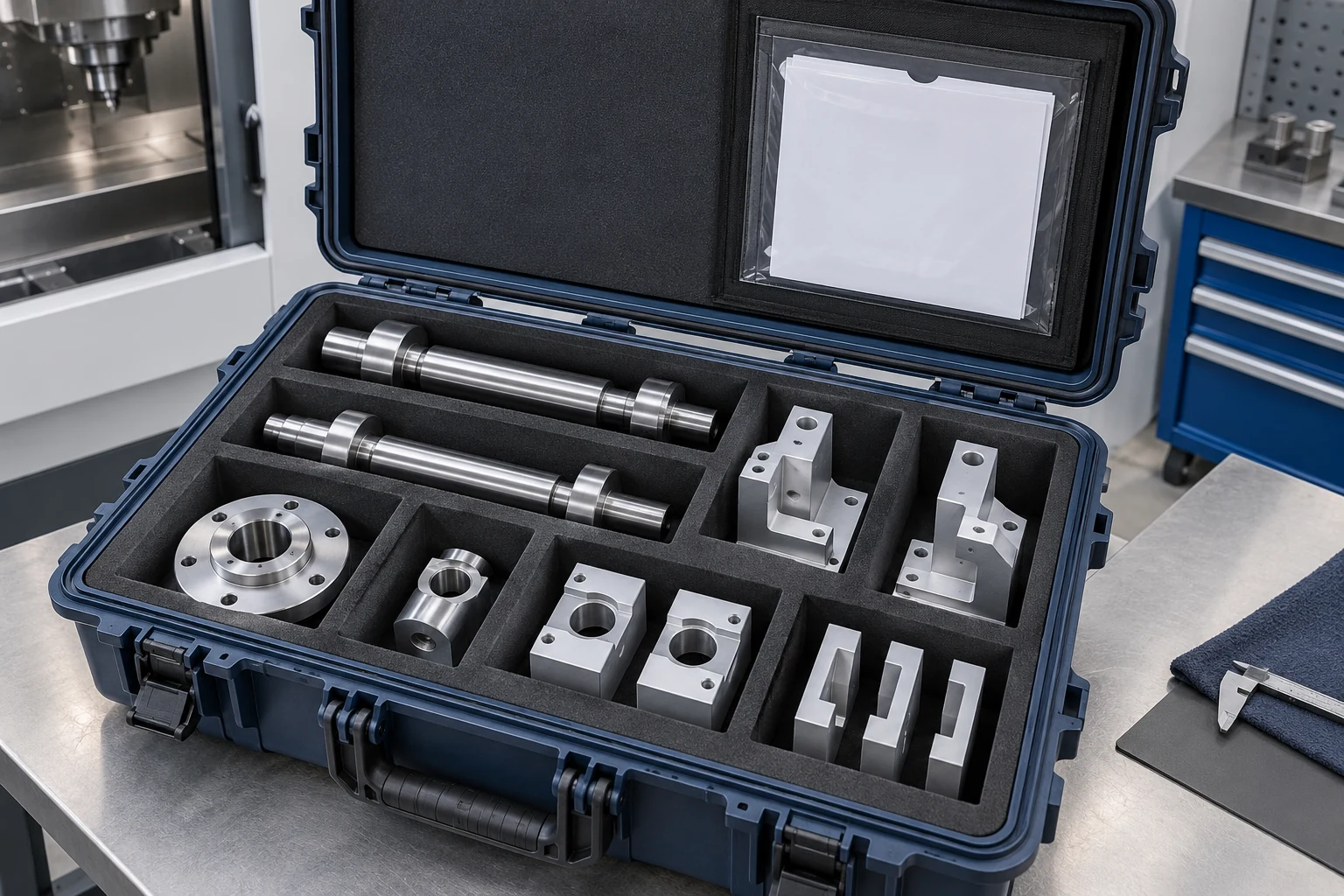
Packaging should protect the features that determine acceptance. Separate parts so machined faces cannot rub together, support vulnerable geometry and agree corrosion protection compatible with the material and subsequent use. Specify package-level part, revision, lot and quantity identification. Review the proposed pack before the first shipment, especially if packages will be split during receiving.
Keep commercial invoice, packing list, shipment identifiers and required quality records consistent. Photographs can document the packed condition and arrangement, while the agreed inspection records address the part requirements.
Control revisions and resolve nonconforming parts
A revision notice should identify the new files and ask for the state of work already committed: stock purchased, parts in machining, parts at outside processing and finished inventory. Agree the disposition of each affected group before restarting. The supplier’s acknowledgment should identify the revision accepted and any cost or schedule effect; an updated email attachment alone does not establish implementation.
For a failed requirement, preserve the lot identity and contain the affected population. Share the characteristic, specified limit, measured result, method and photographs where relevant. Separate a measurement disagreement from an agreed nonconformity. The CNC inspection-planning guide explains how the agreed checks and acceptance rules affect that discussion.
Decide who may authorize use as-is, rework, replacement or return. Include the records needed after rework and the allocation of freight and other recovery costs in the purchasing agreement. Overseas recovery can involve another shipment or local rework, so obtain approval before either party acts. A promise to credit the next order does not by itself supply usable parts for the current assembly.

Before releasing the first production order, the buyer should have a named seller and production route, one approved technical definition, an agreed qualification result, a dated delivered-cost estimate and assigned shipment responsibilities. Keep unresolved items attached to the affected quantity. The sourcing advantage becomes credible when that complete route works for the part, rather than when the initial quote looks attractive.
Technical sources
- State Administration for Market Regulation, National Enterprise Credit Information Publicity System; APEC, Compilation of Publicly Accessible Websites and Databases of the APEC Economies, April 2026, China legal-entity records, printed page 44. Registry identity and search fields.
- International Trade Administration, Perform Due Diligence. Online research and foreign-partner background checks.
- International Chamber of Commerce, Charles Debattista, Introduction to Incoterms 2020, sections I–IV. Scope, exclusions and named places.
- International Chamber of Commerce, Incoterms 2020: Article-by-Article Text of Rules, A2, A4/B4, A7/B7 and A9/B9. FCA, DAP and DDP delivery, carriage and clearance responsibilities.
- US Customs and Border Protection, Tips for New Importers and Exporters. Importer responsibility and information needed to assess merchandise.
- US International Trade Commission, Frequently Asked Questions about Tariff Classification, the Harmonized Tariff Schedule, Importing, and Exporting. Classification, tariff treatment and agency roles.