On this page
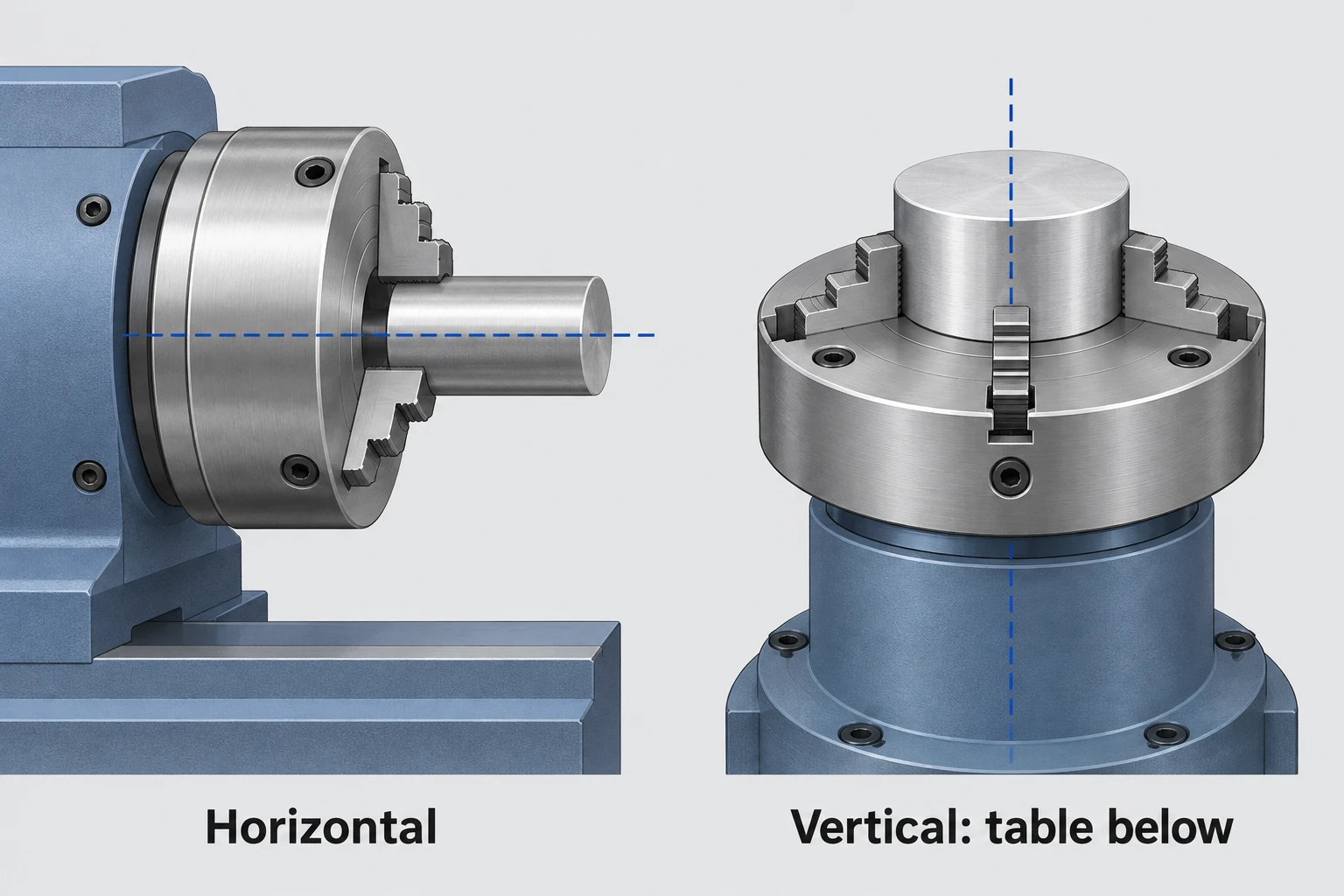
A horizontal lathe turns the workpiece about a horizontal spindle axis. A vertical lathe turns it about a vertical axis. The difference changes how the part is supported, loaded and presented to the tools; it does not establish which machine will make the more accurate part.
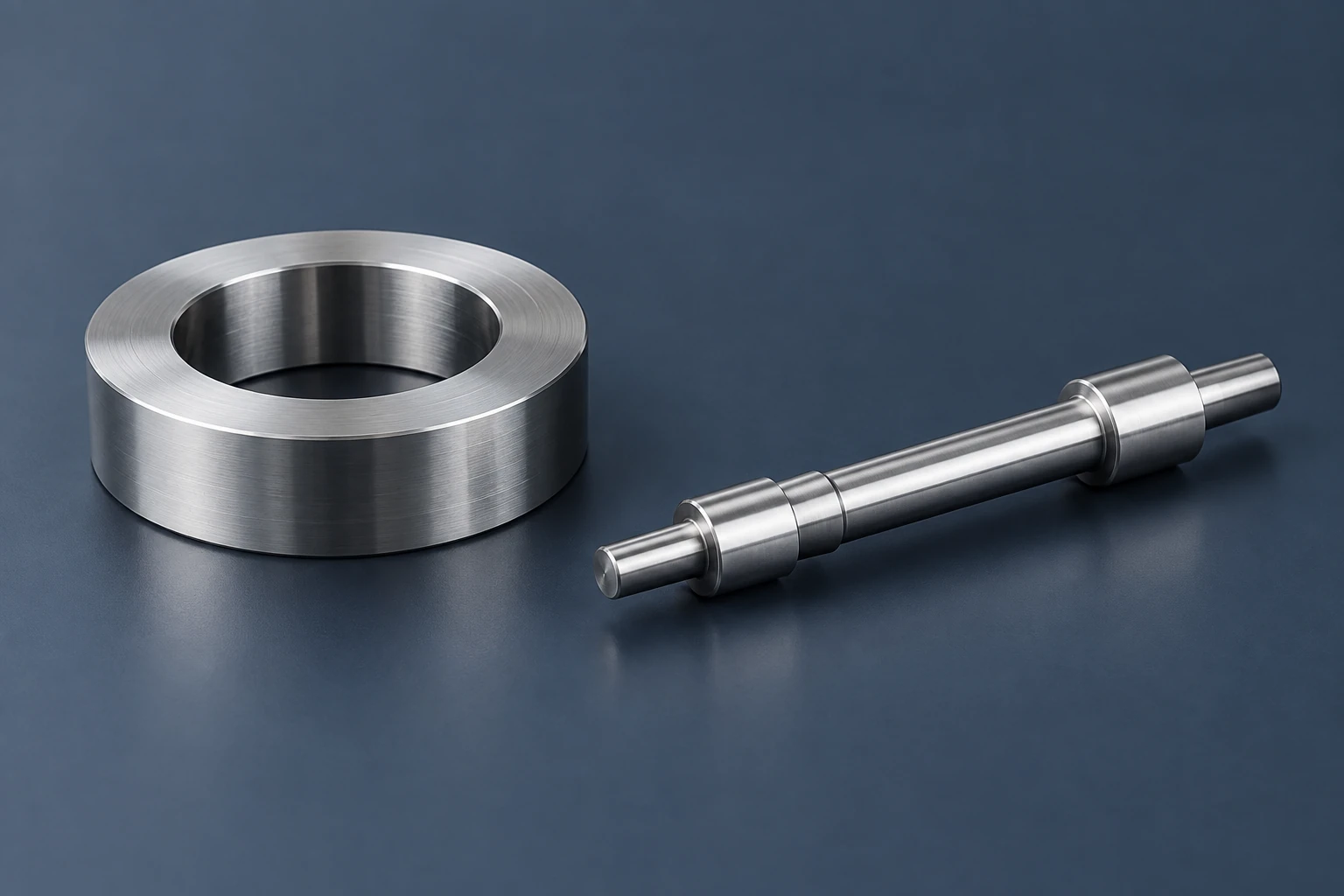
A broad ring and a long shaft raise different support questions. Start with their weight, proportions and accessible gripping surfaces, then compare workable machine configurations.
Follow the workpiece’s axis of rotation
In ordinary turning, the spindle rotates the workpiece while the tool feeds against it. Both orientations can turn diameters, face surfaces and bore holes with suitable tooling. The turning operations guide explains those cutting tasks; spindle orientation changes their physical arrangement.
Support and loading often decide the useful arrangement
On a conventional vertical turning lathe with its workholding below the part, a broad blank can sit on a horizontal supporting surface. Its weight helps seat it against that surface. Okuma’s VTM-series brochure describes this benefit for large-diameter bearings and flanges. The part still needs appropriate location and restraint against cutting and rotational loads; gravity does not replace clamping.
On a horizontal lathe, the chuck or collet holds the work at one end. A longer shaft may need a tailstock center or support along its length. Loading and aligning a heavy blank also need a practical handling arrangement. Conversely, bar feeding can be convenient for suitable repeated parts when the installed spindle, workholding and feeder support that route.
Length alone is not the deciding number. The section between the cutting point and its supports determines much of the flexibility. The explanation of slender-shaft deflection shows why an end support does not make every span rigid.
Vertical turning includes more than a table below the work
An inverted vertical spindle holds the workpiece from above. EMAG’s VSC arrangement, for example, places the work spindle overhead and the tools below. Its downward-facing work area gives chips a different escape path from an upward-facing recess. The actual geometry and chip-management system still determine what clears successfully.
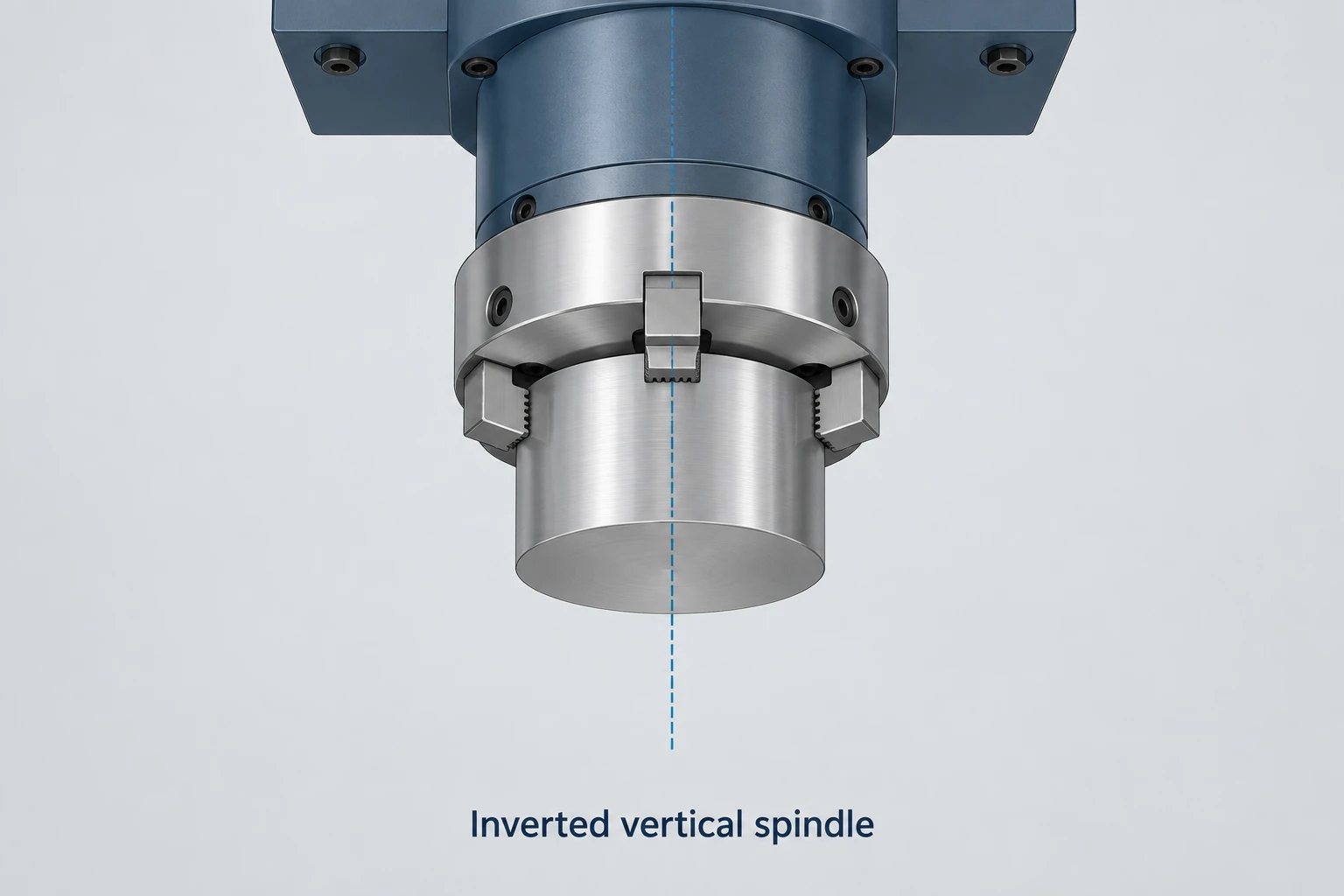
Some vertical pick-up machines also use the spindle to load parts from a transfer system. That automation feature belongs to the particular design. It is not implied by the word “vertical.”
Nor is vertical turning restricted to short discs. EMAG documents vertical shaft-turning machines with a working spindle, tailstock and tool turrets. Shaft support and access remain the relevant questions even when the shaft stands upright.
Compare the proposed setups against the same part
| Part or production need | Useful starting comparison | Check before choosing |
|---|---|---|
| Broad, heavy ring or flange | Lower-table vertical versus horizontal chucking | Seating surface, lifting access, mass and rotating envelope |
| Long shaft with slender sections | Supported horizontal versus purpose-built vertical shaft turning | Support locations, slender spans and tool access |
| Short parts in repeat production | Bar-fed or front-loaded horizontal versus vertical pick-up | Stock form, gripping length, loading and second-end work |
| Thin ring or sleeve | Workholding alternatives in either orientation | Clamping distortion and the specified inspection condition |
Neither orientation automatically exposes the gripped face or finishes both ends. Identify which surfaces each setup completes and how the part is located after transfer. Secondary holes or flats also require suitable driven tooling, axes or a separate operation.
A machine comparison should include the actual blank, fixture, tool access and handling route. Rated diameter, height and load are separate limits; passing one does not prove that the whole setup fits. Compare the complete route at the required quantity, including preparation and transfers.
For a CNC turning review, provide the finished drawing and any known blank dimensions or mass. Mark permitted gripping surfaces, functional bores and faces, and inspection requirements. Those details make the proposed orientation explainable in terms of the part.
Frequently asked questions
Is a vertical turning lathe the same as a vertical machining center?
No. In ordinary vertical turning, the workpiece supplies the cutting rotation. A vertical machining center rotates a milling cutter. Multitasking machines can combine operations, so check the installed functions as well as the name.
Does a slant bed make a lathe vertical?
No. Bed inclination and work-spindle orientation are different features. A slant-bed lathe can still have a horizontal workpiece spindle axis.
Is there a fixed diameter at which a part must move to vertical turning?
No. Machine ranges overlap, and diameter does not describe mass, length, gripping surfaces or required operations. Compare the complete proposed setup rather than applying a universal diameter cutoff.
Technical sources
MIT OpenCourseWare, Lathe, description of workpiece rotation and tailstock support. Okuma, VTM Series: Large Vertical Multitasking Machines, April 2020, spindle arrangement and vertical-load discussion. EMAG, CNC Turning Machines, VL and VSC configurations; and Vertical Turning Center for Shafts: 4-axis Machining of Rotor Shafts, Transmission Shafts and more, March 16, 2021. Hurco, CNC Lathe Bed Design: True Slant vs Flatbed ‘Flying Wedge’ and Buying a CNC Lathe? Here’s What to Know and Consider.