On this page
A useful CNC turning cost estimate starts with the accepted part, not an advertised lathe hourly rate. For a turned component, price the bar that must be purchased, the complete machine cycle for every operation, any second-end work, batch setup, and the required deburring and inspection. Divide batch charges by the number of accepted parts. A short cutting-time calculation alone misses bar-feed loss, part-off, tool changes, handling, and the back face of the part.
The quickest way to improve a quote is to find out whether the drawing can be delivered directly after parting or requires another grip. That decision can change both the machine route and the number of pieces obtainable from each bar. This guide builds an estimate for one aluminum bushing, then shows how a different rear-face requirement changes the result. The same method applies to shafts, spacers, threaded sleeves, and other predominantly rotational parts, with their own operations substituted.
Define the delivered turned part before assigning cost
Start with the material grade and product form, maximum outside diameter, finished length, bore and thread features, quantity, and what must be true of each delivered part. A nominally identical bushing can have two different manufacturing routes if one print accepts a deburred cutoff face while the other requires a machined rear face and a more closely controlled overall length. The second requirement may call for a subspindle transfer or a separate re-chuck. It cannot be priced as an extra few seconds of front-side turning.
Also identify the features that control inspection. A bore may be a clearance hole, a bearing fit, or a datum for another feature. Each imposes a different machining and measurement plan. An external thread changes the tool sequence, while a cross-hole or flat may require live tooling or a separate mill. Those features belong in the route before machine time is estimated. The CNC turning service page explains the kinds of rotational features a turning route can address; this article deals with their cost consequences.
Keep production cost separate from a supplier’s selling price. The model below totals assumed material, machine occupancy, setup, and inspection charges. A commercial quote can also reflect overhead treatment, risk, profit, shipping, taxes, and payment terms. Do not add operator labor or tooling a second time if they are already included in the hourly rate used for a line.
Calculate bar consumption, cutoff loss, and purchasable yield
For a bar-fed part, the bar advance per part is not simply the finished length. It includes metal removed from the front face, the width consumed by the cutoff tool, and any additional material needed for subsequent back-face finishing. A 3 mm cutoff tool removes a strip of material each time; that strip is not part of the delivered length. Haas Automation’s Bar Feeder Operator’s Manual Supplement explicitly treats finished length, cutoff allowance, facing allowance, and minimum clamping length as separate setup inputs. The values vary with the chosen machine, workholding, bar, and operation.
For a uniform bar and a stable route, estimate the pitch per part as finished length + front-face stock + cutoff width + back-face stock, counting each allowance once. Then estimate full-bar yield as the integer part of (purchased bar length − unusable clamping tail − initial trim) ÷ pitch. The actual setup may leave additional unusable stock or require test pieces, so confirm the route before treating this as a guaranteed yield. A short offcut may be usable on another job; its value should be credited only when the quotation actually assumes reuse.
Bar diameter matters separately. If the maximum finished OD is 30 mm and available bar is 32 mm, the OD has machining stock. Moving to a larger purchased diameter adds material along the whole bar and usually more roughing. Yet the closest nominal bar is not automatically suitable: its tolerance, straightness, surface condition, grip, or cleanup requirement may force a larger starting diameter. This is why a quote should identify both the purchased bar specification and the finished OD, rather than quoting only the part’s final weight.
Stock form can change the route. Large or awkward parts may start from saw-cut blanks and be loaded individually instead of using a long bar feeder. In that case, calculate blank length, saw kerf and preparation, loading time, and chucking stock. Do not charge bar-feeder setup for a saw-cut route or assume a bar-fed route has no setup: its liner, collet, feed length, and part-off program still have to be prepared. Haas’s manual lists these bar-feed setup tasks and a workholding-dependent minimum clamping length.
Estimate the complete turning cycle, not one cutting pass
Build the cycle from the actual sequence: face the blank, rough and finish the OD, drill or bore the ID, machine grooves or threads if present, chamfer, part off, and load or advance the next blank. Add tool indexing, approaches, retracts, chuck or collet action, and any in-cycle checks. A part may have a very short engaged-cut time and still occupy the machine for minutes. Autodesk Fusion’s Machining Time display separates feed, rapid, and tool-change estimates; setup, manual handling, deburring, and outsourced finishing remain separate costs.
Sandvik Coromant gives engaged turning time as Tc = lm ÷ (fn × n), where machining length lm is in millimeters, feed per revolution fn is in millimeters per revolution, and spindle speed n is in revolutions per minute. For a single assumed 40 mm pass at 0.15 mm/rev and 1,500 rev/min, the engaged time is 40 ÷ (0.15 × 1,500) = 0.178 min, about 10.7 seconds. That number says nothing about drilling the bore, making another pass, parting, indexing tools, or moving the next piece into position. It should never be multiplied by an hourly rate and presented as the finished-part machine cost.
Cutoff itself is a real operation. The tool must travel from the outside diameter toward the center or, for a through-bore, to the bore. Tool width consumes stock; feed and stability affect time, burrs, and finish at the released end. Sandvik Coromant’s technical article on parting and grooving treats insert width, process stability, and cutoff-end quality as linked choices. Autodesk’s Turning Part strategy also distinguishes an edge-break option and finishing passes on the cutoff side. Thus “parted off” does not by itself define the back-face acceptance condition.
Apply the machine rate to machine occupancy time, not just time when the tool touches metal. If a separate second-end operation uses a different machine, give it its own cycle and applicable rate. Tooling wear and consumables may be included in that rate or priced separately; the estimator should say which. A faster programmed cut is only a cost improvement if it preserves tool life, dimensional acceptance, and the rest of the cycle.
Price the second end as a route choice
After part-off, the newly separated face may have a pip, burr, or finish that does not meet a functional face requirement. Deburring can remove a loose edge without making the face flat, square, or accurately located to the bore. If the back face seals, locates another component, or sets a controlled finished length, a finishing cut and measurement may be required. That can be done after transfer to a subspindle on suitable equipment, or by gripping the part again in a separate operation. Neither route should be assumed from the drawing alone.
A separate re-chuck adds programming or setup, workholding preparation, part handling, machine occupancy, and possibly inspection of the relation between features made in different grips. A subspindle can remove some handling and secondary setup, but its machine time and rate may differ. Compare the total accepted-part route at the target quantity; the mere presence of a subspindle is not a cost answer. The lathe versus turning-center guide covers machine configuration in more detail.
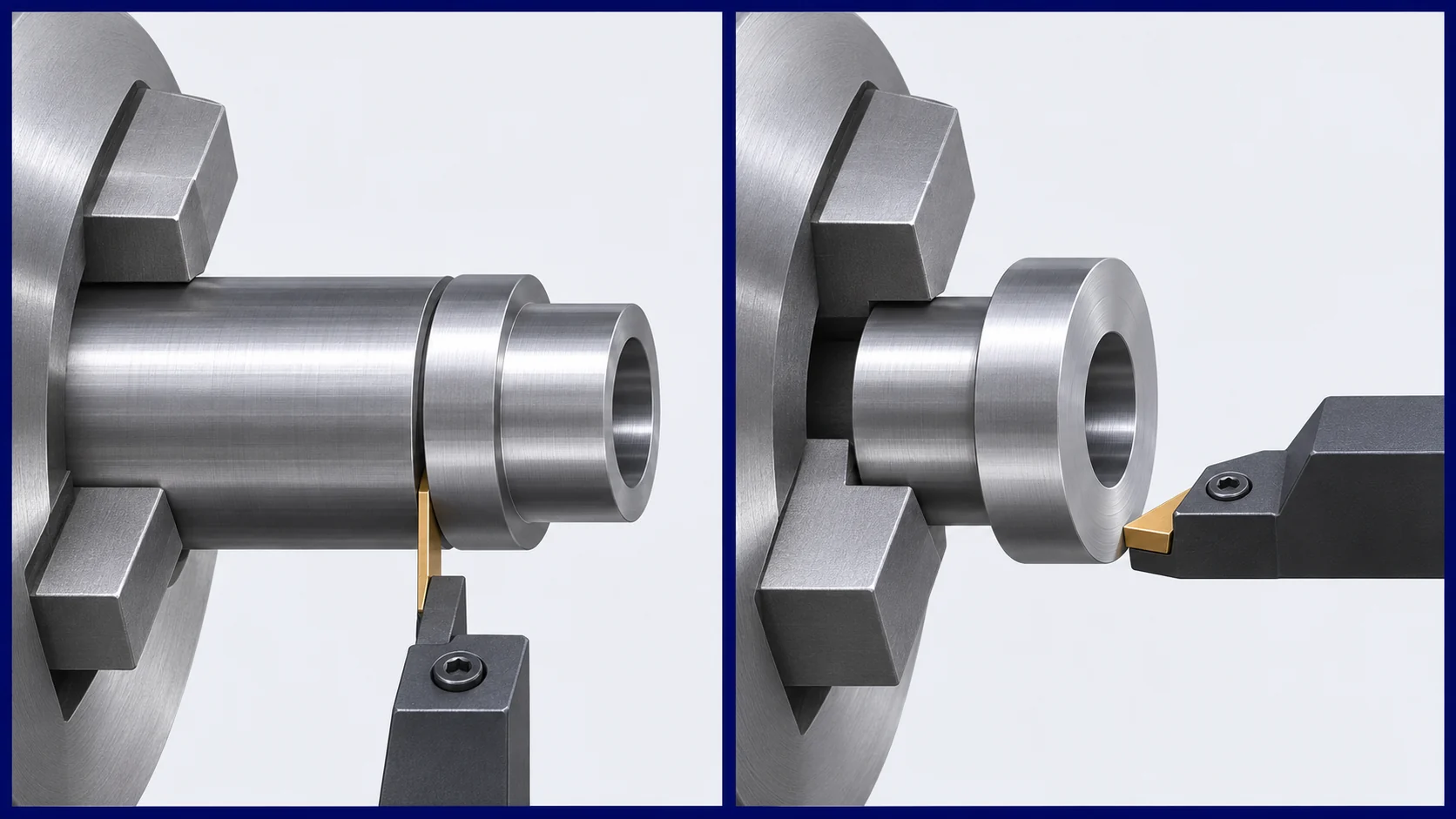
On the drawing, distinguish a nonfunctional edge break from a finished locating face. Put the tighter requirement on the face that performs the function, and identify its datum relationship. If the final rear face must be cut after separation, leave stock for it in the blank calculation. Omitting that stock can make the unit material estimate look attractive while leaving no material for the specified operation.
Worked turning estimate for a 64-piece bushing batch
Consider a stepped 6061-T6 aluminum bushing with a 30 mm maximum finished OD, a 10 mm through-bore, and a 40 mm nominal finished length. The smaller shoulder is included in the front-side cycle; its exact diameter is not needed for the stock-yield calculation. Assume a 32 mm diameter, 3,000 mm long purchased bar costs $48; the route requires a 100 mm unusable clamping tail and no additional initial trim. The front face takes 1 mm and a 3 mm cutoff tool parts each piece. Route A accepts the deburred cutoff face. Route B requires a separate back-face finishing operation and reserves another 1 mm for that cut. These dimensions, rates, and charges are calculation inputs, not a published VETCNC price or a universal machining allowance.
Route A uses 40 + 1 + 3 = 44 mm of bar pitch. With 2,900 mm available after the tail, its theoretical yield is floor(2,900 ÷ 44) = 65 pieces per bar. Route B uses 40 + 1 + 3 + 1 = 45 mm, for floor(2,900 ÷ 45) = 64 pieces per bar. A 64-piece accepted order fits on one bar by either route if setup trials are accepted and there is no rejection. Allocating the full $48 bar to that order gives $0.75 per accepted part. The one extra theoretical Route A position has no assigned credit here.
Assume the front-side machine occupies 3.6 min per part at $70/h, a $240 front-side batch setup, and $0.80 per part for edge finishing and basic inspection. For Route B, assume a separate $100 setup, 1.2 min per part on a second machine at $60/h, and $0.25 per part for additional face/length inspection. The front cycle includes facing, OD and bore machining, tool movement, part-off, and next-piece feed; it is not the 10.7-second single-cut calculation above.
| Cost component | Route A: accepted cutoff face | Route B: finished back face |
|---|---|---|
| Purchased bar, 64 accepted parts | $48 ÷ 64 = $0.75/part | $48 ÷ 64 = $0.75/part |
| Front-side machine occupancy | 3.6 min × $70/h = $4.20/part | $4.20/part |
| Front-side batch setup | $240 ÷ 64 = $3.75/part | $3.75/part |
| Edge finishing and basic inspection | $0.80/part | $0.80/part |
| Second-end setup | None | $100 ÷ 64 = $1.56/part |
| Second-end machine occupancy | None | 1.2 min × $60/h = $1.20/part |
| Additional rear-face inspection | None | $0.25/part |
| Estimated production cost | $9.50/part | $12.51/part |
The $3.01 difference at this quantity comes from a second setup, second machine cycle, and additional inspection, not a change in nominal OD or material grade. Because the complete bar is charged to the 64-piece order in both routes, the 1 mm rear-face stock does not change the material line at this quantity. If a supplier credits usable leftover stock, allocates a setup trial differently, uses a subspindle, or prices a different bar length, its result will change. The table is a way to make those differences visible when comparing an actual quote.
Check quantity thresholds before assuming a smooth unit-price curve
Batch setup per part falls with quantity: the assumed $240 front-side setup contributes $15.00 at 16 accepted parts, $3.75 at 64, and $1.88 at 128. The Route B second-end setup adds $6.25, $1.56, and $0.78 at those respective quantities. This is why a prototype can be expensive even when little metal is removed. It does not mean every other cost line stays fixed as the order changes.
Purchased bar is discrete. In the worked route, one 3,000 mm bar theoretically yields 65 Route A pieces but only 64 Route B pieces. At 65 accepted parts, Route A can still fit the order on one bar under the stated no-reject assumptions; Route B needs material from another bar. If the second bar’s remaining stock is reusable on a later order, charging its entire $48 to the sixty-fifth part would overstate this job’s material use. If it cannot be reused or credited, the purchase step matters. The quote should state how leftover material and setup rejects are treated rather than hiding them in a flat “scrap percentage.”
Tool wear, loading method, inspection sampling, and finishing minimums can also change at a quantity break. A larger order may justify a dedicated tool, fixture, or bar-feed arrangement; a very small order may be cheaper from cut blanks. These are route changes, not automatic quantity discounts. Ask for prices at the actual lot sizes needed, and compare each against the same print, inspection scope, and delivered quantity. The broader cost and supplier-selection guide covers terms outside the turning operation itself.
Reduce cost by changing a real requirement or route
The highest-value design question for the example is whether the rear face needs to locate or seal. If it does, keep the finish and datum requirement and compare a separate second operation with a suitable transfer route. If it is only an exposed end that must be safe to handle, specify the edge condition and acceptable length without adding a close face relationship that serves no function. Removing a necessary finish would save cost on paper and fail the assembly; relaxing an unnecessary one can remove a whole grip.
Next, check whether a standard bar diameter near the maximum finished OD will actually clean up and hold securely. A small OD reduction can sometimes move the part to a smaller bar, but only if the functional diameter and its tolerance allow it. For a large batch, changing bar size affects every piece and potentially bar-feeder hardware; for a small batch, setup and material availability may outweigh that gain. The aluminum machining-cost article covers material and finish choices across aluminum parts, while the calculation here is specifically for a turned bar route.
Finally, isolate the feature that causes another machine or grip. A radial hole, flat, cross-slot, or tightly related back face may be possible on an equipped turning center, or it may be more economical to move the part to another machine. Do not delete a functional feature to satisfy a generic “one setup” rule. Compare two process plans that both produce the same accepted part, including the relationship between machined features and the required inspection. Avoid asking for a live-tool route solely because it sounds advanced; it can carry a different rate and setup.
Compare CNC turning quotes on the same accepted-part basis
A useful RFQ supplies the revision-controlled drawing and, where available, a model, the target quantity and likely repeat quantities, grade and product-form requirement, finish, critical faces and datums, inspection records, and delivery condition. The CNC machining RFQ guide details the general document package. For a turned part, add the back-face condition and any requirement that affects whether parting is final or a second grip follows.
When two offers differ materially, resolve the route differences in this order:
- Confirm the same deliverable. Check the rear face, edge condition, bore/OD relationships, inspection and finish. A lower offer for a deburred cutoff face does not satisfy a print requiring a machined locating face.
- Ask what stock and yield were assumed. Compare bar diameter and grade, purchased length, cutoff and facing allowances, clamping remnant, and treatment of usable offcuts or rejected setup pieces.
- Compare complete operations. Identify the front cycle, second-end or off-axis operations, loading method, and any external processing. A short CAM cutting time is not the same as machine occupancy.
- Check fixed and per-part charges separately. Setup, fixture, programming, and first-article work should be identified once per batch unless the offer explicitly uses another arrangement. Determine whether tooling, deburring, inspection, packaging, and freight are included.
Those questions let a buyer explain a price gap without forcing two shops into the same machine configuration. They also show where a drawing change could help: bar diameter, part-off acceptance, or a separate operation. If the supplier cannot identify the route, its unit price is difficult to compare beyond the first order.
CNC turning cost questions
Can I estimate a turned part from the lathe hourly rate?
No. Apply the relevant rate to complete machine occupancy for each operation, then add stock allocation, batch setup, deburring, inspection, and any second-end or external work. A rate also needs a clear definition so labor, tooling, and overhead are not charged twice.
Is a part-off face always good enough as the finished back face?
No. A part-off face may need only an edge break, or it may need a finishing pass and measurement to meet a locating, sealing, surface, or length requirement. The drawing and chosen route decide which; parting alone is not a blanket acceptance standard.
Why is purchased bar cost higher than the weight of the finished part?
The purchased bar includes OD cleanup, bore chips, face stock, cutoff width, and a workholding tail. For a finite order, unused but potentially reusable bar must also be allocated or credited consistently. Final part weight omits those inputs.
Will doubling the quantity cut the turning unit price in half?
Usually not. Doubling quantity halves a fixed setup charge per part if the route and setup charge stay unchanged, but material, machine cycle, and per-part finishing remain. Additional bars, tool changes, inspection scope, or a different production route can make the total change less smooth.
Technical sources
- Sandvik Coromant, Formulas and definitions for turning — Metric. Defines engaged turning time, machined length, feed per revolution, and spindle speed used in the one-pass calculation.
- Haas Automation, Haas Bar Feeder Operator’s Manual Supplement, Revision P, June 2023. Documents bar-feed setup, workholding, minimum clamping length, and part-length/cutoff/facing inputs.
- Autodesk Fusion, Machining Time. Describes the CAM estimate’s feed, rapid, and tool-change components.
- Sandvik Coromant, Parting & Grooving: How to Achieve Greater Performance, Quality, and Tool Life in the 21st Century, technical article, May 2015. Covers cutoff insert width, process stability, and released-end quality considerations.
- Autodesk Fusion, Turning Part strategy. Explains part-off from bar, edge-break choices, and optional finishing passes on the cutoff side.