On this page
A five-axis machine can have a higher hourly rate and still produce a lower-cost part if it removes enough handling, setup changes or machining time. It can also add cost without a useful saving. The comparison depends on the complete route for the same finished part, at the quantity you actually intend to order.
To estimate five-axis CNC machining cost, separate batch preparation from recurring work, convert machine minutes into cost, and include the operations after the main milling cycle. The example below shows how the result changes with batch size and cycle time.
Compare feasible routes for the same part
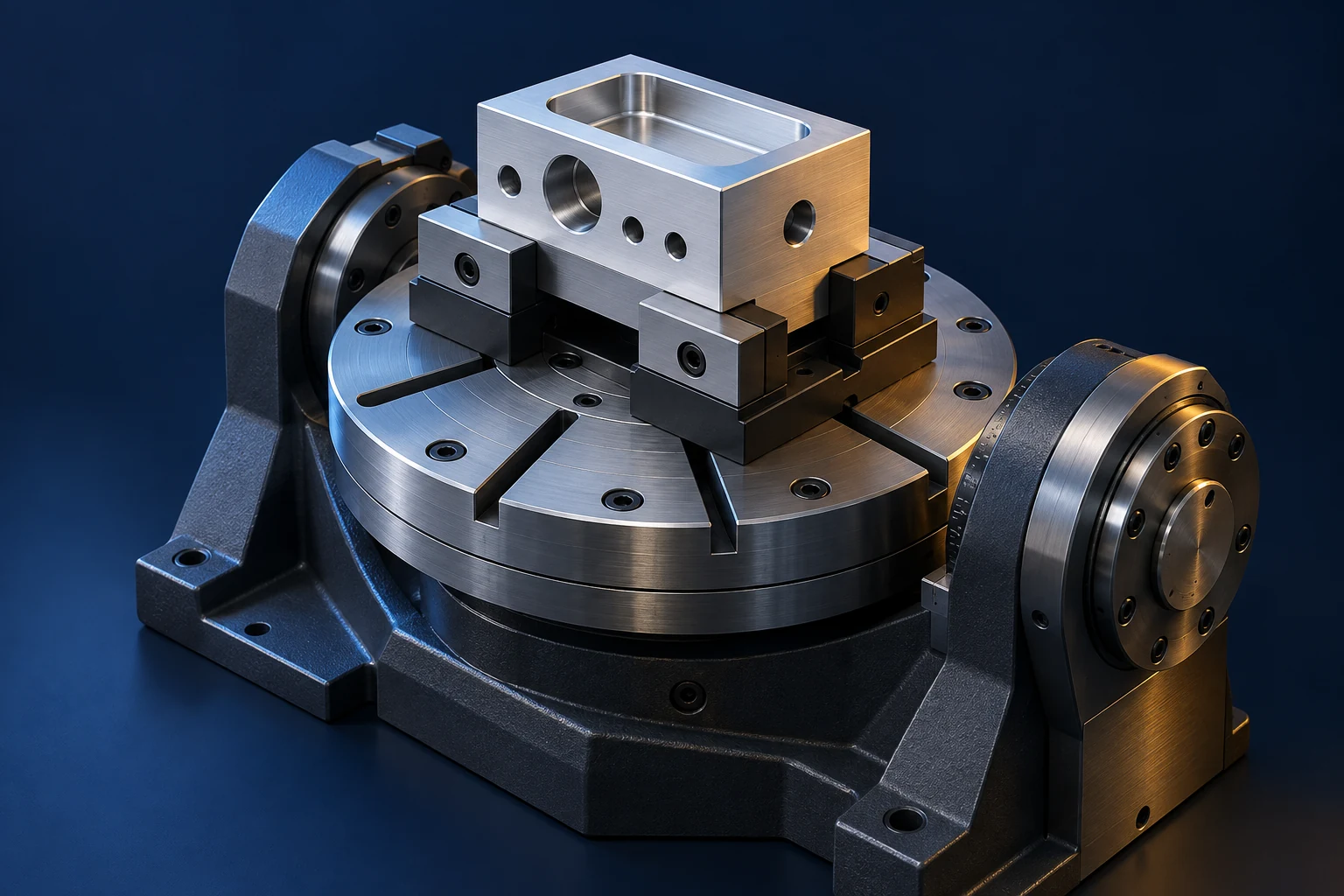
A block with holes and pockets on several faces may need repeated reclamping on a three-axis mill. Rotary positioning can present those faces while the block stays held. That can remove handling and the work of locating the part again. A simple plate machined from one accessible direction may gain little from the extra axes. [1]
Distinguish the machine from the cutting mode. Indexed 3+2 machining and simultaneous five-axis machining can serve different operations on one part. Fixed-angle holes may suit 3+2; a contour that benefits from changing tool direction may justify simultaneous motion. Ask which operations create the saving instead of specifying continuous five-axis cutting for the whole job. [2]
What belongs in a five-axis cost estimate?
Programming and verification are real preparation work: the planned motion must suit the machine, tools, stock and fixture. Workholding also needs enough clearance for indexing without sacrificing support. A short tool helps only if the complete assembly can reach the feature. [2] [3]
| Cost item | What to include | Five-axis question |
|---|---|---|
| Batch preparation | Programming, verification, fixture preparation and machine setup | What changes between the proposed routes? |
| Stock and tooling | Specified material and condition, holding allowance, tool use | Does the fixture need extra stock or a preparation cut? |
| Machine time | Cutting, indexing, tool changes and other included cycle movements | Is the estimate a complete cycle or cutting time alone? |
| Handling and later operations | Loading, deburring, reclamping and machining covered faces | How is the clamping face finished? |
| Acceptance and delivery | Required inspection, records, finishing, packing and delivery scope | Are both routes priced to the same delivered condition? |
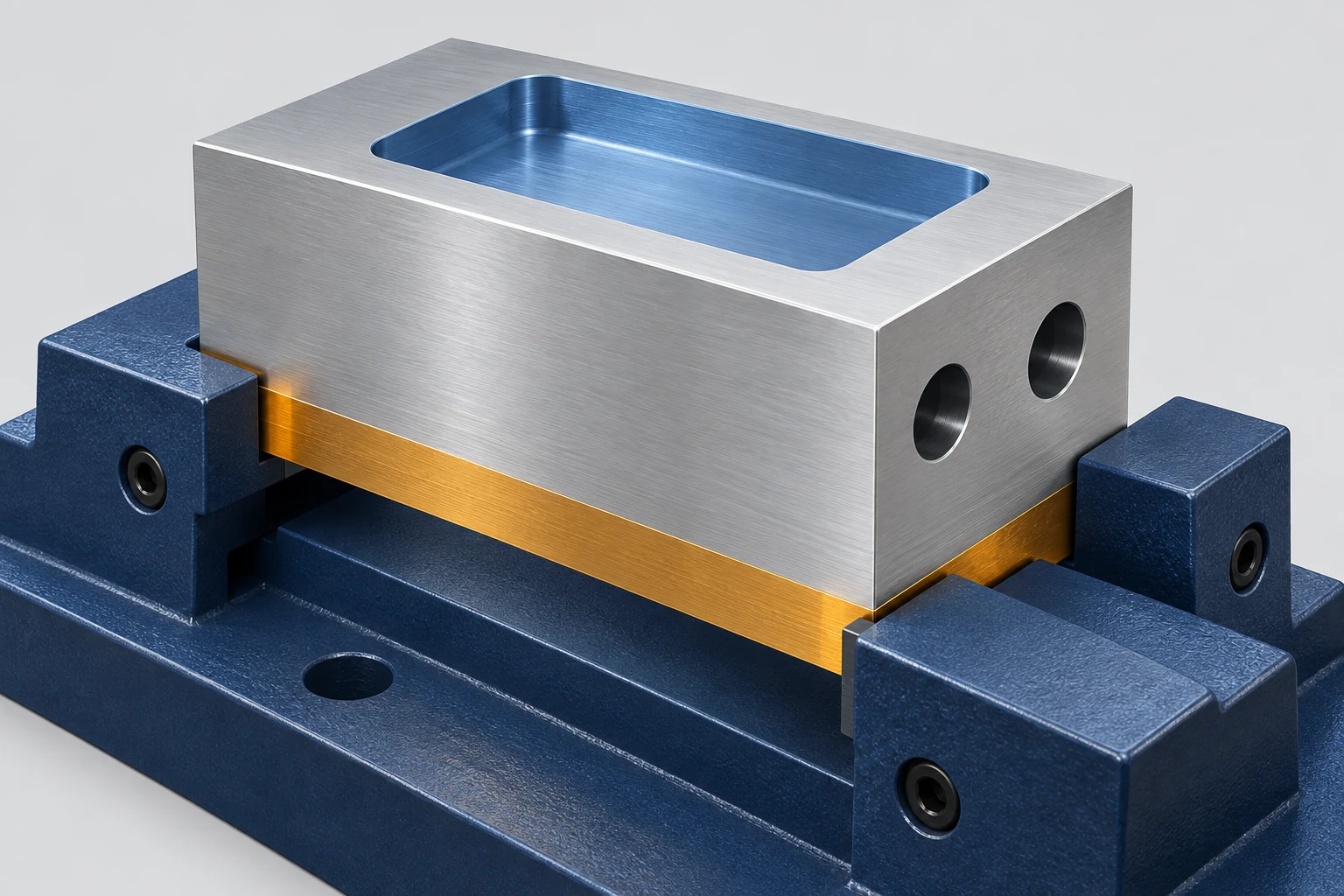
A holding feature can require work before and after the main cycle. NTMA’s workholding discussion, for example, describes preparing a dovetail in stock and removing it after the other faces are machined. Count those operations when that fixture strategy is used; “five sides in one setup” is not a complete-part cost statement. [1]
Build the estimate from fixed and recurring work
For one batch, a useful starting model is:
Estimated unit cost = F ÷ Q + R × t ÷ 60 + V
- F: preparation charged to this batch, in dollars.
- Q: accepted parts in the batch.
- R: the applicable machine-hour rate, in dollars per hour.
- t: included machine minutes per part.
- V: other recurring cost per part, in dollars.
For several machines or operations, add their individual R × t ÷ 60 amounts. Include a cost once: if the rate already covers operator time or tool use, do not add it again in V. Allocate separate batch minimum charges to F; keep clearly excluded freight or other charges visible outside the model.
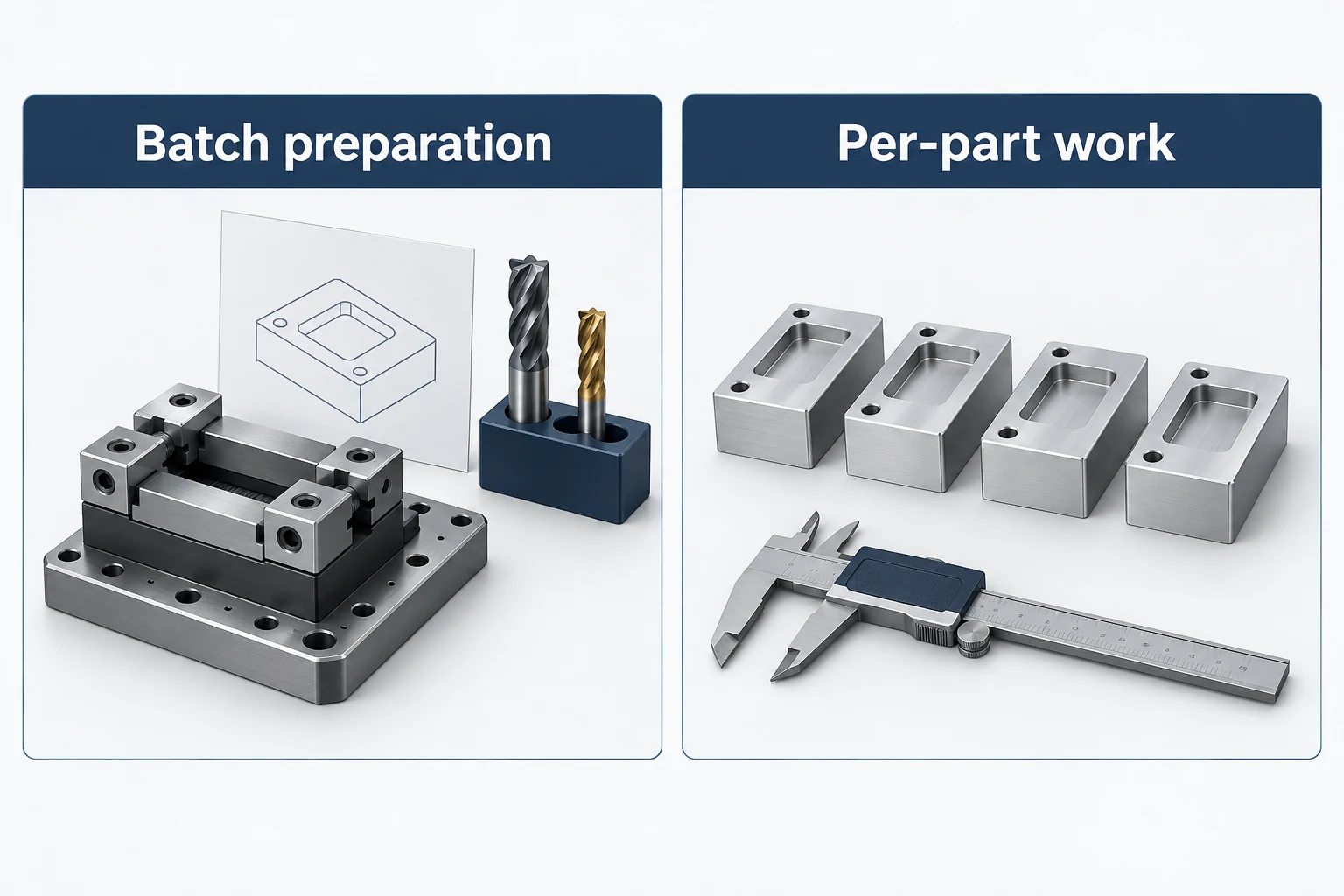
A worked comparison: when the higher rate pays off
Illustrative assumptions, in USD—not market rates or a VETCNC quotation. Both routes make the same accepted part. There is one production batch, no rejected parts or rework, and no change in requirements. The time figures include all machine operations in each route. Other recurring work is assumed equal; freight, taxes and separately applied commercial charges are excluded.
| Assumed input | 3-axis route | 5-axis route |
|---|---|---|
| Preparation F | $300 per batch | $500 per batch |
| Machine rate R | $90/hour | $150/hour |
| Machine time t | 20 minutes/part | 10 minutes/part |
| Machine cost R × t ÷ 60 | $30/part | $25/part |
| Other recurring cost V | $20/part | $20/part |
The three-axis route costs $300 ÷ Q + $50 per part. The five-axis route costs $500 ÷ Q + $45. Its $5 recurring saving must first recover $200 of additional preparation.
| Accepted batch quantity Q | 3-axis unit cost | 5-axis unit cost |
|---|---|---|
| 10 | $80.00 | $95.00 |
| 40 | $57.50 | $57.50 |
| 100 | $53.00 | $50.00 |
The routes break even at ($500 − $300) ÷ ($50 − $45) = 40 parts. This is a result of these inputs, not a recommended minimum order for five-axis machining.
Now change only the five-axis cycle to 12 minutes. Its machine cost becomes $30 per part, matching the three-axis route. With no recurring saving to recover the extra $200, it stays more expensive at every finite batch size under these assumptions. Check the time estimate before relying on the crossover.
If trial results reveal rejects or rework, rebuild the calculation using the total cost required to deliver Q accepted parts. Do not count rejected pieces in the delivered quantity or assume fewer setups eliminate scrap. A model explains a comparison; the supplier’s offered price must still state its scope.
Reduce work that the part does not need
Start with the expensive operations identified in the route. The useful change is the one that removes work while preserving function and acceptance.
- Use the simplest suitable motion. Keep fixed-orientation operations where they provide adequate access. Reserve simultaneous cutting for an identifiable access or surface-contact benefit.
- Review holding and access together. An approved holding allowance may simplify the fixture, but include its removal. Avoid trading a cheap fixture for difficult finishing or an inaccessible surface.
- Keep required quality; question unnecessary scope. Identify the features that need tight control or a specific finish. Have the design owner approve any reduced requirement before repricing it.
- Quote realistic production releases. A retained program or fixture may save preparation later. Machine setup, condition checks and revision review can still recur; ask which charges repeat.
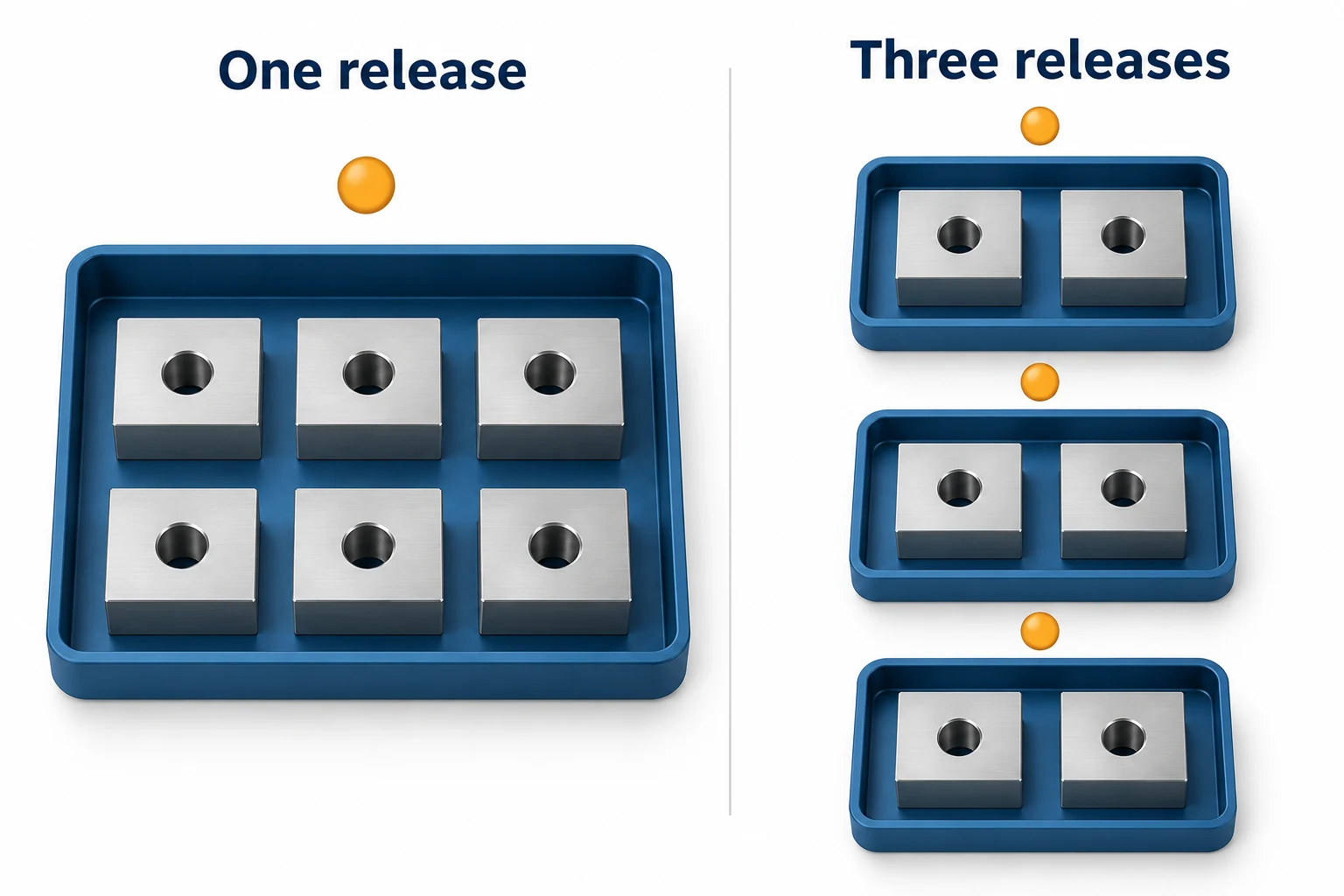
A larger batch spreads preparation cost, but it also commits money to more parts. Do not use an annual forecast as Q when production will restart for several separate releases. The CNC cost and supplier-selection guide covers the wider comparison of order scope and purchasing commitments.
Ask for a price you can compare
Send the same revision, material and condition, realistic batch quantities, final finish and acceptance requirements for each quotation. Ask for the complete part price, any separate preparation charges, exclusions and repeat-order terms. Suppliers may not disclose their internal hourly rates; comparable scope and a clear explanation of the route are still useful.
When a proposal costs more, identify the work behind the difference: a different fixture, a second setup, additional contour finishing or a more extensive inspection requirement. When it costs less, check which operation or requirement changed. For a geometry review, our five-axis machining service page outlines the multi-face and contoured work to discuss.
Frequently asked questions
How much does five-axis CNC machining cost per hour?
There is no useful universal rate without its billing basis and included scope. A rate may include different labor, tooling or overhead components. Ask for the complete part price at your batch quantity; use an hourly rate only with the time and costs it actually covers.
Is 3+2 machining always cheaper than simultaneous five-axis machining?
No. 3+2 may simplify operations that need only fixed approach directions. Simultaneous motion may reduce other work on a suitable contour. Compare programming, verification, machine time and later operations for the same finished requirements.
Does a repeat order eliminate setup charges?
Not necessarily. Programming and dedicated fixtures may be reusable, while loading the setup, checking its condition and confirming the released revision still take work. Agree retained-tooling and repeat-batch charges with the supplier.
Technical sources
- NTMA, The Record, February 2014: “Using 5 Axes to Cut Cost,” pages 24–25. Workholding, access and additional operations; not current pricing data.
- Autodesk, 5-axis Machining and 3+2 Axis Milling (5-Axis Positional) With Autodesk Fusion 360. Cutting modes, CAM preparation and verification.
- Haas Automation, 5-Axis Simplified, page 2. Tool reach, grip and indexing clearance.