On this page
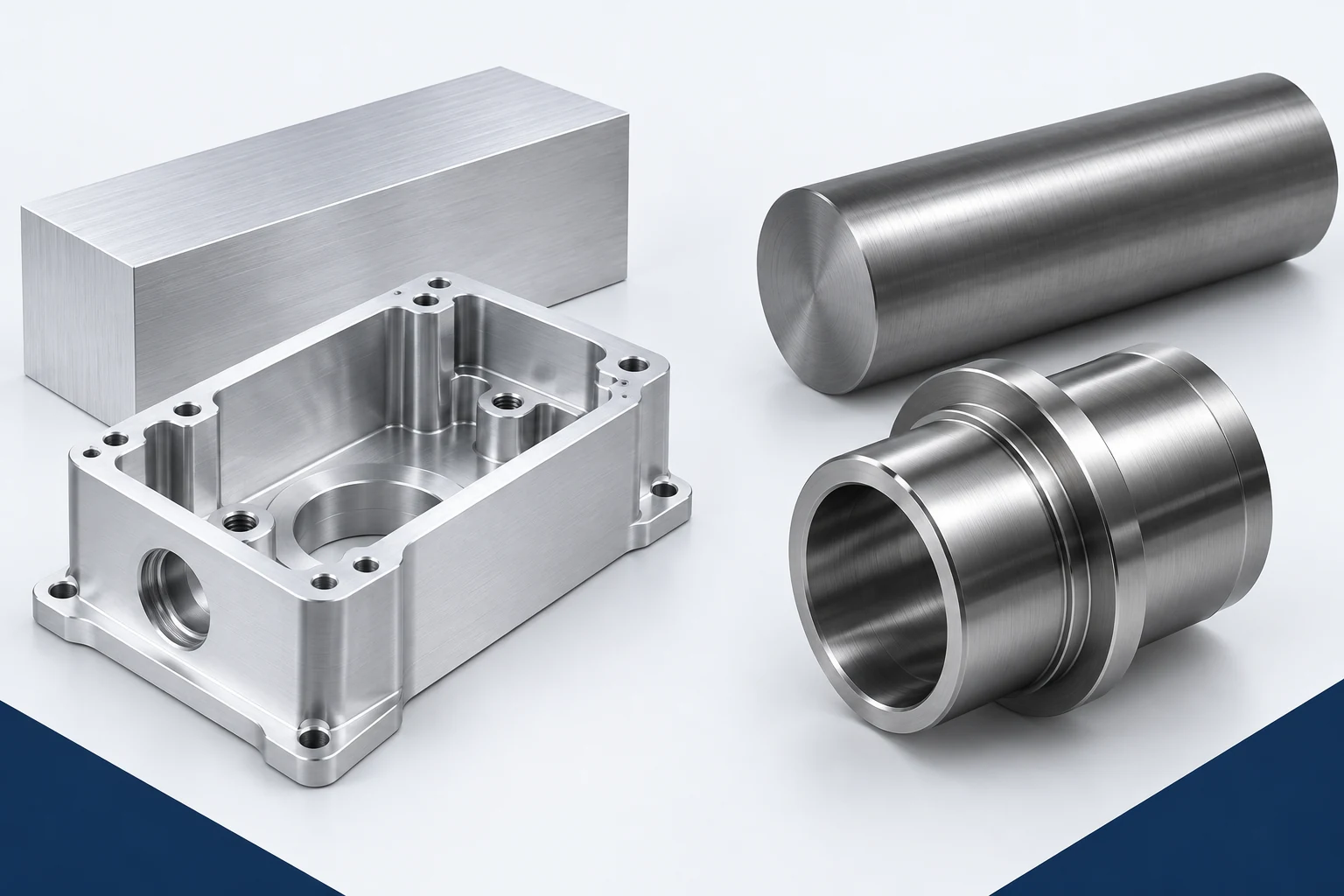
Aluminum is often the practical starting point for a lightweight machined housing or bracket. Austenitic stainless steels such as 304 and 316 become stronger candidates when the service environment requires their corrosion behavior or when stiffness in a fixed space matters more than mass. The manufacturing trade-off is different too: aluminum can stick to a cutting edge and trap chips, while austenitic stainless adds substantial work-hardening and tool-wear challenges.
Choose between specific grades and conditions, not two material names. An easy cutting cycle is useful only if the finished part meets its load, exposure, fit and surface requirements.
Start with the alloy, condition and stock form
“Aluminum” could mean heat-treated 6061 bar, annealed sheet or a high-silicon casting. “Stainless” could mean 304, free-machining 303 or a precipitation-hardening grade. These are different machining jobs. This comparison focuses on wrought 6061 aluminum and common austenitic stainless, using 316L/4404 for the reference-property table.
For 6061, T6 identifies solution heat treatment and artificial aging; T6511 additionally identifies stress relief by stretching for the relevant extruded products. Stock form matters: a plate value should not become an acceptance requirement for an unrelated bar product. Hydro also notes that chips from T6/T6511 turning and drilling can be difficult to break. Aluminum does not automatically produce short, manageable chips. [1]
Compare weight, stiffness and thermal movement separately
These published reference values illustrate the scale of the differences. The 6061 figures are guidance data from thyssenkrupp; the stainless figures describe Outokumpu Supra 316L/4404. They are not guaranteed strength values or a substitute for the supplied material specification. [2] [3]
| Property and condition | 6061 aluminum | 316L/4404 stainless |
|---|---|---|
| Density, approximately 20°C | 2.70 g/cm³ | 8.0 g/cm³ |
| Young’s modulus, reference value | 70 GPa | 200 GPa at 20°C |
| Mean thermal expansion, 20–100°C | 23.0 × 10⁻⁶/K | 16.0 × 10⁻⁶/K |
For an assumed finished material volume of 100 cm³, mass = density × volume gives about 270 g in 6061 and 800 g in 316L, before coatings or hardware. That is a same-geometry comparison. A redesign changes the volume and therefore the result.
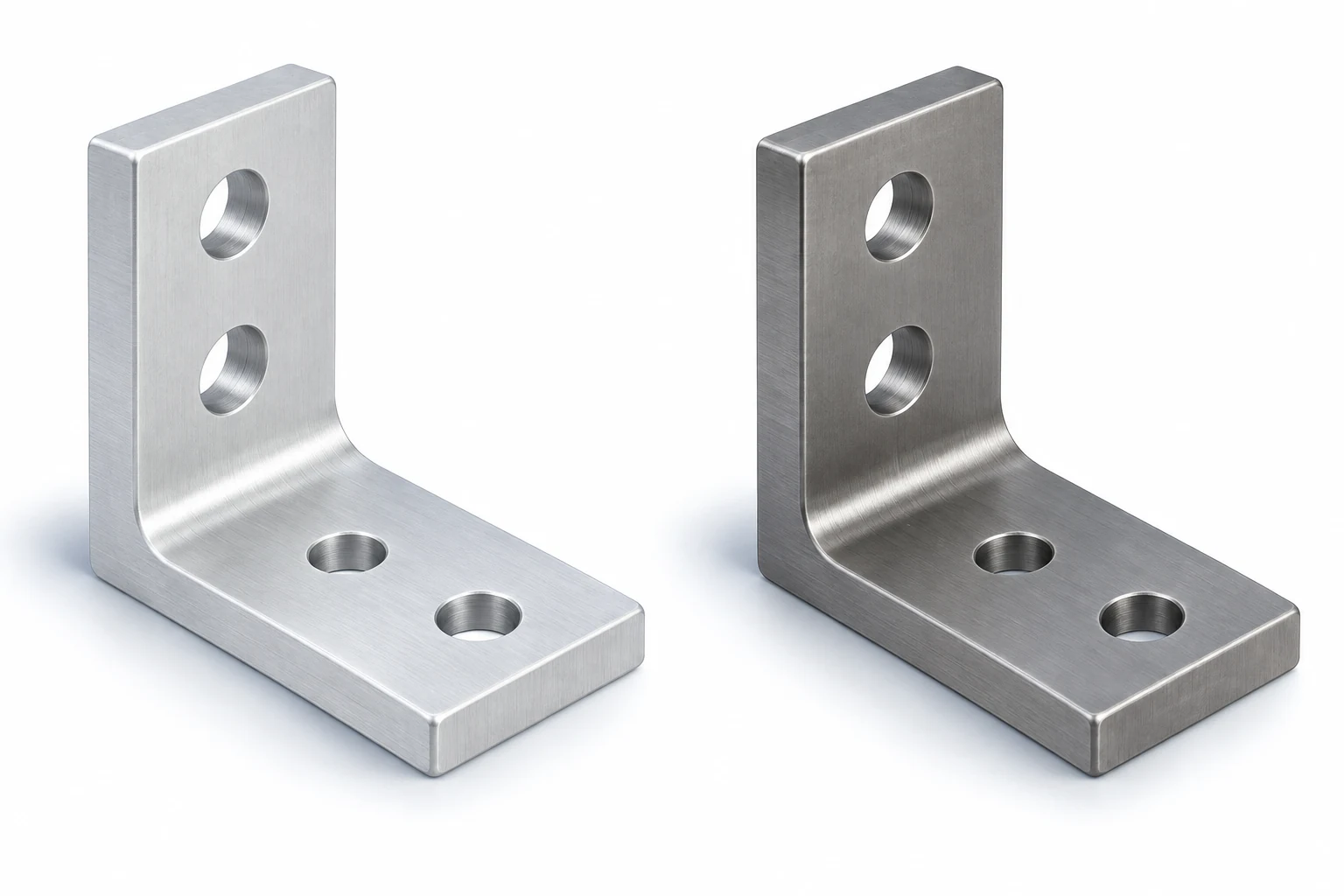
Young’s modulus describes elastic stiffness; yield strength concerns the onset of permanent deformation. With the same geometry and loading in the elastic range, the higher-modulus material resists deflection more. A higher-strength aluminum temper does not necessarily fix an overly flexible bracket. Conversely, an aluminum redesign with a deeper section may achieve the required stiffness with less mass.
Thermal expansion is another independent question. An aluminum bore around a stainless shaft does not grow at the same rate as its mating part. Evaluate clearance over the operating temperature range, rather than checking only whether the room-temperature sample assembles. The materials and design guide connects material selection to these assembly requirements.
Why the machining challenges differ
Aluminum: adhesion, chip evacuation and thin sections
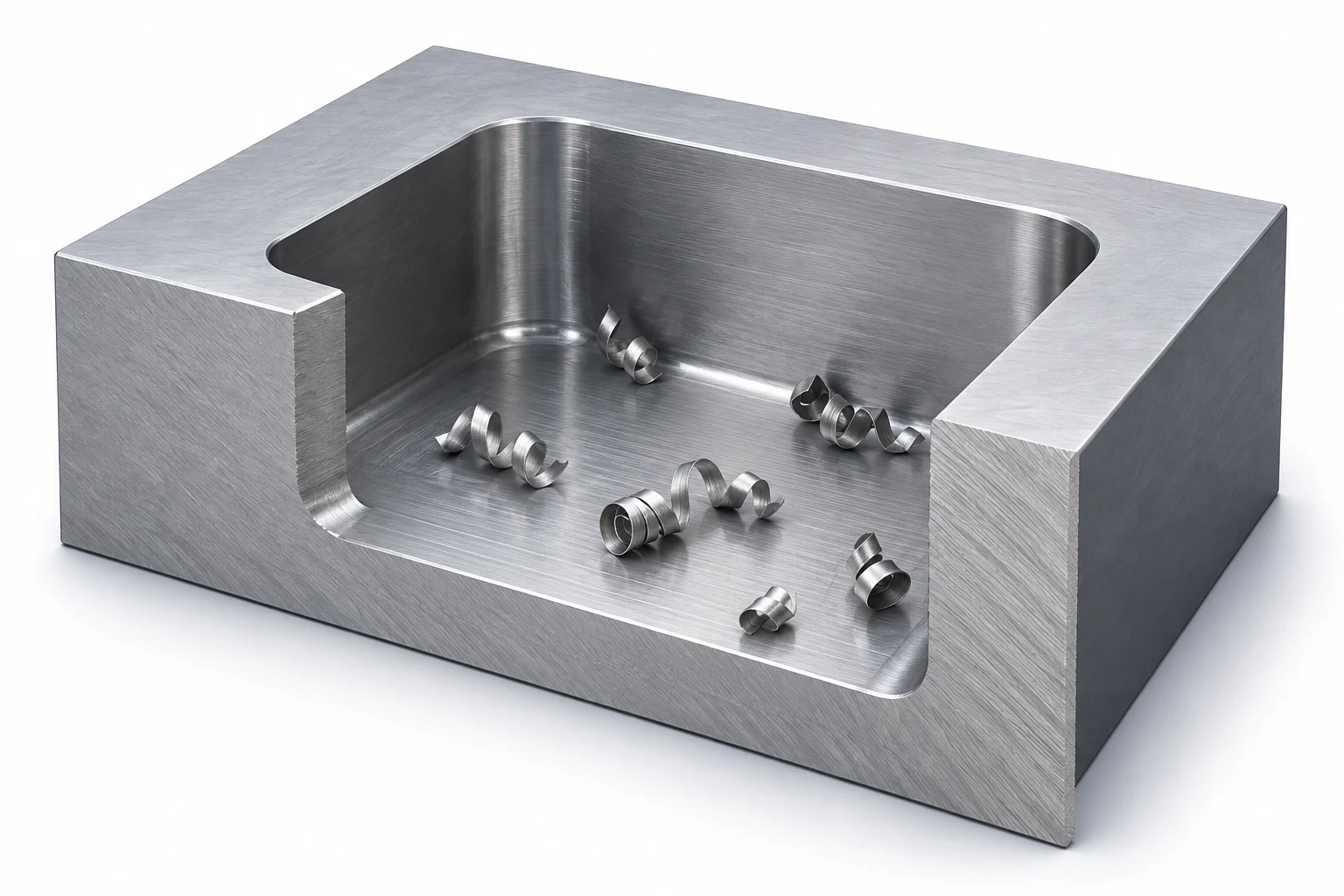
Aluminum can adhere to the cutting edge, creating built-up edge that disturbs the cut and surface. Sandvik’s aluminum-milling guidance emphasizes suitable cutting geometry and chip evacuation; trapped chips can damage the surface when cut again. A deep pocket or narrow slot can therefore be troublesome even in an otherwise readily machined alloy. [4]
The practical review is feature-specific: can chips leave the cavity, can the tool reach without excessive overhang, and is the remaining wall supported? Low density does not make a thin wall rigid. For a heavily pocketed part, stock condition, workholding and the roughing-to-finishing sequence also belong in the distortion review.
Austenitic stainless: work hardening and cutting-edge wear
304- and 316-family steels harden as they deform during cutting. Tough chips, adhesion and a hardened surface can contribute to notch wear and a poor finish. Simply reducing feed until the tool rubs is not a reliable cure: the next cut may encounter the deformation-hardened region. Sharp, appropriate tooling and a rigid setup matter. [5]
Coolant strategy must match the operation and tool. For example, Sandvik distinguishes dry rough milling used to limit thermal cracking from finishing situations that benefit from cutting fluid. “Use more coolant” is not a universal stainless-machining recipe. [4] Nor should a stainless feed-and-speed recommendation be copied unchanged to aluminum.
Which material fits the part?
| Part requirement | Candidate direction | What could change the decision? |
|---|---|---|
| Moving housing or bracket with a strict mass limit | Start with a suitable aluminum alloy and temper | Deflection, fastener loads, wear and service exposure |
| Support with a fixed envelope and a demanding stiffness requirement | Compare stainless against an aluminum redesign | Allowable mass, section geometry and joint flexibility |
| Part exposed to process fluids or repeated washdown | Evaluate a stainless grade against the actual chemicals | Concentration, temperature, crevices and cleaning cycle |
| Aluminum component joined to stainless hardware in a wet location | Review the complete joint before choosing either material | Galvanic contact, isolation, drainage and protective finish |
| Drawing already mandates a material specification | Quote compliant stock | A design-approved alternative, not an informal substitution |
Stainless is not corrosion-proof. Outokumpu identifies environments where chlorides, heat or aggressive exposure require more highly alloyed materials than the 316 family. Hydro likewise flags galvanic corrosion when dissimilar metals contact each other. Review the assembly and environment, not just the exposed face of one component. [3] [1]
Compare the finished-part cost, including the surface
Aluminum often offers a favorable machining route, but the total can include anodizing, masking and final dimensional checks. Anodizing changes the surface dimensions; a fitted bore may need a defined machining allowance or an approved masking plan. Protected areas still need an appropriate corrosion strategy. NASA’s published anodizing guidance discusses these design interactions; its process requirements are not automatic requirements for every commercial part. [6]
Stainless has a different finishing scope. Required cleaning, passivation or polishing must be included rather than inferred from the word “stainless.” Residual cutting fluid and surface contamination need attention after machining. [7] A bright appearance alone does not define the delivered surface condition.
Compare the same quantity, accepted geometry, inspection scope and delivery basis, with each candidate’s necessary finish included. Separate a direct material substitution from a redesigned alternative. There is no dependable universal multiplier for the price of stainless versus aluminum: stock availability, material removal, tool access and secondary operations can change the result.
For the corresponding manufacturing scope, see aluminum CNC machining or stainless steel CNC machining. The cost and supplier-selection guide explains how to compare complete quotations.
Aluminum vs. stainless machining questions
Is stainless steel always stronger than aluminum?
No. Strength depends on the exact alloy, supplied condition, product form and temperature. Compare the relevant yield or tensile requirement separately from stiffness; a higher elastic modulus does not establish a higher yield strength.
Can the same CAD model be used for both materials?
It can describe the same shape, but the material change still needs design review. Mass, elastic deflection, thermal fit, fastener interfaces and finishing may change whether that shape works. Identify each approved material option in the released documentation.
Does a smooth machined surface prove the part will resist corrosion?
No. Grade, contamination, finish and exposure all matter. Choose the material and surface process for the service conditions; visual inspection cannot replace required material records or specified acceptance checks.
Technical sources
- Hydro, Alloy 6061, revision 2019/01 (February 2019), pp. 1–2: extrusion tempers, chip control and dissimilar-metal contact.
- thyssenkrupp Materials Services, Material Data Sheet EN AW-6061, MX/TIS_06.2018, p. 3: reference physical properties. The property table does not assign a separate temper to these guidance values.
- Outokumpu, Supra Range Datasheet, Table 7, p. 8, and corrosion discussion, pp. 3–4: 316L/4404 reference properties and environmental limits.
- Sandvik Coromant, Milling Different Materials: aluminum and austenitic-stainless milling, chip evacuation and operation-specific coolant guidance.
- Sandvik Coromant, Workpiece Materials: austenitic stainless steel, work hardening, chip behavior and cutting-edge wear.
- NASA/JSC, Process Specification for the Anodizing of Aluminum Alloys, PRC-5006 Rev. D, June 2020, sections 3.0–3.1. Used for general design principles; the applicable drawing and contract determine the required specification and revision.
- British Stainless Steel Association, General Principles of Machining Stainless Steels: post-machining cleaning and consideration of passivation.