On this page
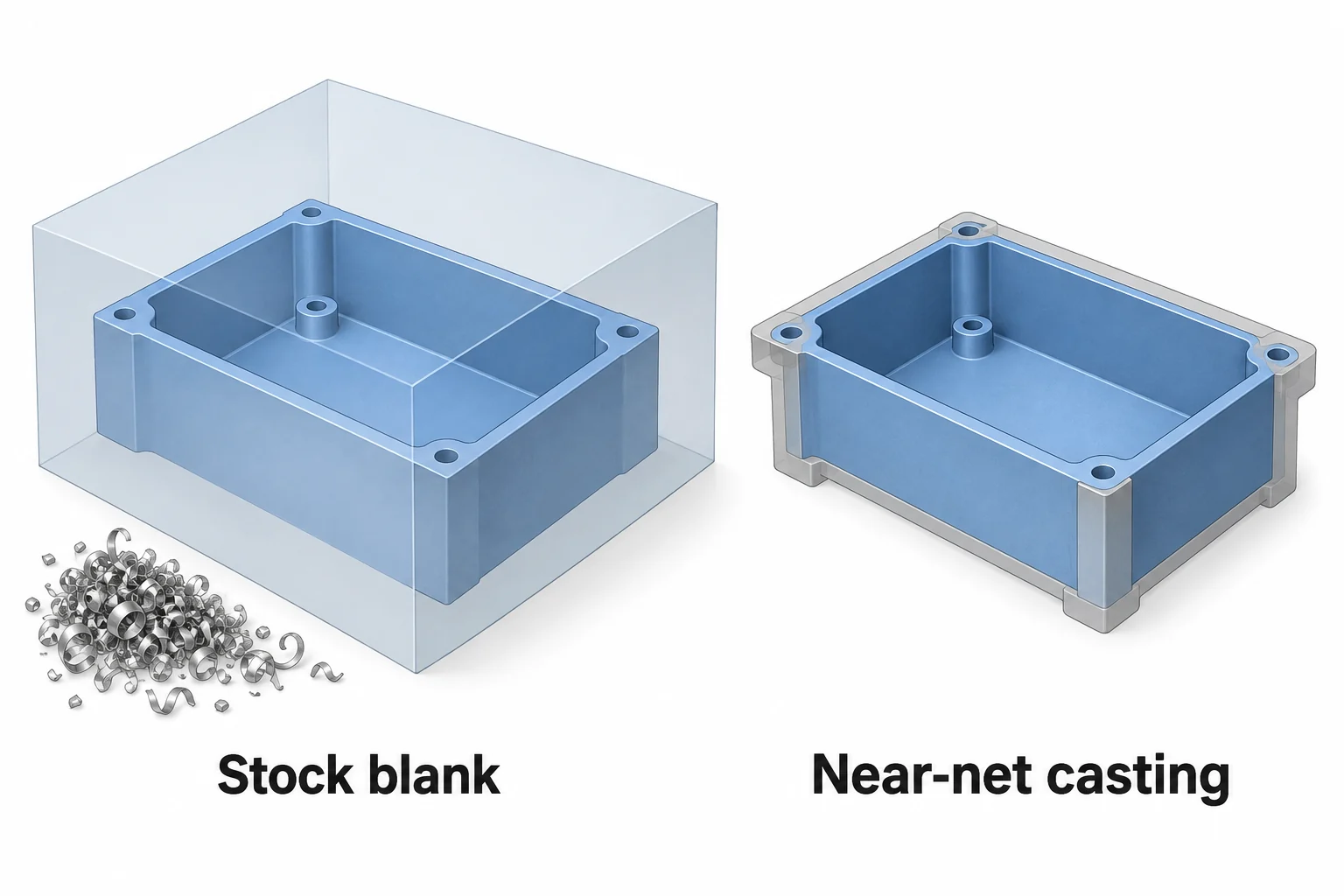
CNC machining is a useful starting route when a metal part needs available stock material, the design is changing, or demand does not justify dedicated casting tooling. Casting becomes attractive when shaping the blank can avoid extensive cutting or create geometry that is difficult to machine. Many parts use both: cast the body, then machine the interfaces that control assembly.
The choice depends on the casting process, not just the word “casting.” Compare routes that meet the same functional requirements, including material condition, finished dimensions and inspection. A casting price and a finished machined-part price may cover very different work.
Which casting process are you comparing?
CNC machining removes material from a blank with cutting tools. That blank might be plate, bar or a shaped casting. Casting forms metal by solidifying it in a mold; its tooling and production steps vary considerably. [1]
| Casting route | How the shape is formed | What changes the comparison with CNC |
|---|---|---|
| Sand casting | A sand mold forms the exterior; cores can form internal spaces. | Pattern, core and cleanup work; casting variation and machining allowance. |
| Investment casting | A ceramic shell surrounds an expendable pattern; the pattern is removed before pouring. | Pattern and shell preparation; complex shapes and any precision mating surfaces. |
| High-pressure die casting | Molten metal is injected into a reusable steel die. | Dedicated die investment, repeated production, release geometry and secondary work. |
Sand and investment molds are expendable; a die is reused. Investment patterns can also be printed, so a machined metal pattern tool is not the only option. None of these routes means that every surface is ready for assembly straight from the mold. [1] [2] [3]
Geometry: cutter access or mold removal
A milled pocket needs space for a cutter to reach its floor and walls. A deep, narrow cavity or an enclosed curved passage may require a different design or manufacturing route. More machine axes do not make a straight cutter pass through a solid roof.
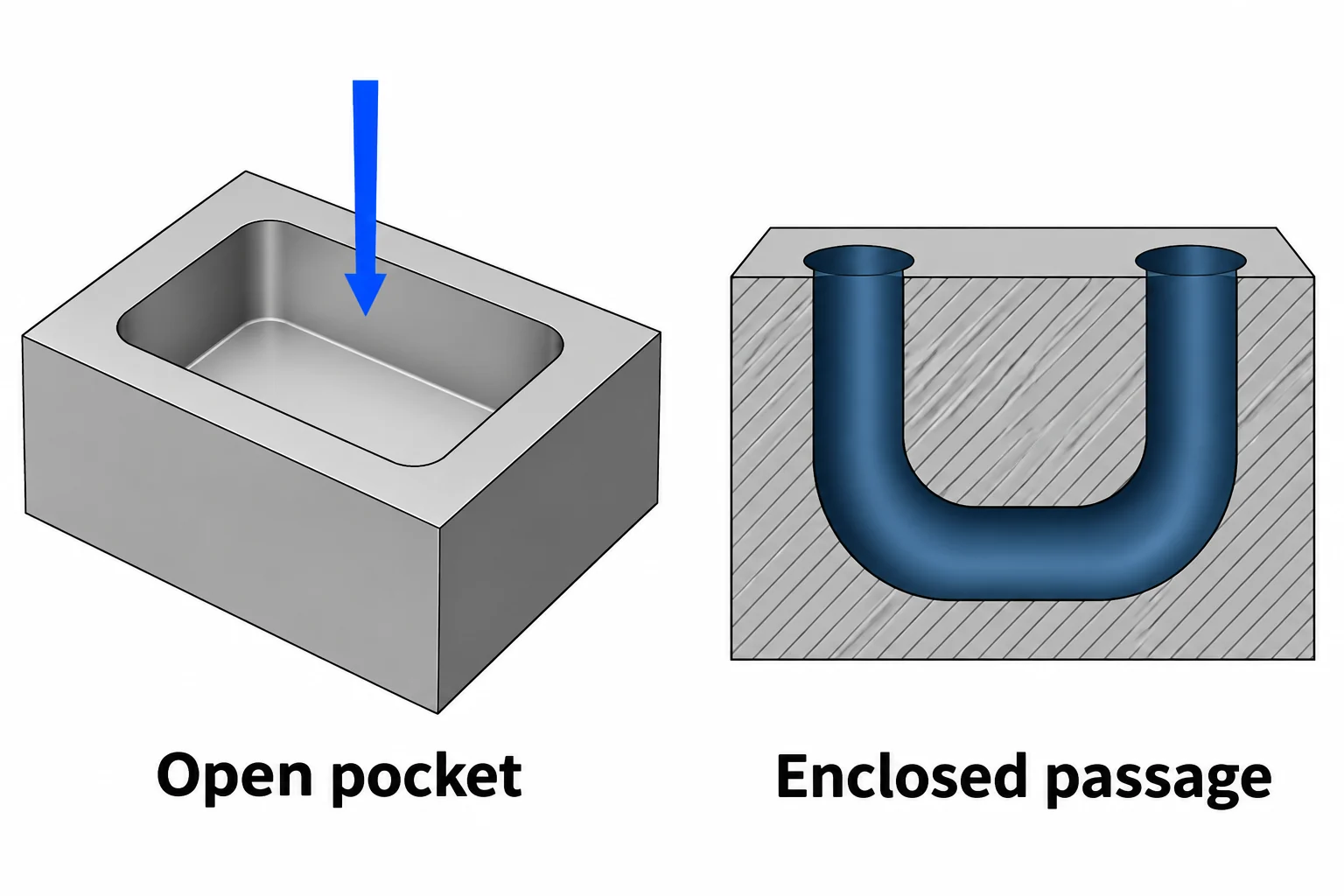
Casting can form internal spaces with cores, but the core must be supported and removed by a workable method. SFSA notes that inaccessible cavities can make core removal difficult and expensive. Casting therefore does not make every enclosed shape practical. [4]
High-pressure die casting adds release requirements. Draft is the taper that helps a casting leave the die; its amount depends on the surface, depth and alloy. Review parting lines, undercuts and any moving die sections before treating a CNC model as a casting design. [3] [5]
Machine the surfaces that need it
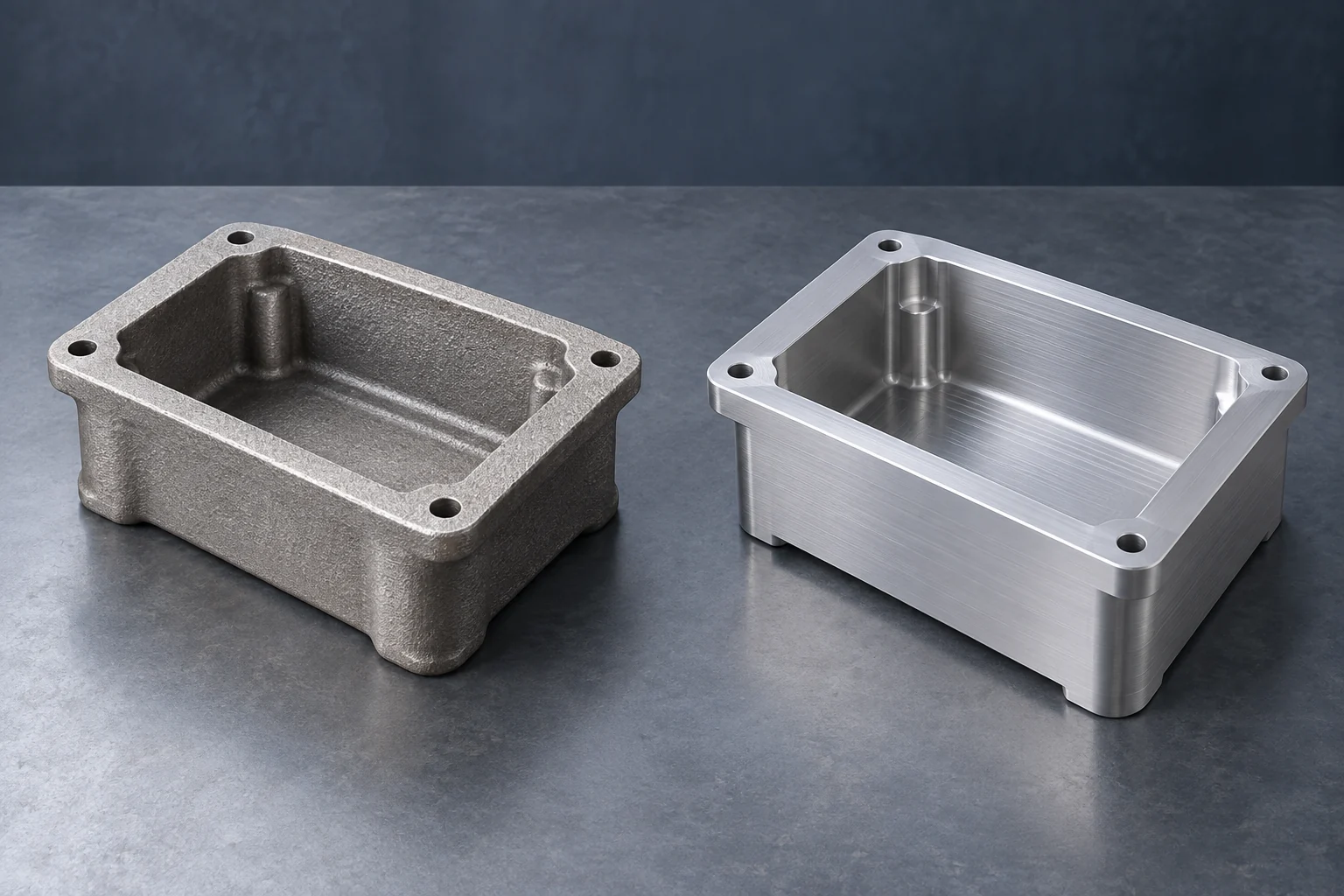
A tight bore or flat sealing face does not automatically rule out casting. The body can be cast near its finished shape while selected features receive machining. Keep the as-cast and finished definitions distinct so the foundry and machine shop can see which material remains to be removed. NADCA recommends separate as-cast and machined model configurations for this purpose. [6]
Machining allowance is the extra material provided for that removal. It must cover the actual blank variation and permit cleanup of the required surfaces. The first setup also needs reliable locating and clamping areas; later features must relate to the specified finished datums. There is no single allowance suitable for every casting. [4]
For cast iron components, our cast iron machining page explains the blank information, datum relationships and inspection scope used to review the machining work.
Match the material and acceptance requirements
“Aluminum” or “steel” is not a complete specification. Compare the actual alloy, product form and heat-treatment condition available for each route. A substitute needs to satisfy the design requirements; matching the outside shape is not enough.
Nor does the label “cast” or “machined” establish strength. NADCA explains that die-cast properties can vary with solidification and section geometry, and that test-specimen values may differ from the production part. Its structural guidance calls for verification on final parts and assemblies. [7]
Separate dimensional acceptance from material soundness. If the application requires leak testing or another defect check, specify its method and acceptance criteria. A smooth machined surface alone does not establish internal casting quality. [4] [8]
A housing can divide the work by feature
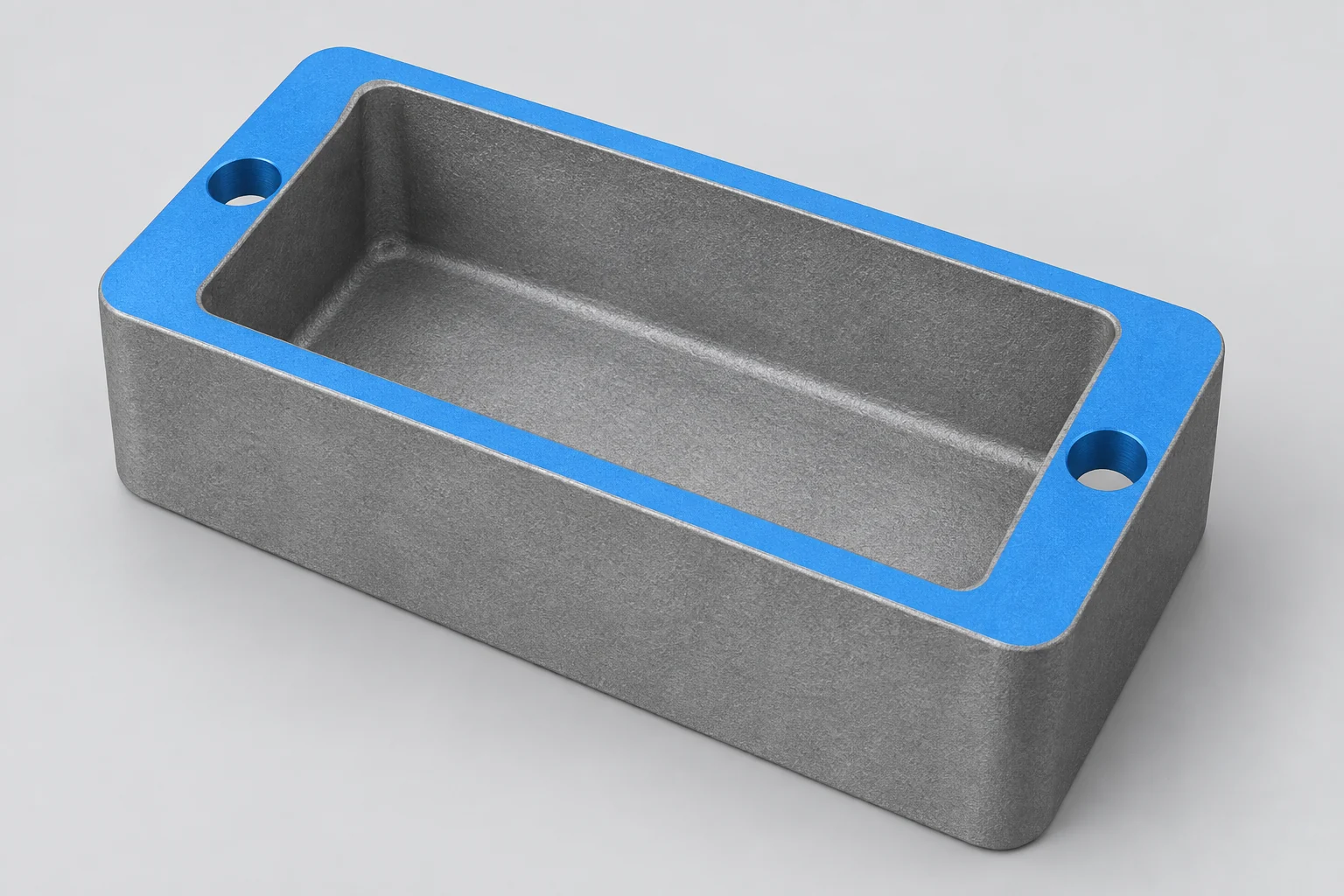
Consider a housing with a cover, locating holes and threaded fasteners. The following is a design comparison: the required interfaces stay fixed while the body and manufacturing route are evaluated.
| Housing feature | Machined from stock | Cast body with machining |
|---|---|---|
| Outer walls and open cavity | Remove stock with accessible tools. | Retain suitable cast surfaces; review wall transitions and release. |
| Cover sealing face | Machine to its specified flatness and finish. | Leave allowance, then machine the required face. |
| Locating holes | Machine their size and position from the drawing datums. | Machine from agreed references; a cored opening is not automatically a finished fit. |
| Internal threads | Prepare holes and machine the threads. | Include hole preparation and threading as secondary work. |
This division can save bulk removal without asking the casting to deliver every precision interface. Its value disappears if the blank needs extensive correction, cannot be held securely, or does not meet the material and acceptance requirements. [6] [8]
How volume changes the cost
High-pressure die casting commits money to durable tooling. A stable design and repeated demand can spread that investment across more parts. CNC avoids that casting die, but programming, fixtures, cutting tools and repeated setups still cost money. Treat “no mold” as one cost difference, not zero preparation cost. [9]
Request a finished-part comparison at the quantities you expect to release. Include the blank, tooling, machining, heat treatment where required, finishing, inspection and agreed reject or rework responsibility. A lower casting unit price may not reduce the finished-part cost when essential secondary operations sit outside the quote. Our machining cost guide explains the broader quotation scope.
Compare the first approved batch separately from repeat orders. Casting may need pattern or die preparation and trials; machining needs stock, programming and workholding preparation. Design changes can affect either route, but a change to a reusable die can alter the investment already made. Use actual supplier schedules rather than assuming one process is always faster.
Choose stock machining when its flexibility and material route meet the need at an acceptable total cost. Choose casting when the selected process, design stability and complete finished-part economics support it. Use casting plus CNC when the body benefits from near-net shaping but selected interfaces still need cutting. There is no universal quantity at which that choice changes. Our CNC machining services cover the cutting routes to evaluate for those features.
Questions about casting and machining
Is die casting the same as injection molding?
High-pressure die casting injects molten metal into a steel die. Plastic injection molding injects a polymer into a mold. The similar use of injection does not make their materials, tooling conditions or finished properties interchangeable.
Does machining a casting remove porosity?
Machining removes material, but it is not a general remedy for internal porosity. Removing the surface can expose a subsurface void. Acceptance, further testing and any approved treatment depend on the casting and its service requirements; a dimensional pass alone does not resolve the issue. [7] [8]
Sources
- SFSA, Overview of the Casting Process, sand molds, cores and further processing.
- Investment Casting Institute, The Investment Casting Process, pattern creation, ceramic shells and precision mating surfaces.
- NADCA, Frequently Asked Questions, high-pressure die casting and die construction.
- SFSA, Ordering Steel Castings, core removal, machining allowance, locating and testing principles.
- NADCA Design, Draft, surface-dependent release taper.
- NADCA Design, CAD Feature Order, as-cast and machined configurations.
- NADCA Design, Structural Criteria, specimen applicability, section structure and final-part testing.
- NADCA Design, Secondary Processing Costs, machining, finishing and specified pressure testing.
- NADCA Design, Tooling Costs, die investment and repeated production.