On this page
CNC machining often suits plastic parts that are still changing, needed in small quantities, or specified in an available stock material. Injection molding becomes a stronger candidate when the design is stable, the part can be molded successfully, and committed demand justifies the tooling investment.
The switch depends on more than quantity. A low molded unit price is useful only if the finished part meets the material, assembly and acceptance requirements. This comparison covers thermoplastic parts; metal injection molding and casting need a different assessment.
Where each process fits
CNC machining cuts a part from stock, such as plate or rod. Injection molding fills a mold with molten polymer, then cools and ejects the part. CNC avoids a dedicated molding tool, but programming, cutting tools, fixtures and setup still carry costs.
| Order or part requirement | CNC machining | Injection molding |
|---|---|---|
| Design changes expected | Revise the program and holding as needed | Assess changes before committing to the mold |
| Small or uncertain demand | Often limits the initial tooling commitment | Include tooling and trial costs in the comparison |
| Stable repeat demand | Price repeated setup and cutting work | Can spread tooling cost over more accepted parts |
| Thin walls, ribs and bosses | Check access and support during cutting | Check filling, cooling and release from the mold |
Compare the actual material and finished condition
“ABS,” “nylon” or “POM” identifies a material family, not an interchangeable production specification. Verify the stock grade and dimensions for machining, and the resin grade and additives for molding. Availability in one form does not establish availability in the other.
Processing also affects properties. Ensinger describes how flow orientation and thermal history differ between injection-molded specimens and extruded stock; cooling history is particularly relevant to crystallinity in semicrystalline polymers. Compare applicable data for the intended process and condition, rather than transferring a resin test value directly to a machined component. [1]
For dimensional requirements, consider machining stresses and any relevant moisture conditioning. Define the condition in which the part will be inspected and used. [2] Our plastic CNC machining page covers material choices and features for the stock-machining route.
The geometry may need to change
A machined pocket needs a cutter that can reach its floor and walls while the workpiece remains supported. Deep narrow spaces, small internal corners and thin unsupported walls can make that difficult. A shape that is convenient to cut from a solid block is not automatically a good molding design.
For molding, review wall transitions, ribs and screw bosses together. Thick local masses can create sink or internal voids as the material cools. Draft—the taper that helps release a surface—and undercuts affect how the mold opens and the part ejects. There is no single draft angle suitable for every material, depth and texture. [3]
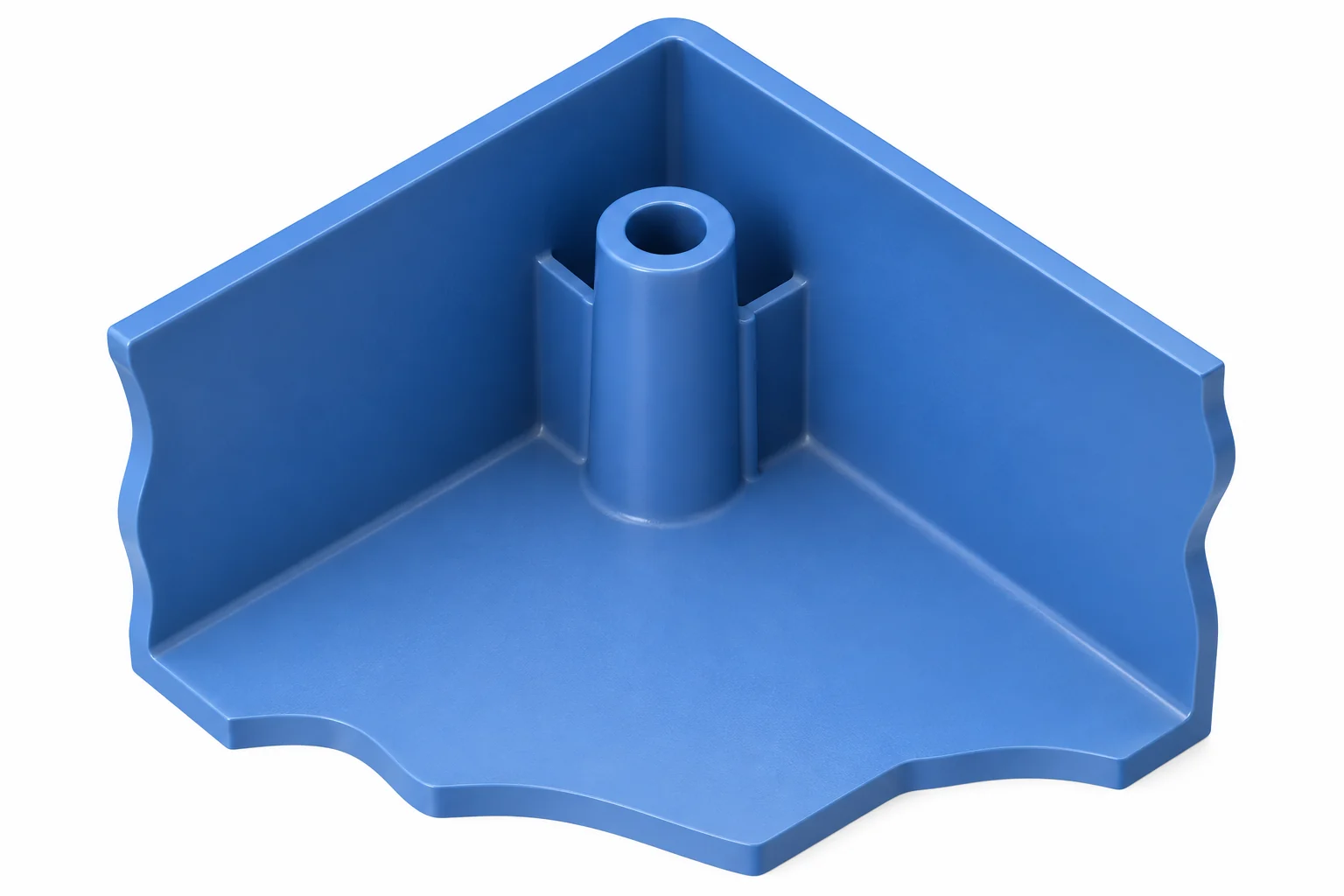
An undercut may require a side action, another tool arrangement or a design change. BASF’s design example also shows why gate location and local wall thickness belong in the review before tooling is made. [4] Compare functionally acceptable designs for both routes, and identify any geometry changes that need engineering approval.
Calculate the cost crossover from comparable quotes
Start with the same accepted-part quantity, material requirements, finish and inspection scope. Separate the fixed charge from the recurring cost per accepted part. The simple model is total cost = F + vN, where F is the fixed cost, v the cost per part and N the quantity. Average cost is F/N + v. MIT’s manufacturing-cost lecture explains this distinction. [5]
Consider these hypothetical USD inputs for one batch: CNC has a $500 fixed charge and $25 per accepted part; molding has a $5,500 fixed charge and $5 per accepted part. Assume both include the agreed preparation, finished-part work and inspection. These are teaching inputs, not market prices or quotations; freight and taxes are excluded.
| Accepted quantity | CNC total | Molding total |
|---|---|---|
| 100 parts | $3,000 | $6,000 |
| 250 parts | $6,750 | $6,750 |
| 500 parts | $13,000 | $8,000 |
With a higher molding fixed charge but lower recurring cost, the crossover is:
N = (Fmold − FCNC) / (vCNC − vmold)
Here: ($5,500 − $500) / ($25 − $5) = 250 parts.
Now add a hypothetical $2,000 mold modification before production, leaving the other inputs unchanged. The crossover moves to 350 parts. The example shows why design stability matters; it does not establish a universal switch quantity.
Use demand that is credible for the relevant design revision. Recalculate if quantity discounts, repeated setups, trial charges, reject allowances or replacement tooling change the inputs. If molding has both an equal-or-higher fixed charge and equal-or-higher per-part cost, this model provides no cost advantage. Our machining cost guide explains the CNC cost components in more detail.
Approve the process change, not just the price
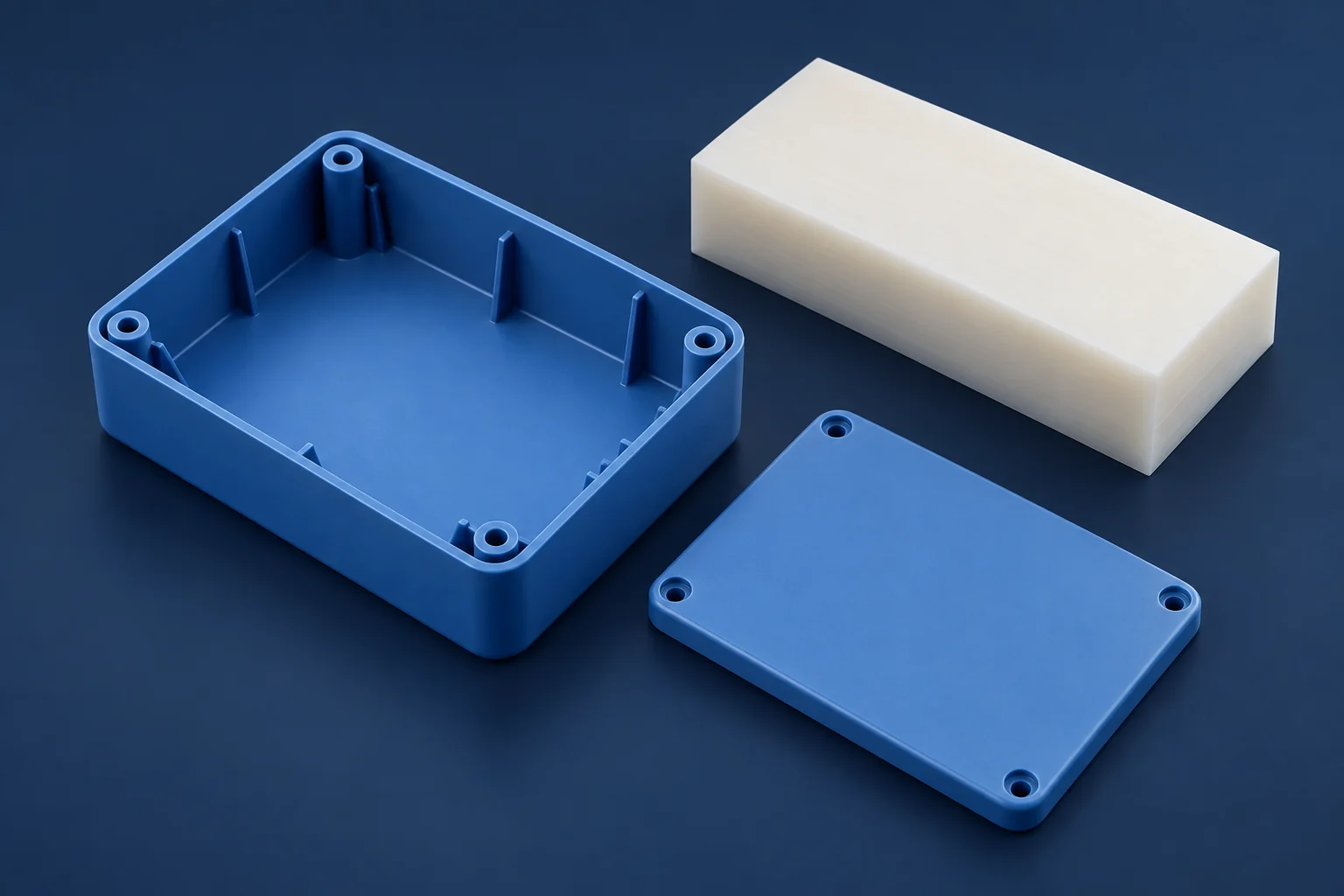
For a plastic enclosure, a machined sample can help check the cover fit and mounting geometry. It cannot demonstrate how the intended mold fills, cools or releases the part.
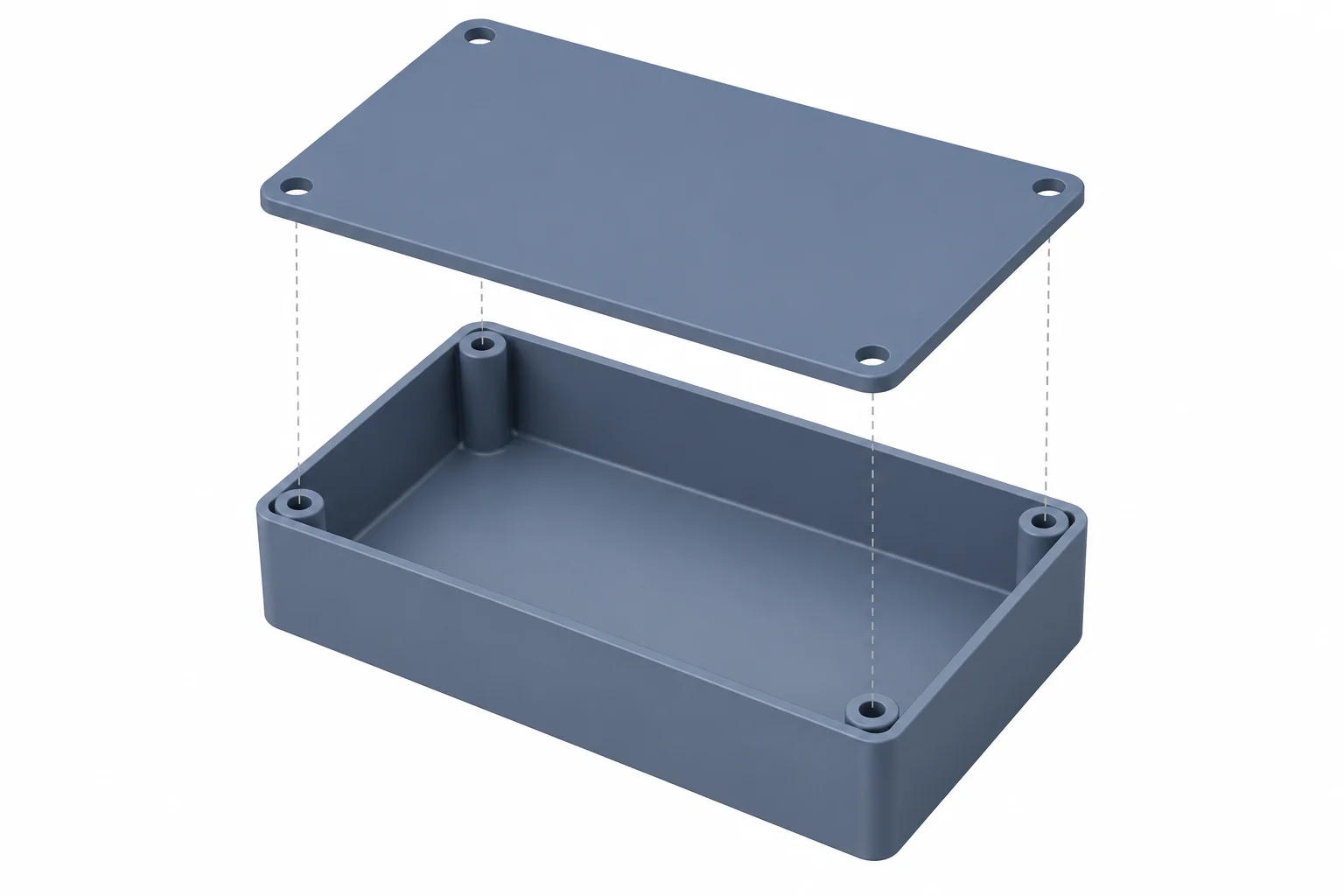
Molded samples may reveal weld lines where flow fronts meet, or distortion associated with uneven shrinkage. Their significance depends on location, material and function. BASF’s troubleshooting guide treats these as process-and-design questions, not defects that a matching CAD outline rules out. [3]
Before switching, close three decisions:
- Design release: agree the molding revision, material, interfaces and acceptable gate or ejector marks.
- Acceptance: inspect the required dimensions and surface condition, test relevant functions, and establish how production variation will be checked. Neither process wins every tolerance comparison.
- Delivery: distinguish the first approved batch from repeat orders. Include tool manufacture and trials for molding; include stock, programming and holding preparation for machining. Compare actual supplier schedules.
Keep machining when flexibility or the required stock material outweighs the potential unit savings. Move toward molding when the design, material, process validation and demand support the investment. For the CNC stages, our prototype and production service explains sample and repeat-order planning.
Questions about changing processes
Can a molded part also be CNC machined?
Yes, selected features can be machined after molding when there is suitable stock allowance, tool access and a reliable way to locate and hold the part. Include that operation in the cost and acceptance plan; do not assume a thin molded wall can support any secondary cut.
How does an existing mold change the comparison?
Compare the costs still ahead. A usable, already-paid mold may remove a major new investment, but transfer, repair, trials and remaining tool life still matter. Do not charge the original mold purchase again when comparing only the next order’s avoidable costs.
Sources
- Ensinger, Stock Shapes: Plastics Used in Aerospace Technology, p. 18, “Influence of processing on test results.”
- Ensinger, FAQ: engineering plastics, dimensional stability, machining stresses and conditioning.
- BASF, Injection-Molding Problems in Engineering Thermoplastics: Causes and Solutions, sections on weld lines, sink marks, demolding and warpage.
- Andreas Wonisch, BASF Ultrasim, How to improve your injection molding designs, design changes, wall thickness and undercuts.
- MIT OpenCourseWare, 2.008 Spring 2025, Lecture 17: Manufacturing Cost, fixed and variable cost model. The numerical example above uses separate hypothetical inputs.